

What specific advantages does metal protective coating spray offer over traditional liquid coatings?
Metal protective coating spray can provide a tougher, more uniform and durable finish than traditional liquid coatings, with strong resistance to impact, wear and corrosion when correctly specified and applied. Powder application also avoids many solvent-related emissions and reduces the risk of runs, sags and uneven coverage associated with liquid paint.
Metal protective coating spray, when referring to an electrostatically applied powder coating, offers several practical advantages over traditional liquid coatings: it can simplify the application process, reduce material handling losses, produce a solvent-free dry film and provide a finish that is ready for controlled handling after curing. The precise benefit depends on the metal, component design, required film performance and curing conditions.
Lower solvent-related impact
Powder coating is supplied as a dry powder rather than a liquid containing solvent. This removes the need to evaporate large quantities of carrier solvent during application and curing. It can reduce solvent-related emissions in the coating area and avoids some of the odour and storage considerations associated with solvent-borne paint. Powder coating still requires appropriate extraction, housekeeping and waste controls, but its formulation can support a cleaner production environment than many conventional liquid systems.
More efficient use of coating material
During electrostatic spraying, charged powder particles are attracted to the earthed metal component. Powder that does not initially settle on the part may be collected through suitable recovery equipment, depending on the system and colour requirements. This can reduce material waste compared with liquid paint lost through overspray, evaporation or disposable application consumables. Recovered powder must be managed carefully, since contamination and colour changes can affect whether it is suitable for reuse.
Shorter process route for suitable components
Liquid coatings commonly require drying or flash-off between coats, particularly where primers, build coats and topcoats are specified. A powder system may achieve the required protective layer in one application and one controlled oven-cure cycle, reducing the number of wet stages. This can simplify production planning and reduce the space needed for wet-paint drying between operations. The part must, however, be able to tolerate the curing temperature, and the coating specification must provide the required protection without relying on a multi-layer liquid system.
A dry film that is easier to handle after curing
Once correctly cured, powder coating forms a dry, continuous film rather than a coating that remains vulnerable to marking while residual solvent leaves the surface. This is useful for components that need to be moved, packed or assembled after finishing. Handling performance depends on complete cure, coating chemistry, substrate preparation and the severity of subsequent service conditions; a cured powder finish should not be treated as automatically suitable for every aggressive environment.
Consistent control of the finished specification
Powder systems can be selected by chemistry, gloss level, texture, colour and intended service conditions. The applicator can then control key variables such as substrate preparation, powder application, oven temperature and curing time. This gives the specification a repeatable framework and makes it easier to match batches of components when the same approved material and process are used. Liquid coatings can also be tightly controlled, but they may involve additional variables such as viscosity adjustment, solvent evaporation and mixing of several wet products.
Useful performance characteristics
Depending on the powder type selected, a protective finish may be specified for resistance to abrasion, handling damage, moisture, weathering or particular industrial conditions. Powder can also provide a broad choice of surface appearance, from smooth finishes to textured or matt surfaces. These characteristics should be selected against the actual operating environment rather than assumed from appearance alone. Edge geometry, exposed welds, crevices and areas that receive less powder during spraying may require particular attention in the design and preparation stages.
Where liquid coating may remain preferable
Powder coating is not a universal replacement for liquid paint. Liquid systems may be more suitable when:
- the substrate cannot withstand the heat required for curing;
- the component is too large for the available spray and oven equipment;
- coating must be applied on site or to a fixed structure;
- a very thin film or highly specialised multi-coat system is required; or
- the component contains materials that need different preparation or curing conditions.
The fairest comparison is therefore between complete coating specifications, not simply between powder and liquid products. Assess the substrate, component dimensions, required appearance, exposure conditions, preparation standard, cure capability and expected handling before choosing the system. For manufactured metal parts that can be prepared and oven-cured under controlled conditions, powder protective coating can offer a more efficient and process-friendly alternative to conventional liquid coating.
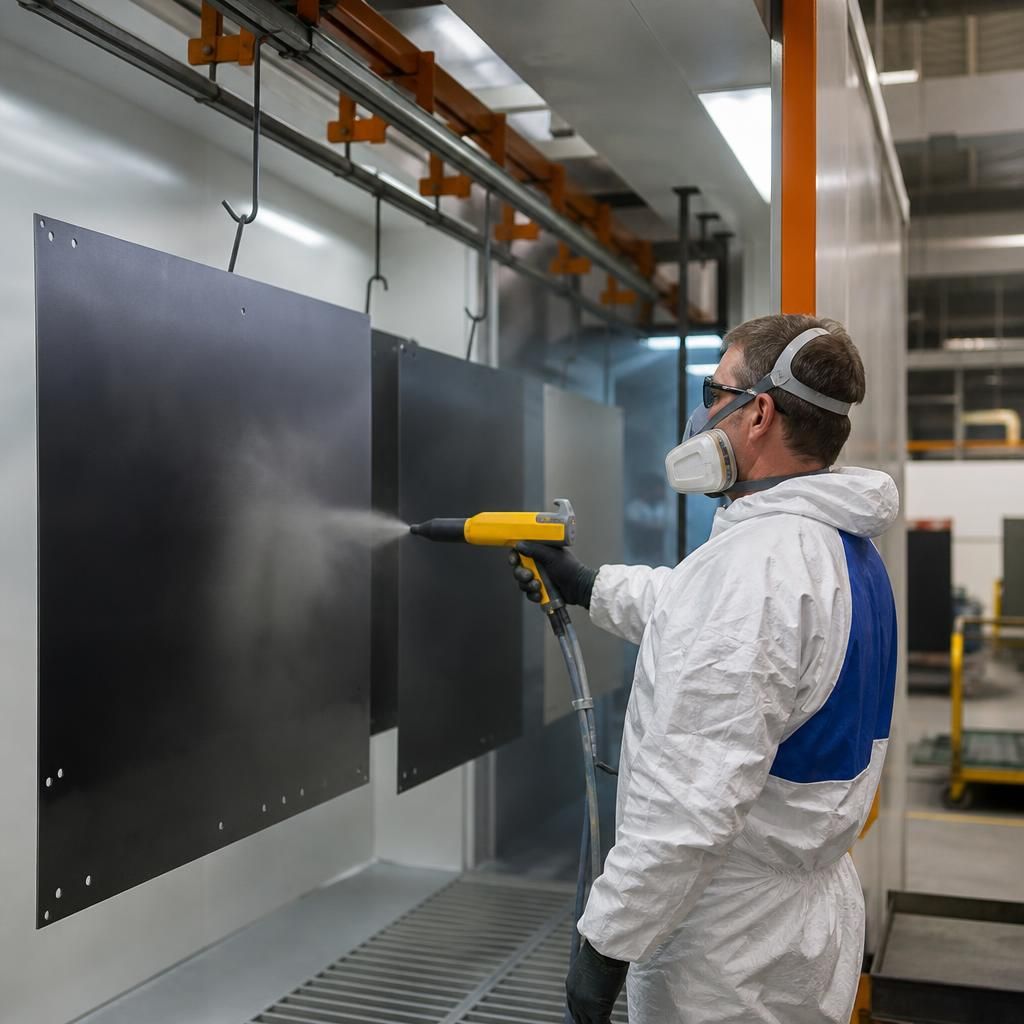
Powder coating can simplify equipment cleaning and colour changeovers. Traditional liquid coatings often leave wet residue in spray equipment, hoses and mixing vessels, so cleaning may require solvent or extensive washing before the next coating is introduced. Powder application does not create the same liquid residue, allowing equipment to be cleaned using the procedures specified for the booth, spray gun and recovery system.
This is a practical advantage in controlled production because it can reduce contamination between coating runs and make the changeover process more straightforward. It does not remove the need for thorough housekeeping: residual powder must still be cleared carefully, particularly when changing colour or finish, and recovery equipment must be maintained to prevent unwanted carry-over.
Discuss the right protective coating for your metal components
Discuss your component dimensions, substrate, service environment and required finish with a powder-coating specialist to establish whether protective coating spray is a suitable alternative to liquid coating. This assessment helps identify the appropriate coating specification and preparation requirements before production.