

How can I determine the most suitable metal protective coating spray for my specific industry requirements and environmental conditions?
Determine the most suitable metal protective coating spray by assessing the component’s substrate, operating environment, exposure to corrosion, chemicals, moisture or abrasion, required service life, and the finish required. Then match those conditions to a coating system and application specification suited to your industry, confirming compatibility and performance requirements with a specialist coater.
The most suitable metal protective coating spray is selected through a documented coating specification rather than by choosing a colour or finish alone. The specification should link the component’s use and exposure to an appropriate coating chemistry, pretreatment method, film thickness, curing process and inspection standard.
Start with the performance requirement. Define what the coating must do during service and which failure would be unacceptable. A component that mainly needs decorative protection has different requirements from one exposed to continual handling, impact, chemicals, outdoor weathering or elevated temperatures. Consider the expected service life, whether the finish must retain its colour and gloss, and whether the coated part will be visible, enclosed or assembled against other materials.
Choose the coating chemistry for the exposure. Powder coating chemistries have different strengths. Epoxy-based systems are commonly considered where chemical resistance and strong adhesion are important, although prolonged ultraviolet exposure can affect their appearance. Polyester-based systems are generally considered for external applications where weathering and colour retention matter. Hybrid systems can provide a balance of properties for suitable indoor uses. The correct choice depends on the complete exposure profile, not simply whether a part is used indoors or outdoors.
Where both appearance and protection matter, specify the required colour, gloss level, texture and visual tolerance separately from the protective performance. A textured finish may disguise minor surface irregularities, while a smooth or low-gloss finish can make defects more noticeable. Colour matching should also account for the substrate, coating system, batch variation and the lighting under which the finished component will be viewed.
Check the design of the component before selecting the spray system. Deep recesses, narrow channels, folded sections, welds, sharp edges and overlapping joints can affect powder access, coating build and curing. Sharp edges may receive less effective coverage than broad faces, while enclosed areas can create drainage or venting problems during pretreatment and curing. If the component is being designed or modified, radiused edges, suitable drain holes and access for handling can improve the consistency of the finished coating.
Dimensional tolerances are also important. Coating adds material to the surface, so threads, bearing seats, sliding faces, mating surfaces and close-fit assemblies may need masking or a defined coating allowance. Identify these areas on the drawing and confirm whether the coating should stop at a boundary, be removed after application or be applied at a controlled thickness.
Specify preparation as part of the coating system. The selected preparation route should be compatible with the metal and the level of protection required. It may involve cleaning, removal of oils and contaminants, mechanical preparation, chemical pretreatment or blasting. Weld spatter, sharp burrs, corrosion products and fabrication residues can affect adhesion and appearance if they remain on the surface. Different metals may require different preparation controls, particularly where galvanic effects or pretreatment compatibility are concerns.
For higher-risk applications, ask the coater to define the complete system rather than treating the powder as a standalone product. This should include the preparation method, primer or additional protective layer where required, topcoat chemistry, target film build, cure schedule and inspection method. A primer may be appropriate where additional corrosion protection is needed, but it must be compatible with the substrate, topcoat and curing conditions.
Match the cure process to the part. Powder coating performance depends on the coating reaching the specified cure, which is influenced by the metal’s actual temperature and the time at that temperature. A large or heavy component may heat differently from a small section, while an assembly containing heat-sensitive parts may need an alternative approach. Confirm that the proposed cure cycle is suitable for the component’s mass, geometry, materials and any components that cannot be removed.
Ask for a sample or trial panel where the finish is critical, the component is unusually shaped or the operating conditions are severe. A trial can reveal issues with colour, texture, masking, edge coverage, dimensional fit and compatibility before a full batch is processed. For demanding applications, testing representative coated parts is more useful than relying only on a generic product description.
Define how compliance and quality will be evidenced. The purchase specification can state the required coating system, preparation standard, film-thickness range, colour reference, gloss or texture, curing requirements, permitted visual defects and inspection records. Depending on the application, useful checks may include dry-film thickness, adhesion, visual uniformity, cure verification and corrosion or chemical-resistance testing. The test method should reflect the actual risk; a laboratory result does not automatically predict performance in every service environment.
Industry requirements may also affect the selection. Consider restrictions on substances, waste handling, workplace controls, fire or chemical exposure, and any customer-specific documentation. Where a component forms part of a regulated product or construction system, confirm the required declarations, test evidence and traceability before specifying the coating. The coating supplier or applicator should be able to explain what evidence is available and what it does—and does not—demonstrate.
For a practical specification, provide the coater with the metal type and condition, component drawings or photographs, areas requiring masking, intended use, exposure details, appearance requirements, assembly tolerances, batch size and any compliance documentation needed. Powder-coating specialists can then assess whether the proposed system is appropriate, identify preparation or design risks and recommend a finish based on the component’s actual requirements rather than a generic indoor or outdoor label.
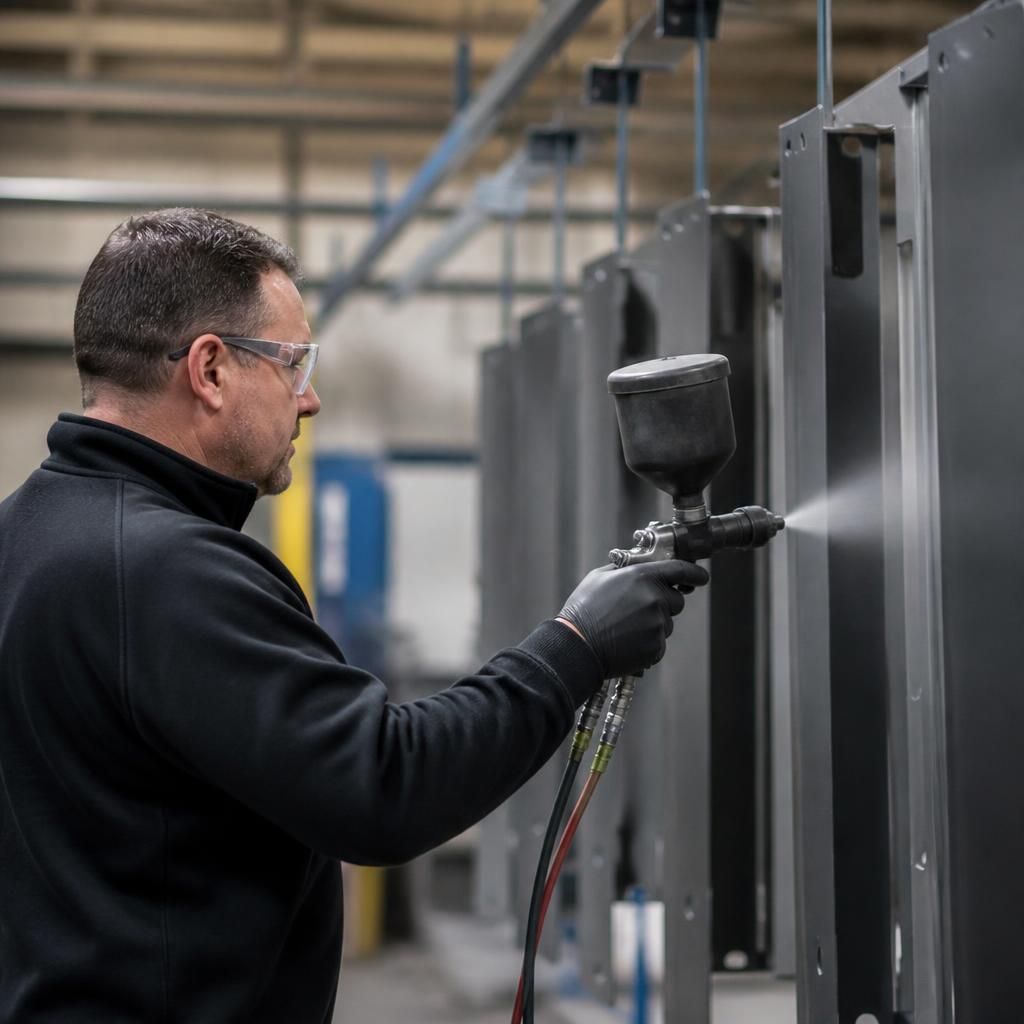
The most suitable metal protective coating spray is determined by the consequences of coating failure as well as the surrounding environment. A component that is difficult to access, replace or inspect may justify a more robust specification than a similar part in a low-consequence application.
Assess the part’s role within the finished product and consider what could happen if protection deteriorates. Factors include:
- whether failure could interrupt production or affect the operation of connected equipment;
- how easily the component can be removed, recoated or replaced;
- whether deterioration can be identified during routine inspection;
- the cost or disruption associated with dismantling surrounding assemblies; and
- whether the part is safety-related or subject to customer or sector-specific acceptance requirements.
This assessment helps avoid both under-specifying and over-specifying the coating. The chosen system should provide an appropriate level of protection for the part’s actual importance, with inspection and maintenance requirements recorded alongside the coating specification. Sharing this information with a powder-coating specialist gives them useful context when reviewing the proposed finish for a particular industrial application.
Share Your Coating Requirements for Specialist Guidance
Share your component drawings, metal type, operating conditions and required finish with our coating specialists for practical guidance on selecting a suitable protective coating system. We can help review the specification and identify any preparation, masking or application considerations before processing.