

How does the use of specific pretreatment chemicals influence the curing temperature and time required for different powder coating types?
Pretreatment chemicals do not usually change the powder manufacturer’s specified curing temperature, but they can affect the time needed for the coated metal to reach that temperature and the reliability of the final cure. Zinc phosphate, chromate and other conversion treatments must be thoroughly rinsed and dried; residual moisture or excessive chemical film can delay heat transfer, cause defects and require process adjustment, particularly with epoxy, polyester and hybrid powders that have different cure schedules.
Specific pretreatment chemicals generally do not change the powder manufacturer’s stated cure schedule. Their main influence is indirect: they alter the surface chemistry, coating adhesion, electrical behaviour and heat transfer at the metal interface, which can affect how consistently a powder reaches and completes its required cure. The correct temperature and time must therefore be established from the powder specification and verified against the actual component, rather than selected solely from the pretreatment used.
Why the powder type still matters
Epoxy, polyester and hybrid powders contain different resin and curing systems. An epoxy powder may be specified for a different cure window from a polyester powder, while a hybrid powder may require its own balance of temperature and dwell time. Pretreatment cannot be used to make one powder cure according to another powder’s schedule. Applying more heat to compensate for an unsuitable chemical treatment can instead cause yellowing, loss of gloss, embrittlement or other changes in appearance and performance.
Polyester powders are commonly selected where exterior durability and colour retention are important, so a reliable cure across the complete part is essential. Epoxy powders can provide strong chemical and corrosion resistance but are generally less suitable for prolonged direct exposure to ultraviolet light. Hybrid systems combine characteristics from more than one resin type and must be assessed using their own technical data. In each case, the specified metal temperature and minimum dwell time remain the starting point.
How pretreatment chemistry can affect the process
- Phosphate treatments: Zinc phosphate and related phosphate systems create a conversion layer that supports adhesion and corrosion protection. The coating weight, crystal structure and degree of uniformity can influence how evenly the powder film behaves during heating. If the layer is poorly controlled, local differences may show as adhesion variation, blistering or inconsistent corrosion resistance rather than as a simple change to the nominal cure temperature.
- Chromate treatments: Chromate conversion films, particularly on aluminium, can provide a chemically active surface for adhesion and corrosion protection. Their effect on curing is usually indirect. Process control is needed to avoid a film that is too heavy or chemically unsuitable for the powder system, as this can affect intercoat adhesion and the appearance of the finished surface.
- Alkaline cleaners and acidic stages: These stages prepare the metal by removing oil, oxide or other contamination. If their concentration, contact time or rinsing is poorly controlled, the resulting surface can interfere with powder wetting and adhesion. Increasing oven temperature will not correct a chemically unsuitable surface.
- Sealers and final rinses: A sealing stage can improve the stability of a conversion coating, but its compatibility with the powder system and subsequent process must be confirmed. The final surface condition should be consistent from batch to batch so that the powder melts, flows and cures under repeatable conditions.
Temperature versus time
Powder curing is governed by the temperature of the metal, not simply the air temperature displayed by the oven. A large fabricated component, a dense batch or a part with significant thermal mass takes longer to reach the required metal temperature than a thin small component. Pretreatment may contribute to differences at the interface, but component geometry, loading pattern, steel or aluminium thickness and oven airflow usually have a greater effect on heat-up time.
This distinction is important when a powder data sheet gives a cure range. The stated dwell period normally begins once the component has reached the relevant metal temperature. Extending the time that a cold part spends in an oven is not equivalent to holding it at the required cure temperature. Conversely, increasing the oven setting without checking the part temperature may over-cure thin sections while heavier sections are still approaching the target.
Potential effects on different powder systems
- Epoxy: An unsuitable conversion layer or residual process contamination can reduce adhesion and corrosion performance even when the film appears fully cured. The process should be judged by both cure and substrate compatibility.
- Polyester: Consistent pretreatment is particularly important where the finished component will face outdoor exposure. Under-curing can reduce film performance, while excessive thermal exposure may affect colour, gloss or surface texture.
- Hybrid: Hybrid powders should be treated as a separate formulation rather than assumed to behave like either epoxy or polyester. The specified cure schedule, pretreatment compatibility and finished-use requirements all need to be considered together.
How to establish the correct process
- Identify the exact powder chemistry and obtain its required metal-temperature range and minimum cure time from the technical documentation.
- Define the pretreatment sequence, including the type of cleaner, conversion coating, sealer and rinse stages. Check that the chemistry is suitable for the substrate and the powder system.
- Assess the component’s thickness, shape, thermal mass and position within the oven. These factors determine how quickly the metal reaches the curing temperature.
- Measure the temperature profile on representative parts rather than relying only on the oven controller. Include the coldest or most heavily built-up areas likely to govern the process.
- Inspect the cured film for adhesion, appearance, hardness and other relevant performance characteristics. Where service demands are high, corrosion and environmental testing may also be appropriate.
- Record changes to chemical concentration, bath condition, powder type, loading and oven settings. A change in pretreatment should trigger process verification even if the nominal powder schedule has not changed.
The practical conclusion is that pretreatment chemicals influence cure reliability more often than they alter the nominal cure temperature. The most dependable approach is to match the chemical system to the metal and powder, control the conversion layer, and validate the complete thermal cycle on the actual component. This is especially important for mixed batches containing different thicknesses or for specialist protective coatings where adhesion and corrosion resistance are as important as surface appearance.
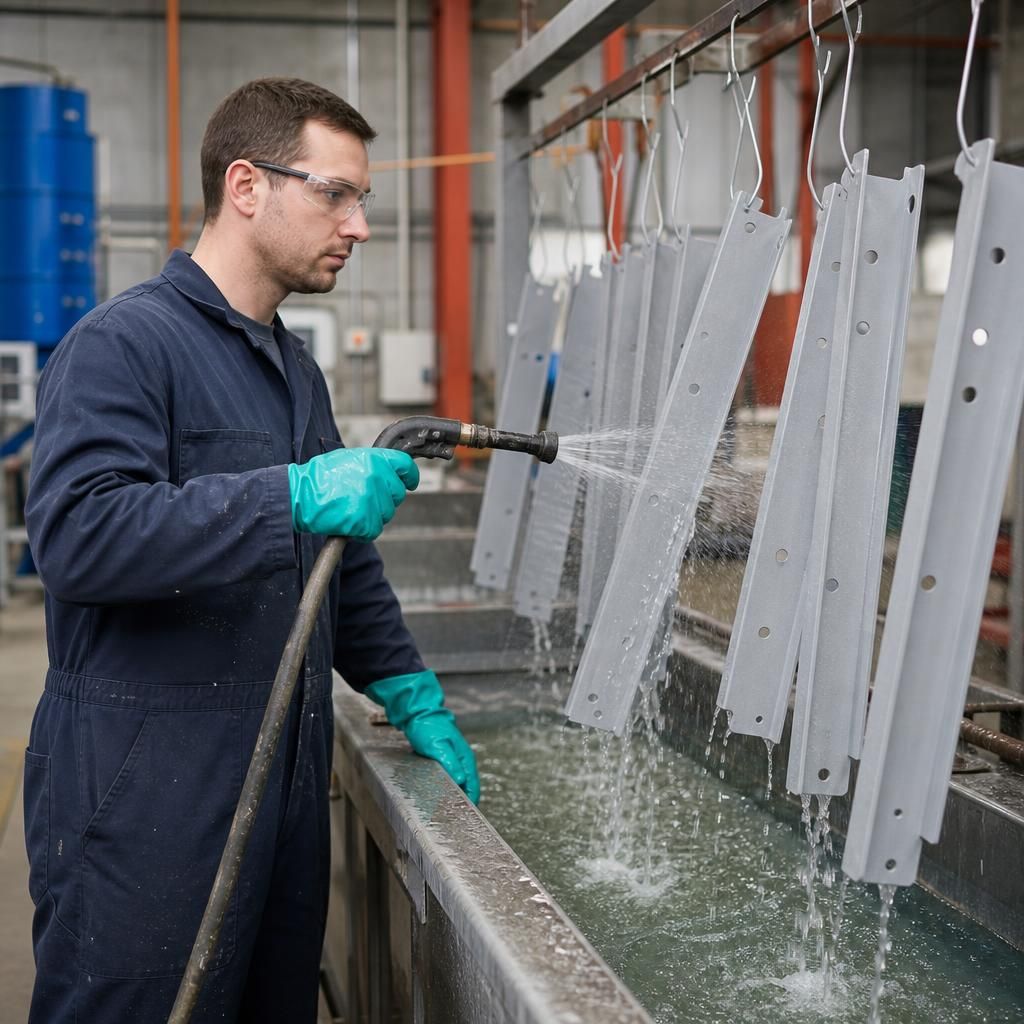
Rinse-water quality can influence how a pretreatment affects powder coating more than the nominal chemistry alone. If dissolved salts or chemical residues remain on the metal, they may cause pinholes, blistering or poor adhesion during heating. These defects can be mistaken for an incorrect cure temperature or insufficient oven time, even though changing the powder schedule will not remove the contamination. Consistent rinsing and complete drying help ensure that the powder’s specified cure cycle is assessing the coating system itself, rather than residue left by the pretreatment process.