

Which factors determine the suitability and efficiency of a small powder coating machine for my specific industrial applications?
A small powder coating machine is suitable when its part capacity, application method, powder delivery, curing requirements and control features match the size, material, coating type and production volume of your components. Efficiency depends on consistent powder flow, minimal changeover and cleaning time, suitable oven capacity, and a configuration that supports your required batch sizes without unnecessary equipment.
A small powder coating machine is suitable for an industrial application when it can produce a repeatable, properly bonded finish on the intended components without creating constraints in preparation, handling, curing, inspection or future production. Its efficiency should therefore be assessed as part of the complete coating process, rather than by the size or output of the machine alone.
Component geometry is a major selection factor. Deep recesses, internal corners, folded sections, mesh, perforations and narrow gaps affect how powder reaches the surface. These features can require careful adjustment of gun settings, nozzle selection and operator technique. A compact system may be appropriate for geometrically straightforward parts but less efficient if the work regularly requires extensive repositioning or manual correction. Assess both the external dimensions and the most difficult areas of the component, not just its overall footprint.
Electrical continuity and grounding also determine application quality. Powder is attracted to a correctly grounded conductive workpiece. Paint, rust, grease or poorly prepared contact points can interfere with this attraction and lead to uneven deposition or increased overspray. The equipment layout should allow reliable contact between the component, hanger or jig and the grounding system. Where parts are coated in batches, the design of the hanging method matters because inconsistent contact can produce variation between otherwise identical items.
Consider the required finish specification. A machine may need to handle different colours, textures, gloss levels, film thicknesses or functional coatings. Decorative finishes can place different demands on application consistency from protective or wear-resistant coatings. If the application involves a specialist powder, confirm that the equipment can accommodate its handling and application characteristics. The relevant question is not simply whether the machine can apply powder, but whether it can support the finish tolerances and inspection criteria required for the finished part.
Powder utilisation affects the practical efficiency of a small installation. Transfer efficiency is influenced by gun settings, operator technique, part shape, booth extraction and the amount of overspray. A configuration that makes it easy to control application and keep powder within the intended coating area can reduce avoidable waste. If recovery or reclaim is being considered, check whether the proposed process is appropriate for the number of colours and coating types involved. Frequent changes between products can make recovery more complicated where cross-contamination would affect the finish.
Preparation and handling should be included in the assessment. Powder coating does not correct oil, scale, corrosion, moisture or unsuitable surface condition. The machine must fit into a process that provides the necessary cleaning and pretreatment before application. Parts also need to be loaded, moved and unloaded without damaging prepared surfaces. Review the available space around the equipment, the location of hanging points and the method used to transfer components between preparation, coating and curing. A compact machine can still become inefficient if handling requires excessive manual movement.
The oven should be evaluated by the workpiece rather than by the powder alone. Required curing depends on the coating specification, metal type, component mass and the way heat reaches the part. Heavy sections, assemblies with different material thicknesses and parts with enclosed areas may heat at different rates from thin sheet. Confirm that the oven can deliver a suitable and repeatable thermal profile for the actual components. Where the machine is used for varied work, the ability to monitor and record process conditions can be more useful than relying solely on the nominal oven setting.
Control and repeatability are especially important in small-batch production. Useful controls should allow the operator to reproduce proven settings for comparable work and make deliberate adjustments when the component or powder changes. Recordable settings can support quality checks, troubleshooting and process standardisation between operators. Examine how easily the equipment permits controlled adjustment of powder output, air settings and application voltage, while avoiding unnecessary complexity for the people who will use it.
Installation requirements can determine whether a machine is genuinely suitable. Check the available electrical supply, compressed-air quality, extraction arrangements, ventilation, floor area and access for installation and maintenance. Moisture or oil in compressed air can affect powder delivery and finish quality, so filtration and air preparation should form part of the specification. The surrounding workspace must also support safe movement of components and prevent contamination from unrelated processes.
Safety and housekeeping features influence efficiency as well as compliance. Powder overspray should be controlled through suitable extraction and a booth arrangement that supports effective cleaning. Enclosures, interlocks, isolation points and access for routine inspection should be considered alongside the application equipment. A design that is difficult to clean or inspect can increase the risk of contamination and unplanned interruption, particularly when several coating types are used.
Maintenance access is another practical distinction between machines that appear similar on paper. Inspect the ease of cleaning the gun, hoses, hopper or powder container, filters and contact points. Consumable parts should be identifiable and accessible, and the equipment should allow faults such as irregular powder delivery or loss of grounding to be traced without dismantling unrelated components. A clear cleaning procedure is particularly important when changing colours or finishes.
Before selecting a machine, define the application in measurable terms:
- the component materials, dimensions, mass and most difficult geometries;
- the required finish types, film characteristics and inspection standards;
- the range of batch sizes and frequency of colour or powder changes;
- the pretreatment, handling and curing stages that will connect to the machine;
- the available utilities, workspace, extraction and operator access; and
- the records, checks and repeatability needed for quality control.
Application trials using representative parts are often the most reliable way to confirm suitability. Test the hardest component to coat, not only an easy sample, and assess coverage in recesses, finish uniformity, curing, cleaning time and operator handling. The result should be considered alongside installation, maintenance and process requirements. A small powder coating machine is efficient when it fits the whole production method, produces repeatable results and avoids adding hidden work before, during or after coating.
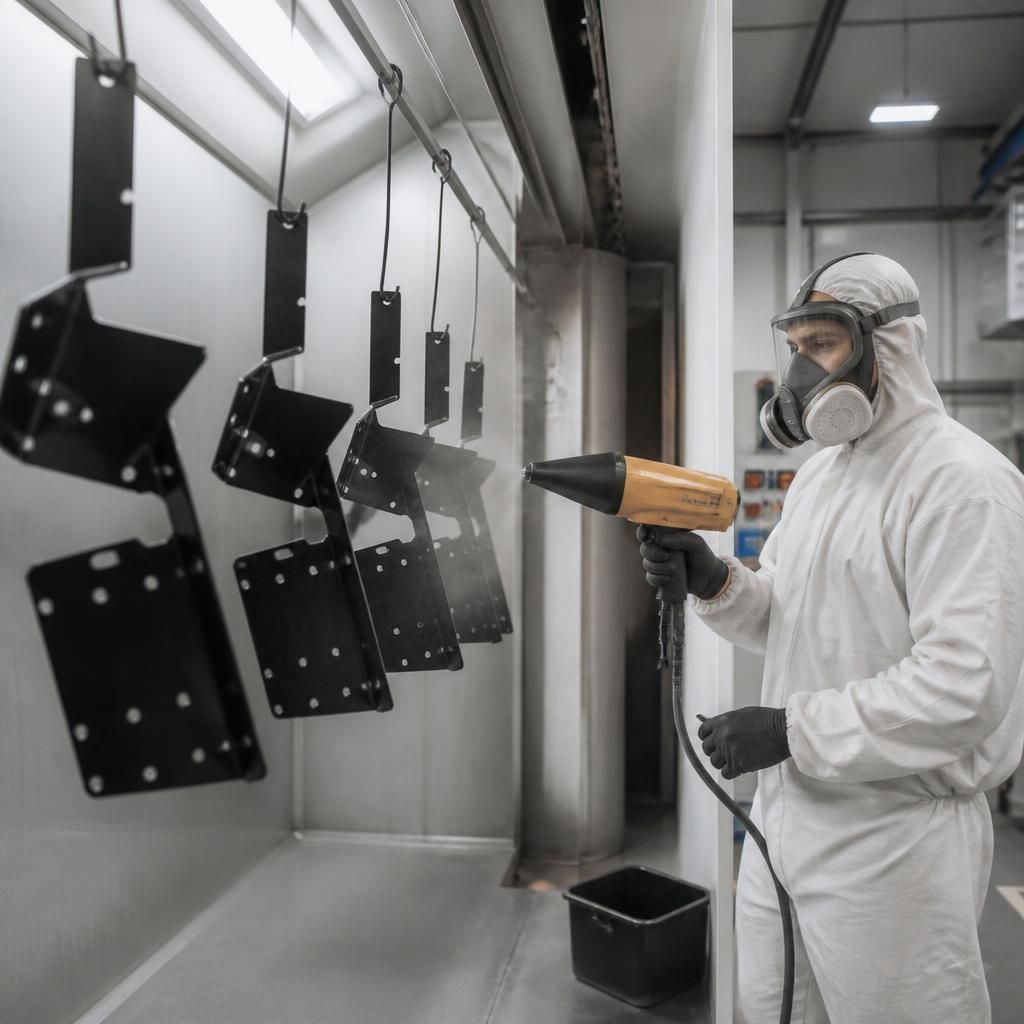
The usable capacity of a small powder coating machine depends on how components can be spaced and supported during a cycle, not simply on the maximum dimensions stated for the equipment. Parts must remain separated so the powder reaches exposed surfaces and the cure process receives consistent heat. Closely packed or poorly positioned components can create shaded areas, contact marks or uneven coverage, even when each part technically fits inside the booth or oven.
Assess the equipment with the actual jigging method and a representative load. Consider the number of components that can be hung without restricting access for the spray gun, obstructing airflow or increasing the risk of contact during transfer. This reveals the machine’s practical batch capacity and helps determine whether its physical size suits the way your parts are produced.