

What are the potential benefits of investing in a fluidizing hopper compared to other powder coating equipment?
Investing in a fluidising hopper can improve powder flow and provide a more consistent feed to the spray gun than basic powder containers or manual feed methods. This can support more even coverage, reduce powder-handling interruptions and make equipment operation easier to control in batch and industrial coating work.
A fluidising hopper is a powder coating powder vessel that introduces controlled air through a porous membrane to loosen and condition the powder before it is drawn into the application system. Compared with a basic container, gravity-fed arrangement or manually agitated powder pot, its main potential benefits are more reliable powder conditioning, improved handling of difficult powders and better suitability for repeatable production work.
More dependable powder conditioning
Powder can compact during storage, transport or use, particularly when it is fine, damp or has been subjected to vibration. A fluidising hopper helps break up this compacted material by suspending the particles in a controlled air stream. This can reduce problems such as rat-holing, bridging and intermittent pickup, where powder leaves a cavity or tunnel rather than moving evenly through the vessel.
This is different from relying on gravity alone. A gravity-fed container may work adequately with free-flowing powder, but it gives the operator less control when the material settles or consolidates. Mechanical agitation can address some of these issues, although it may introduce additional moving parts and does not condition the powder in the same way as aeration.
Better suitability for repeat production
For batch coating, a fluidising hopper can provide a more controlled way to hold and condition powder between fills. This is useful where the same coating process is repeated across multiple components and the operator needs the powder to behave similarly throughout the run. A stable powder condition can make it easier to maintain agreed application settings rather than continually adjusting the equipment to compensate for changes in the material.
The benefit is greatest when the hopper is correctly sized for the coating system and used with suitable powder. An oversized vessel that is only partly filled, or a hopper operated with unsuitable air pressure, may not give the intended result. Selection should therefore consider the powder type, expected batch size, spray equipment and the way powder is transferred into the hopper.
Reduced dependence on manual intervention
Compared with a simple open container, a fluidising hopper can reduce the need for operators to stir, shake or otherwise disturb the powder during use. This gives the coating process a more consistent operating method and can make training easier because powder preparation is less dependent on individual technique. It also keeps the powder in a dedicated vessel rather than requiring repeated handling in improvised containers.
That does not remove the need for operator checks. The hopper still needs the correct powder level, clean air supply and appropriate fluidising settings. Operators should also monitor the condition of the powder and investigate any change in pickup, spray behaviour or finish rather than increasing air flow without identifying the cause.
Potential material and process advantages
A suitable hopper may help limit waste associated with powder that has compacted, cannot be picked up consistently or must be discarded after excessive handling. It can also support more controlled transfer from the powder vessel to the spray equipment, which is particularly relevant where reclaim powder or blended powder requires careful management. Any reduction in waste depends on the powder, application method and operator settings; a hopper does not by itself guarantee lower consumption.
Fluidising equipment can also be preferable where the coating process uses powders with different flow characteristics. However, powders that absorb moisture, have unusual particle sizes or are prone to separation may require additional controls. Dry storage, filtration and correct housekeeping remain important because aeration cannot correct contaminated or degraded powder.
Comparison with other powder coating equipment
- Basic powder containers: these are simple and inexpensive, but they provide little assistance when powder settles or compacts. A fluidising hopper adds controlled aeration and a more structured feed arrangement.
- Gravity-feed vessels: these rely mainly on the weight of the powder. They can be suitable for straightforward applications, but their performance may change as the fill level falls or the powder becomes less free-flowing.
- Manual feed methods: these give flexibility for occasional work but depend heavily on operator handling. A hopper provides a more repeatable preparation method for recurring batches.
- Vibratory or mechanically agitated systems: these use movement to encourage powder flow. A fluidising hopper uses air and may offer a simpler approach where the primary issue is powder conditioning rather than conveying or screening.
- Larger automated feed systems: these may be more appropriate for high-throughput lines with integrated powder recovery and automatic replenishment. A fluidising hopper can be a more proportionate option for smaller or variable batch operations, provided its capacity and controls match the process.
Points to assess before investing
The potential benefit should be weighed against the purchase cost, compressed-air requirement, cleaning needs and space available around the coating equipment. Check that the hopper is compatible with the powder feed arrangement and that its materials and seals are suitable for the intended coating environment. Earthing and static-control arrangements should also be considered, as powder coating equipment must be installed and operated with appropriate electrical safety measures.
Cleaning is especially important when changing colours or coating materials. Residual powder in the vessel, membrane or outlet can contaminate the next batch and affect the finish. A hopper that is easy to empty and clean may provide a greater practical benefit than one selected solely on vessel capacity.
In summary, investing in a fluidising hopper is most likely to be worthwhile where powder conditioning, repeatability and reduced manual handling are important, particularly in recurring batch production. It may offer limited additional value for occasional work using a small quantity of naturally free-flowing powder. The right choice depends on powder characteristics, production pattern, feed equipment, cleaning requirements and the level of process control the business needs.
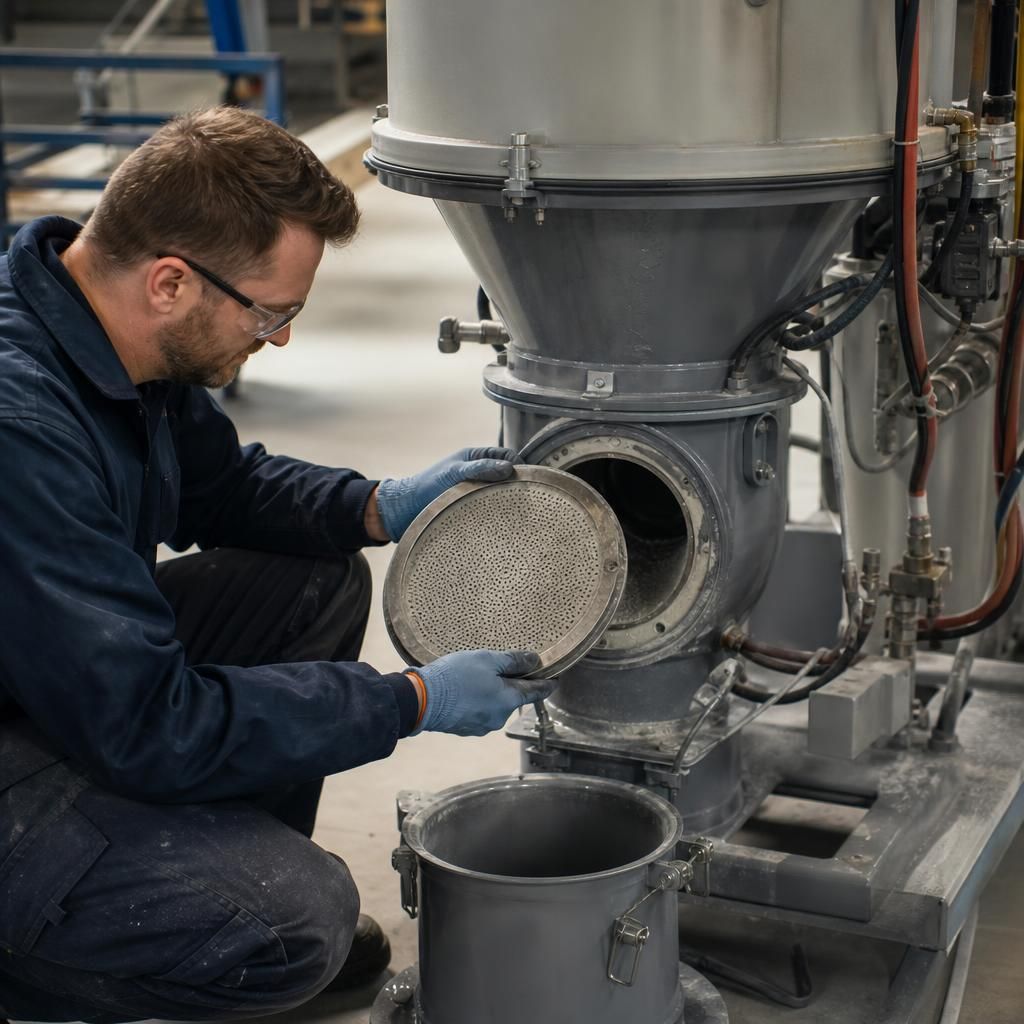
A fluidising hopper’s benefits depend on maintaining the parts that control air distribution, particularly the porous membrane, seals and air filtration. These components determine whether powder is aerated evenly before it reaches the spray equipment. If the membrane becomes blocked with residue or damaged during cleaning, the powder may fluidise unevenly even when the air supply appears to be working correctly.
This gives the hopper a different maintenance profile from a basic powder container. Before investing, check how easily the vessel can be emptied, whether the membrane is accessible for inspection and how replacement parts are managed. Regular checks should also confirm that the air entering the hopper is clean and dry, since moisture or oil contamination can affect powder condition and undermine the consistency the equipment is intended to provide.