

What are the advantages of using fluidizing hoppers over traditional powder feed systems in powder coating?
Fluidising hoppers keep powder coating material aerated and easier to draw into the spray system, helping provide a more consistent feed than traditional powder feed systems. This can support steadier powder application, reduce interruptions caused by compacted powder and make the equipment more suitable for controlled batch production.
Fluidising hoppers offer advantages over traditional powder feed systems by conditioning the powder before it reaches the spray equipment, improving powder pickup, reducing operator intervention and making the coating process easier to control. Their value is greatest where a production line needs repeatable transfer of powder without relying on frequent manual loosening, stirring or repositioning of the material.
A fluidising hopper uses a porous membrane or plate beneath the powder container. Regulated air passes through this surface and gently separates the powder particles, creating a powder bed that can be drawn towards the spray gun or pump. In a conventional system, powder may be taken directly from a box, drum or static container. As the material settles, the pickup point can become less effective, particularly with fine or compacted powder, placing greater dependence on manual adjustment and the design of the suction arrangement.
More predictable powder pickup: Fluidisation helps maintain a usable powder bed around the pickup point. This can reduce fluctuations caused by powder settling and support more uniform transfer to the spray equipment. The result is better control of the relationship between gun settings, powder output and the coating specification being applied.
Less manual disturbance of the powder: Traditional arrangements may require an operator to break up settled material, move a suction tube or agitate the container. A hopper with correctly adjusted fluidising air performs much of this conditioning within the equipment. This can make the process less dependent on operator intervention and reduce avoidable variation between batches.
Improved suitability for fine powders: Fine coating powders can be more prone to compacting, bridging or forming a dense layer around the pickup tube. Fluidising equipment is designed to make these materials easier to draw into the system. However, the powder still needs to be dry and suitable for fluidisation; excessive moisture, contamination or unsuitable particle characteristics can prevent the hopper from working correctly.
Better control of spray application: When the feed supply is stable, the operator can make adjustments to voltage, current, powder output and air settings with greater confidence that changes in the finish are not being caused by an erratic supply. This is particularly useful when coating components with defined film thickness requirements, complex geometry or areas where excessive powder could affect appearance or rework.
More efficient use of equipment capacity: A fluidising hopper can help a pump or injector receive powder in a condition that is easier to transport. This may reduce the likelihood of air-starved pickup, surging or interruptions that require the spray system to be checked. It does not increase the capacity of the gun or curing oven, but it can help the feed system operate within its intended settings.
Flexible integration: Fluidising hoppers can be used as part of a standalone spray arrangement or integrated into a wider powder coating equipment package. The correct size depends on powder consumption, container dimensions, replenishment practices, the number of guns supplied and whether the installation is intended for individual batches or a more continuous process. Connections, pump type, air regulation and control arrangements should be checked as a complete system rather than selected in isolation.
Compared with a traditional feed system, a hopper may also make powder handling more orderly. A suitable container can reduce exposure of the powder to workshop contamination during transfer and provide a defined location for the pickup equipment. This is useful where different coating powders are used for separate jobs, although the container, membrane and pickup components must be cleaned properly between changes to avoid colour or formulation contamination.
There are limitations to consider. Fluidising air must be regulated carefully: too little air may leave the powder dense and difficult to draw, while too much can make the powder excessively lively, produce unstable pickup or carry unwanted air into the spray system. Air quality is also important because oil or moisture in the compressed-air supply can affect the powder. The hopper should therefore be used with appropriate filtration, pressure control and routine inspection of the membrane and air lines.
Cleaning and maintenance remain necessary. Operators should remove old powder from the hopper and pickup path, inspect seals and hoses, check that the porous plate is not blocked and confirm that the air supply is functioning correctly. Powder should be stored and loaded in a way that limits moisture absorption and foreign-particle contamination. These practices protect the benefits of fluidisation and help distinguish a feed problem from an issue elsewhere in the spray equipment.
Traditional systems can still be appropriate where powder volumes are low, the material is easy to draw, equipment changes are infrequent or the process does not require finely controlled powder delivery. A fluidising hopper is more suitable when powder behaviour, operator intervention or feed stability is limiting application control. The decision should be based on the powder formulation, required finish, number of spray guns, batch size, cleaning procedure and available compressed-air system, rather than on hopper capacity alone.
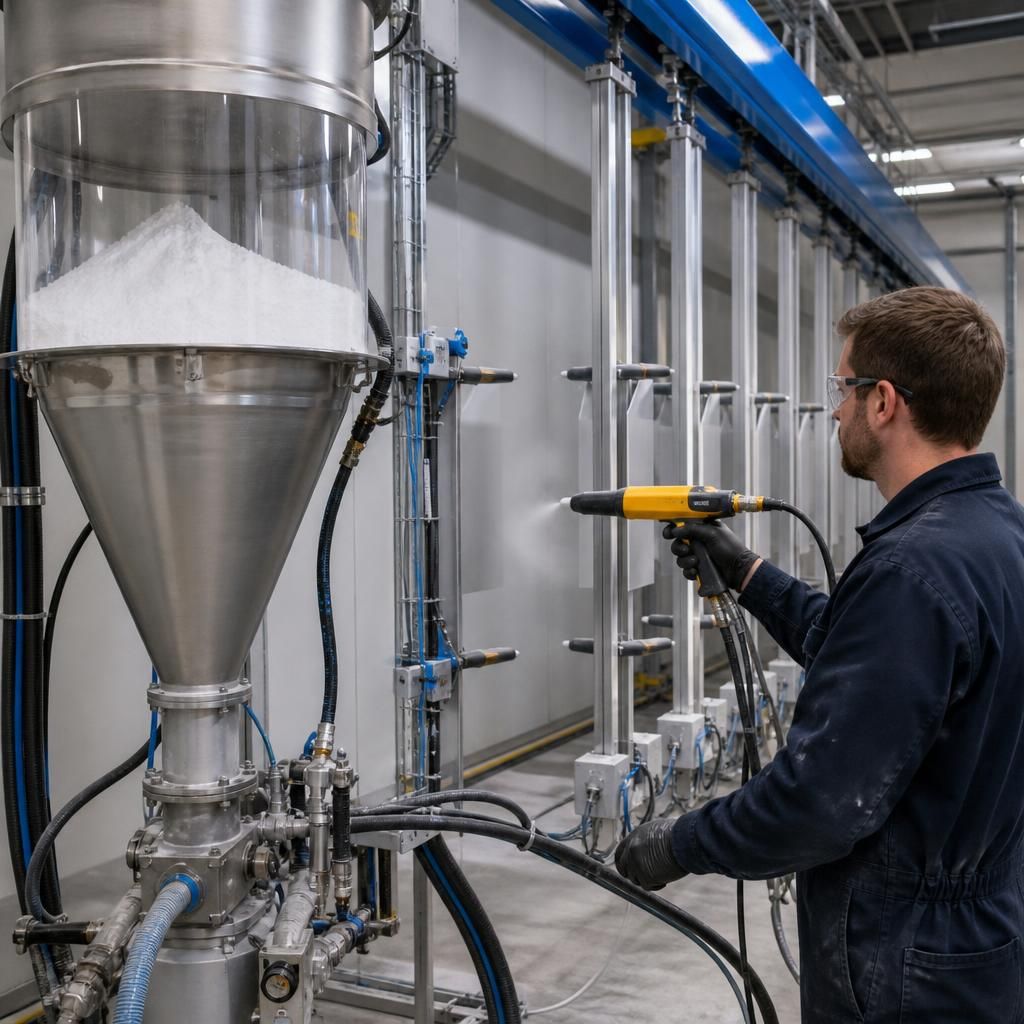
A fluidising hopper can also simplify powder supply where more than one spray gun is used. A suitably designed system can provide a common, conditioned powder source for several pickup points, helping each gun receive material with similar flow characteristics. This can make coordinated application more manageable on components that require coverage from different angles or stations.
That benefit depends on correct system design. The hopper, pumps, hoses and air settings must be matched to the number of guns and the required powder output. If the supply arrangement is not balanced, one pickup point may draw more effectively than another, so a fluidising hopper should be assessed as part of the complete feed system rather than treated as a universal replacement for traditional equipment.