

What should I consider when choosing a small powder coating machine for my specific needs?
When choosing a small powder coating machine, match its working capacity, component dimensions, powder application controls and curing method to your parts, coating materials and required finish quality. Also assess available space and utilities, extraction and safety provisions, expected batch volumes, ease of cleaning, future capacity needs and the total cost of ownership, including installation, maintenance and operator training.
A small powder coating machine should be selected as a complete coating system rather than as a single spray gun. The right choice depends on how consistently it can prepare, apply, handle and record the required finish across the actual range of components, powders and working conditions in your business.
Start with the required finish and quality standard
Define what constitutes an acceptable coated part before comparing equipment. Relevant criteria may include film uniformity, edge coverage, smoothness, gloss, colour consistency, adhesion and resistance to impact, chemicals or corrosion. A decorative finish on fabricated panels may require different control from a protective coating on brackets or components exposed to demanding service conditions.
Consider how much variation is acceptable between operators and between coating runs. Equipment with repeatable parameter settings, clear displays and controlled application conditions is generally easier to standardise than a basic system that depends heavily on individual technique. If parts are supplied to a customer specification, check whether the machine can support the inspection and process records needed to demonstrate conformity.
Assess the application method
Small systems are commonly used for manual coating, but manual does not have to mean inconsistent. Examine the gun’s balance, trigger operation, cable arrangement and ease of adjustment. An operator who can maintain a stable spray distance and angle is more likely to achieve an even deposit, particularly on recesses, edges and tubular sections.
Look at the controller’s ability to store or repeat suitable settings for different parts. Useful controls may include output adjustment, electrostatic voltage and current management, and modes intended for complex shapes or previously coated areas. The most sophisticated controls are not automatically the best choice if operators cannot understand or repeat them, so usability should be assessed alongside technical specification.
Where a business coats several colours or powder types, consider how the application equipment supports changeover. The design should allow powder-contact components to be removed and cleaned without unnecessary dismantling. Poor changeover arrangements can create contamination, wasted material and longer preparation between jobs, even when the spray performance itself is satisfactory.
Check compatibility with your substrates and component design
Different metals and surface conditions can affect electrostatic attraction and final finish quality. Confirm that the proposed system is suitable for the substrates used in production, including components with different thicknesses, profiles or surface treatments. Parts with deep recesses, Faraday areas, sharp edges or narrow internal sections may need different application techniques from open, flat surfaces.
Grounding is particularly important. The workpiece, hanging arrangement and booth should provide a reliable path for electrostatic charge. Test whether your existing racks, hooks and jigs make adequate contact or whether coating build-up could interrupt that contact between runs. The design should also allow parts to be positioned and rotated without damaging uncured powder.
Evaluate the booth and powder-handling arrangement
The booth is not merely an enclosure for spraying. Its internal dimensions, lighting, airflow and access affect visibility, operator control and contamination risk. Check that the layout gives the operator a clear view of the coating area and that overspray is drawn away without disturbing the powder pattern.
Decide whether a simple collection arrangement is sufficient or whether powder recovery is appropriate for the materials and job mix. Recovery can reduce waste in some production situations, but it also introduces cleaning and contamination-control considerations. If multiple colours are used, a system designed for rapid cleaning may be more useful than a more complex recovery arrangement.
Examine how powder is supplied to the gun and how consistently it is fluidised. Moisture, compacted powder or an unstable feed can cause surging and uneven application. The equipment should make it straightforward to identify and correct feed problems rather than leaving the operator to compensate at the gun.
Consider workflow and operator interaction
A machine may have suitable technical specifications but still be a poor fit if it interrupts the rest of the process. Map the movement of components from preparation and hanging through spraying, curing, inspection and unloading. The equipment should allow safe access, sensible part flow and enough room to handle coated work without contact damage.
Review the height and position of controls, the effort needed to move parts, and the amount of manual handling required. These details matter when components vary in shape or when one operator must carry out several stages of the process. Clear operating instructions, straightforward adjustment and accessible consumables can reduce avoidable errors.
Allow for inspection and process control
Choose equipment that supports the checks your customers require. Depending on the specification, this may involve visual inspection, coating thickness measurement, adhesion testing, cure verification or recording the powder batch and process settings. The machine does not perform every quality check itself, but its controls should make the coating process repeatable enough for those checks to have meaning.
Ask what information can be recorded for each job and whether settings can be locked or protected from unintended changes. A basic log of substrate preparation, powder identification, application settings and curing conditions can help trace the cause of defects and establish a consistent working method.
Review documentation, conformity and support
Request full technical documentation before purchase, including electrical requirements, operating instructions, maintenance information, recommended consumables and any stated limitations. Confirm that the machine’s installation and use can be managed in accordance with applicable UK workplace, electrical, dust and fire-safety requirements. The supplier should clearly identify what is included and what must be provided separately.
Support is also part of suitability. Check how faults are diagnosed, whether replacement parts are readily identifiable, and whether operators receive adequate instruction on setup, cleaning, grounding and fault conditions. A machine that is difficult to troubleshoot can create more disruption than its purchase price suggests.
Use a practical comparison before deciding
Prepare a representative trial using the substrates, component shapes and powder types that matter most to your business. Assess not only the appearance of the first part but also repeatability across a run, changeover effort, powder consumption, handling practicality and the quality of difficult areas. Record the results against your acceptance criteria rather than relying on a demonstration with an easy test piece.
Finally, compare the complete installed arrangement, including ancillary equipment, extraction, hanging fixtures, inspection tools, training and ongoing consumables. If your work includes irregular volumes, unusual component sizes or specifications that demand tightly controlled results, outsourcing some jobs to a specialist powder coater may be more appropriate than selecting a machine that only suits routine work. The best choice is the system that matches the real process, quality obligations and operating discipline of your business.
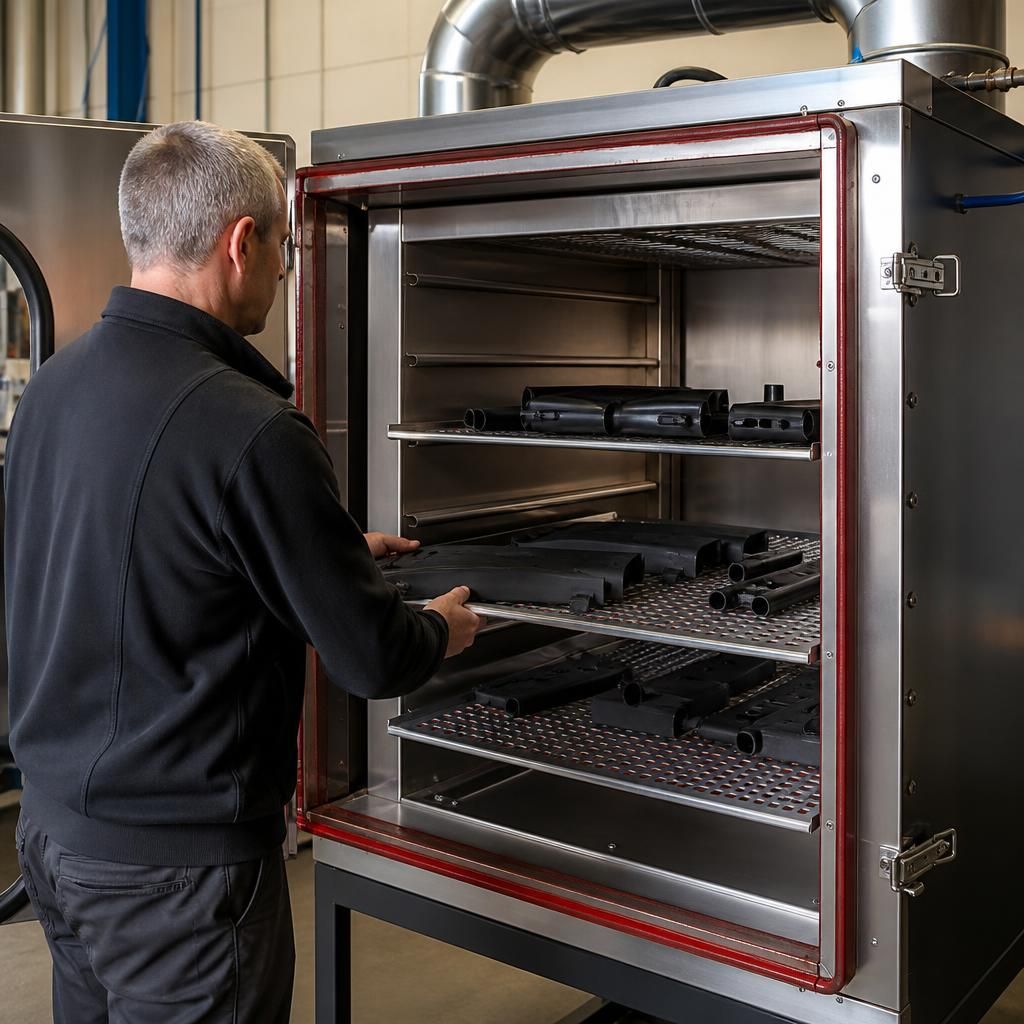
When comparing small powder coating machines, assess the curing oven by its usable curing envelope rather than its stated internal dimensions. Shelves, hooks, airflow clearances and the required spacing between components can significantly reduce the amount of work that can be loaded safely. Check that your largest parts can be positioned without touching the oven walls or one another, and that typical batches allow air to circulate around every coated surface.
Ask how the oven performs with the loads your business actually expects to process. A trial should confirm that the chosen arrangement reaches and maintains the required metal temperature throughout the load, not just the air temperature shown on the control panel. Consider the effect of different component thicknesses, dense batches and repeated loading on temperature recovery and cycle consistency. These checks help prevent a machine that appears compact and economical from becoming a restriction at the curing stage.