

What safety features should be looked for in small powder coating machines to ensure operator safety and compliance with industry standards?
Small powder coating machines should include effective powder extraction and ventilation, secure guarding, door interlocks, emergency-stop controls, electrical protection and reliable earthing to reduce risks from dust, moving parts and electrical faults. Check that the machine is supplied with clear operating instructions, maintenance requirements and conformity documentation, and that its safeguards can be incorporated into the workplace’s risk assessment and relevant UK safety requirements.
In addition to basic extraction, guarding and electrical safeguards, a safe small powder coating machine should control electrostatic, dust, thermal, pneumatic and maintenance-related hazards, while providing clear evidence that its protective functions can be checked. The correct specification depends on the powder, substrate, process arrangement and workplace risk assessment, rather than on machine size alone.
Electrostatic application controls are particularly important. Look for a spray gun with controlled voltage and current output, automatic discharge when the trigger is released, and protection against unintended energisation. The system should prevent spraying or charging where a required operating condition has not been met. Controls should also make it clear when high voltage is active, so an operator cannot mistake an idle-looking gun for a de-energised one.
The workpiece, hanging equipment and supporting fixtures should be capable of maintaining electrical continuity. Suitable machines may provide a grounding or continuity-monitoring arrangement, but the installation still needs conductive hooks, racks and contact points that are kept free from cured powder and contamination. A sound connection to the component reduces the risk of charge accumulating on isolated metalwork and supports consistent application.
Powder-dust management should include features that help the operator identify a loss of capture or a restricted filter before dust escapes into the work area. Useful provisions can include airflow indication, filter condition monitoring, alarms and access panels that can be opened without releasing a cloud of powder. Collection equipment should be suitable for the powder being used, and the design should prevent accumulated deposits from reaching hot surfaces, motors or other possible ignition sources.
Where combustible powder may form a hazardous atmosphere, the business should consider the requirements of the Dangerous Substances and Explosive Atmospheres Regulations (DSEAR). This involves assessing the powder, concentration, ventilation, ignition sources and zoning of the workplace. Equipment installed in a classified hazardous area may need to be suitable for that zone and appropriately certified. A small machine should not be assumed to be exempt from these considerations simply because it has a limited capacity.
Oven and heating safeguards apply where the equipment includes a curing oven or integrated heat source. Look for an independent over-temperature cut-out, accurate temperature control, protection against heater failure and a design that prevents the oven from continuing to heat during a dangerous fault. Gas-fired equipment requires suitable burner controls, flame-failure protection and safe management of the fuel supply. Door switches or equivalent measures may be appropriate where opening the enclosure could expose the operator to heat or moving parts.
Controls should be arranged so that faults cannot be bypassed casually. A reset should require a deliberate action after the fault has been cleared, rather than allowing automatic restarting. The machine should also prevent unexpected start-up after a power interruption. Clear status indicators, fault codes and plainly labelled controls help the operator distinguish between standby, running, charged and fault conditions.
Safe isolation is necessary for cleaning, filter replacement, inspection and fault finding. Check that the machine has an accessible means of isolating electrical, pneumatic, electrostatic and, where relevant, gas energy. Residual pressure and stored electrical charge should be capable of being released or verified as safe. Isolation points should be identifiable, and maintenance instructions should explain how to prevent another person from restoring power while work is in progress.
Compressed-air systems also need suitable pressure regulation, secure hose connections and protection against uncontrolled movement if a hose fails. Operators should not use compressed air to disperse settled powder unless the process and equipment are specifically designed for that purpose; doing so can create an airborne dust cloud and increase exposure or explosion risk.
The physical design should reduce avoidable contact and handling hazards. Consider stable construction, secure doors and panels, rounded or protected edges, heat shielding around hot surfaces and access arrangements that do not require the operator to reach across an active spray area. If components or powder containers are heavy, the layout should allow safe lifting and positioning without placing hands near moving or heated parts.
Machine safeguards are only effective when supported by suitable workplace controls. Operators should receive instruction on:
- the hazards of the particular powder and the information in its safety data sheet;
- the meaning of alarms, indicators and fault conditions;
- correct use of protective clothing, gloves and eye protection;
- respiratory protective equipment where the COSHH assessment identifies a need;
- safe cleaning methods and the prohibition of unsafe dust-raising practices;
- routine checks of contacts, hoses, filters, enclosures and protective functions; and
- what to do if powder escapes, a component loses continuity or a safeguard fails.
For compliance, the purchaser should identify which UK workplace duties apply to the complete installation. These can include the Provision and Use of Work Equipment Regulations (PUWER), the Control of Substances Hazardous to Health Regulations (COSHH), DSEAR, and requirements concerning electrical systems and workplace fire safety. The machine should be assessed as part of the production arrangement, including its booth or enclosure, curing equipment, extraction, electrical supply, powder storage and cleaning process.
Before purchase, ask for the operating and maintenance information, safety data for the intended powder, details of protective devices, inspection intervals and instructions for testing them. Check that the supplier can explain which safeguards are built into the machine and which must be provided by the installer or user. A competent person should then verify the completed installation, record the findings and include the equipment in the site’s inspection, training and maintenance arrangements.
The most useful selection checklist therefore covers electrostatic discharge control, continuity monitoring, dust-deposit prevention, hazardous-area suitability where applicable, heating protection, safe isolation, controlled restarting, fault indication and operator training. These features provide a stronger basis for compliance than relying on a general claim that a machine is safe or suitable for industrial use.
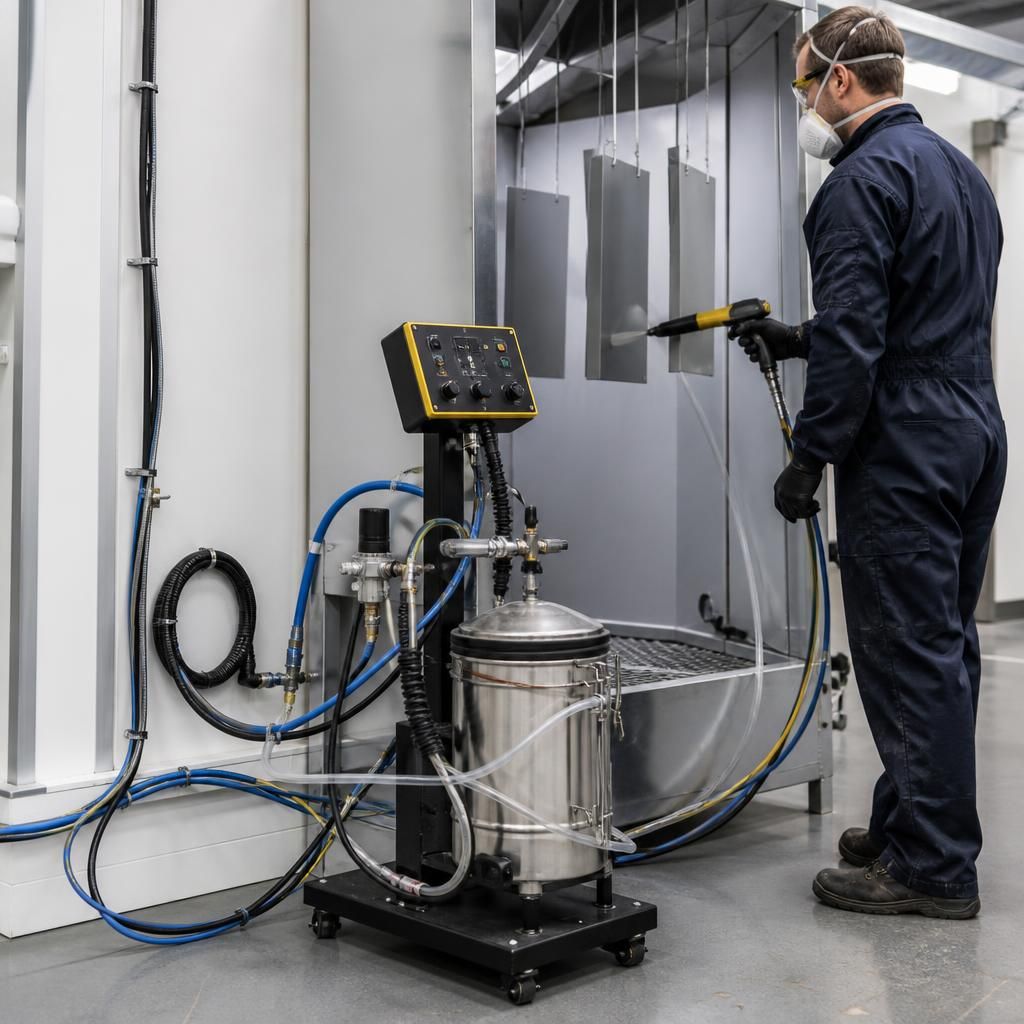
Hose and cable management is an important safety feature in a small powder coating machine. Spray-gun leads, compressed-air hoses and power cables should be routed away from walkways, hot surfaces, sharp edges and moving parts, with suitable strain relief at connection points. Secure routing reduces trip, snagging and accidental disconnection hazards during spraying, cleaning or component handling.
Also assess whether the controls, gun holder and powder container can be reached without awkward stretching or reaching across the spray area. A well-arranged workstation keeps the operator’s hands and body clear of active equipment while making routine adjustments possible from a stable standing position. These design details should be considered alongside the formal risk assessment, particularly where several operators will use the machine.
Review your small powder coating machine safety requirements
Use this checklist when reviewing a small powder coating machine, then discuss the intended powder, process and installation with a competent powder coating specialist. Ask for the relevant safety documentation and confirmation of which safeguards require installation or site-level assessment.