

How do small powder coating machines ensure precision in complex applications?
Small powder coating machines support precision by allowing operators to control powder flow, electrostatic charge, spray pattern and application distance to suit a component’s geometry. Careful masking, consistent grounding and controlled curing then help produce an even film across edges, recesses and other complex surfaces.
Small powder coating machines achieve precision in complex applications through repeatable process control, accurate preparation and systematic inspection. The machine itself does not guarantee a precise result: operators must match the process to the component’s geometry, material, required film build and coating specification.
Complex parts often contain recesses, apertures, sharp transitions, threaded sections and areas that are partly hidden during spraying. These features affect how powder accumulates and how easily a consistent film can be achieved. A precise process therefore starts with a coating plan that identifies critical surfaces, areas requiring masking and locations where coverage or thickness must be checked.
Part preparation and fixturing
Cleanliness is essential because oil, moisture, oxide, swarf and residues can interfere with adhesion and create visual defects. Pre-treatment should be suitable for the substrate and the intended service conditions. Components should also be supported securely so that they remain stable during application and can be transferred to the oven without contact damage.
Fixtures should expose as much of the required surface as possible while avoiding marks on visible faces. The contact point must provide a reliable electrical path, and the design should allow similar parts to be positioned in the same way from one batch to the next. Consistent orientation makes the application more repeatable and helps operators follow an established spray sequence.
Managing geometry-related coating risks
Recesses and internal corners can behave differently from broad, exposed faces. Powder may accumulate at an edge or be less accessible in a narrow cavity, while enclosed areas can be affected by air movement and the order in which surfaces are coated. Operators can reduce variation by using a planned sequence, approaching difficult areas before surrounding faces become heavily coated and avoiding unnecessary passes over edges.
Small equipment can be useful for this work because the operator can handle individual components or limited batches with close visual control. It is particularly important, however, to distinguish a genuinely controlled small-scale process from simply applying powder by hand without a defined method. A written sequence, repeatable component position and agreed acceptance criteria provide greater precision than machine size alone.
Controlling film thickness
Film thickness is a key precision requirement. Too little coating can leave weak coverage or an inconsistent appearance; too much can obscure detail, interfere with assembly and cause problems around holes, threads and mating faces. Thickness should be specified according to the component’s function and checked on representative locations rather than judged only by appearance.
For complex parts, inspection points should include flat faces, edges, corners and recessed areas. A suitable thickness gauge can identify variation that is not visible under normal lighting. Where dimensions are critical, the coating allowance should be considered before production because the cured film changes the final size of the part.
Establishing repeatable settings
Precision improves when the process is established using representative components or test pieces before a production batch begins. The trial should examine coverage, appearance, film thickness and any areas affected by the component’s geometry. Once acceptable results are achieved, the settings and application sequence can be recorded as a process reference.
Powder condition also matters. Material should be stored and handled in accordance with its technical requirements, with contamination and moisture controlled. Where reclaimed powder is used, its suitability and proportion should be managed consistently because changes in material characteristics can affect appearance and application behaviour.
Verifying the finished result
Inspection should combine visual checks with measurable tests appropriate to the component. Visual inspection can identify runs, pinholes, orange peel, uneven appearance and missed areas. Dimensional checks can confirm that coated holes, threads and interfaces remain usable, while adhesion and cure verification may be required where the coating forms part of the component’s protective performance.
Inspection results should be linked to specific process stages. For example, poor coverage in a recess may indicate an issue with access or application order, whereas inconsistent thickness across otherwise identical parts may indicate variation in positioning, material condition or operator technique. Recording these findings allows the process to be adjusted based on evidence rather than appearance alone.
For manufacturers and fabricators, the most reliable approach is to define the critical characteristics of each component, validate the coating method on a representative sample and retain clear process and inspection records. Small powder coating machines can then deliver precise results on complex applications when their capabilities are supported by disciplined preparation, repeatable handling and objective quality checks.
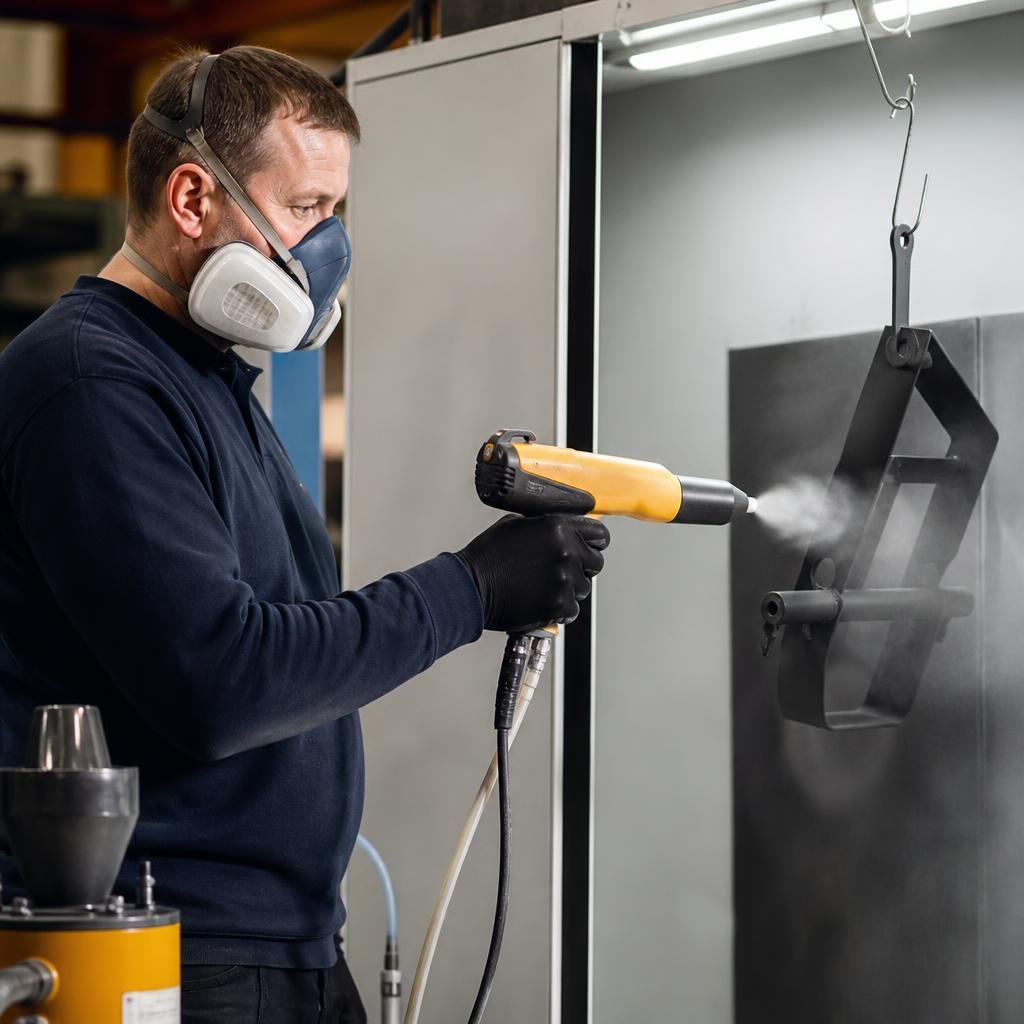
Small powder coating machines maintain precision when powder delivery and compressed-air flow remain stable throughout the application. The operator should check that the hopper, feed system, hose and spray gun are delivering powder evenly, because partial blockages, moisture or a worn nozzle can alter the spray pattern without an obvious machine fault. Comparing the output at the start of a job with an agreed reference condition helps identify variation before complex components are coated.
Control settings should be adjusted as a matched system rather than changing one control in isolation. Powder flow, air assistance and electrostatic charge influence how much material reaches the part and how it behaves around detailed features. Recording the settings that produce an acceptable result for a particular component makes repeat work more consistent, while checking gun components and delivery lines between batches helps preserve that reference condition.
Discuss precision coating for your complex components
If you are assessing a coating method for complex metal components, discuss the geometry, substrate and finish requirements with the powder-coating.co.uk team. Sharing drawings or representative parts can help establish a suitable application and inspection approach.