

What are the benefits of using a powder coating setup over traditional painting methods?
A powder coating setup can provide a tougher, more uniform finish than traditional wet painting, with improved resistance to chipping, corrosion and wear. It also reduces material waste because overspray can often be collected for controlled reuse, while the dry application avoids solvent evaporation during coating.
The main benefit of a powder coating setup is that it combines controlled dry application with oven curing, creating a repeatable production process rather than relying on the drying and application stages associated with wet paint. For manufacturers and fabricators, this can improve workflow control, handling, housekeeping and finish consistency across batches.
Production efficiency is one of the clearest differences. Wet painting may require several application stages, flash-off periods and drying space between coats. Powder coating can often achieve the required coating in a single application and then cure it in a dedicated oven. Once curing is complete, components do not need a prolonged air-drying period before they can move to inspection, assembly or dispatch. The exact process depends on the powder specification, component design and oven capability, but the setup can reduce the amount of floor space and handling devoted to drying.
A dedicated setup also gives the operator greater control over the variables that affect coating quality. Application voltage, powder delivery, gun distance, line speed, oven temperature and curing time can be monitored and adjusted as part of a defined process. This is particularly useful for repeat production, where consistent settings help reduce variation between batches. By comparison, wet painting can be more sensitive to mixing ratios, viscosity, application technique, drying conditions and the time allowed between coats.
Powder coating can simplify material management as well. There is no need to prepare liquid paint by measuring solvent or thinner into each batch, and unused material is not left as a liquid mixture that may have a limited working life. The dry powder format can make stock handling and colour change planning more straightforward, although operators still need suitable storage, identification and contamination controls. Equipment must also be cleaned properly when changing between colours or coating types.
For industrial work, a powder coating line can support a more controlled working environment than a conventional wet-paint area. The process avoids many of the housekeeping issues associated with liquid paint drips, spills and wet overspray. However, powder is still a fine airborne material during application, so the booth, extraction system, filters, personal protective equipment and cleaning procedures must be appropriate for the equipment and coating being used. Powder coating is not maintenance-free or risk-free simply because the coating is applied dry.
The cured coating can also provide a practical lifecycle advantage. A properly prepared and cured finish is less likely to require attention caused by early surface damage or premature breakdown, which can reduce interruptions for touch-up work and recoating. This benefit depends on correct preparation, suitable powder selection, adequate pretreatment and a cure that matches the manufacturer’s requirements. Poor preparation or insufficient curing can undermine the result regardless of how sophisticated the setup is.
Compared with traditional painting, powder coating is especially suited to metal components that can be electrically grounded and safely passed through a curing oven. It works well for repeatable batches, fabricated parts, frames, brackets, panels and other components where the available equipment can accommodate their dimensions and mass. A setup may include different application equipment or coating materials where the work requires specialist functional finishes, but compatibility should be confirmed before investment.
There are also limitations to consider before treating powder coating as a universal replacement for wet paint:
- Components must generally tolerate the curing temperature, so heat-sensitive materials may require another process.
- Large or complex items must fit within the booth, handling system and oven, with sufficient access for effective coating and curing.
- Colour changes and small one-off jobs may require careful cleaning and process planning to avoid contamination and unnecessary downtime.
- Powder coating is normally carried out in a controlled facility, whereas some wet-paint systems are more adaptable for on-site repairs or components that cannot be moved.
- Surface preparation remains essential. Oil, rust, scale, welding residues and other contaminants can affect adhesion and the service life of the finish.
In practical terms, a powder coating setup offers the greatest advantage where a business processes compatible metal parts in repeatable batches and can control preparation, application and curing as one integrated workflow. Traditional painting may remain more suitable for temperature-sensitive parts, very small repairs, complex on-site work or applications requiring a coating system that powder cannot provide. The right choice therefore depends not only on the finish required, but also on component size, material, production volume, colour-change frequency, oven capacity and the level of process control the business needs.
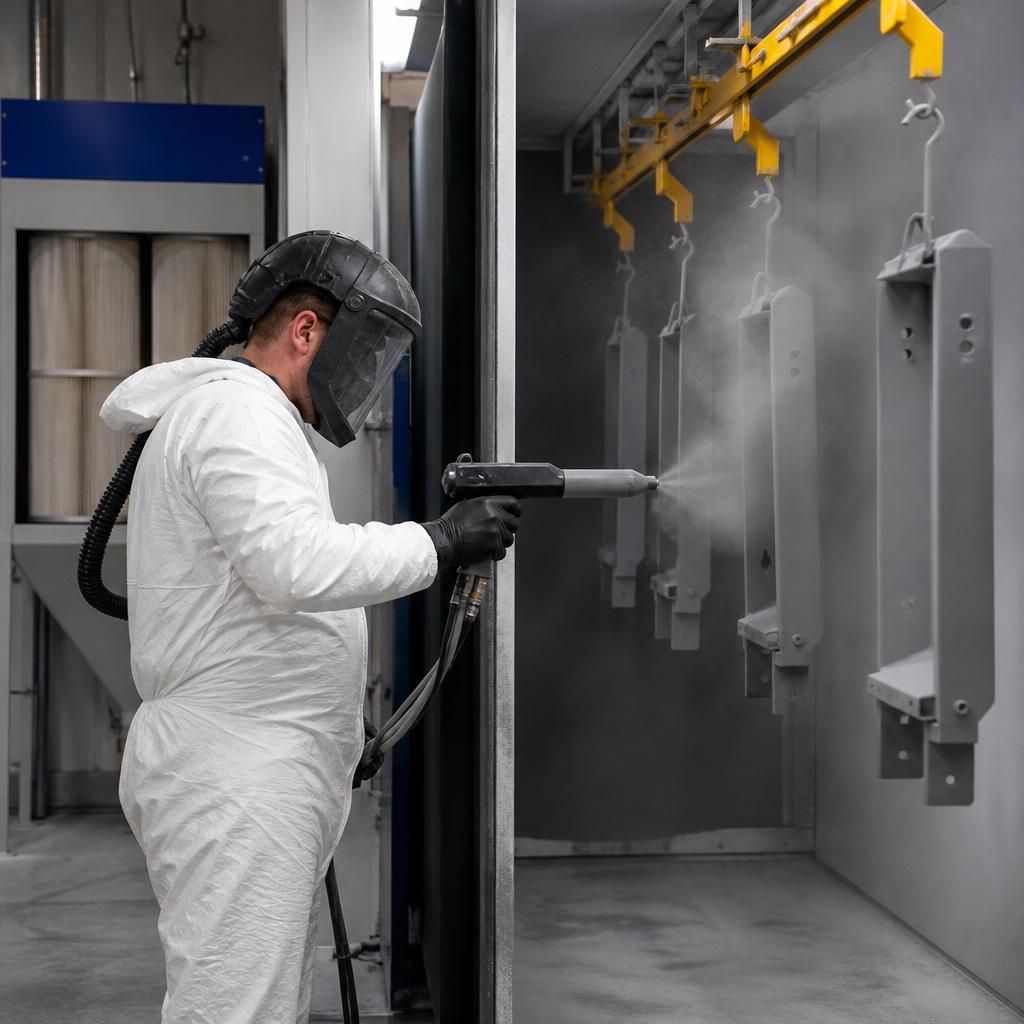
One distinct benefit of a powder coating setup is the reduced reliance on liquid solvents compared with many traditional wet-paint systems. Powder is applied as a dry material, so the coating process does not require the same solvent-based carrier to evaporate from the film. This can reduce solvent-related emissions and simplify control of paint vapours within the working environment, subject to the powder specification and the safeguards required for the installation.
This environmental advantage should not be treated as an exemption from proper controls. Powder remains a fine particulate during application, and unused material, contaminated filters and cleaning residues still need to be managed responsibly. A suitable booth, extraction arrangement and waste procedure are therefore essential. The benefit is that the setup can avoid some of the liquid paint and solvent handling associated with traditional painting while retaining a controlled industrial coating process.