

How do I ensure the powder coating setup aligns with my production needs?
Align a powder coating setup with your production needs by matching its loading capacity, part dimensions, throughput and curing process to your actual workload. Confirm that the pretreatment, application, recovery, extraction and oven systems support the materials and finishes required, while allowing the workflow to integrate safely and efficiently with your existing production line.
Ensuring a powder coating setup aligns with production needs requires translating the required finish, part mix and working pattern into practical equipment specifications. The assessment should cover the complete process, including preparation, hanging or loading, powder application, curing, inspection, handling and maintenance, rather than focusing on one item in isolation.
Start with a representative production profile. Document the metals being coated, the largest and smallest components, typical batch sizes, part weights, surface condition and the finishes required. Include occasional or specialist work as well as routine production. A setup that suits a regular run of similar brackets may be unsuitable for long fabrications, intricate parts, heavy assemblies or products that require a different coating system.
Separate essential requirements from expected future requirements. A useful specification should identify:
- the range of component shapes, weights and handling requirements;
- the coating types, colours, textures and film-build tolerances needed;
- the required appearance and performance standard for each product;
- how frequently the process will change between colours, powders or component types;
- the level of manual intervention available from the production team; and
- which operations must remain compatible with existing manufacturing equipment.
Check the workflow against the factory layout. Map how parts move from incoming inspection through to finished-goods dispatch. The setup should provide logical movement with sufficient room for loading, unloading, temporary holding and inspection. Avoid creating crossing routes between untreated and finished components, or placing handling points where they obstruct other production activities. Consider access for maintenance, delivery of consumables, extraction ducting, electrical supplies and any lifting equipment used for heavier parts.
Match the control system to the required level of repeatability. Production teams should be able to set and verify the relevant process parameters, record changes and identify deviations. Useful controls may include recipe management, temperature monitoring, powder delivery adjustment and alarms for abnormal operating conditions. The right level of automation depends on product variation, batch frequency and available operators; automation is not automatically the best choice if frequent changes make programming, cleaning or changeover more complex.
Allow for changeovers and product variation. Colour changes, different powder chemistries and changes in part geometry can affect cleaning routines, reclaim arrangements and application settings. The specification should explain how the system will be cleaned between jobs, how unused powder will be handled and whether recovered powder is suitable for the intended work. If production includes small batches or varied components, assess the time and labour involved in each changeover as part of the total operating requirement.
Confirm that utilities and building constraints have been assessed. Before selecting equipment, verify available electrical capacity, compressed-air quality and pressure, ventilation arrangements, floor loading, ceiling height and access for installation or replacement. Any limitations should be reflected in the design rather than discovered after purchase. This review should also include noise, heat, dust control and the safe separation of process areas.
Build quality checks into the operating method. Decide how parts will be checked for cleanliness, coverage, curing and visible defects, and where those checks will take place. The setup should make it practical to quarantine non-conforming work and trace the relevant batch, powder and process settings. Trial parts or representative samples can help confirm that the proposed arrangement achieves the required finish before the process is adopted for routine production.
Finally, compare the proposed setup with a written production specification and test it against normal, peak and unusual workloads. Review operator access, cleaning, planned maintenance, spare-part access and training requirements alongside output capability. This approach identifies gaps early and produces a setup that fits the actual manufacturing process, rather than one selected only on the basis of individual equipment features.
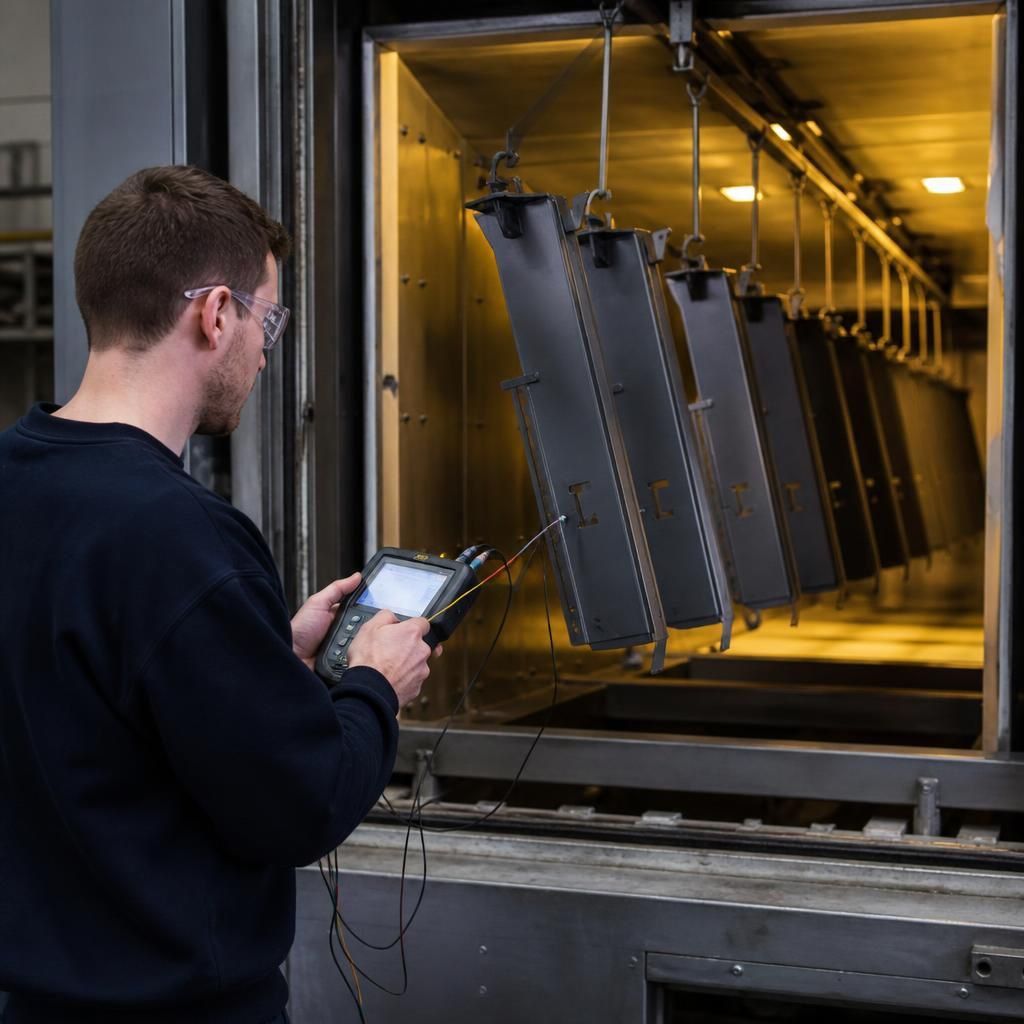
A production-aligned powder coating setup must achieve the required cure at the surface of each component, not simply display the correct air temperature inside the oven. Cure performance depends on metal thickness, component mass, loading density, hanger position and the powder manufacturer’s specified time and temperature range.
Use temperature profiling to establish how quickly representative parts heat through and how long they remain within the required cure window. Test both lightweight and thermally demanding components, particularly where the same setup will handle varied batch sizes. The results can show whether the oven capacity, conveyor speed and loading pattern are suitable, or whether the process needs revised settings, different part spacing or separate curing arrangements for certain products.