

What specialised features should I prioritise in a powder coating equipment package to ensure it meets my industry's specific requirements?
Prioritise equipment features that match your substrates, component sizes, coating types and production pattern, including adjustable application settings, suitable booth and oven capacity, reliable temperature control, and compatibility with specialist finishes such as nylon or protective coatings. For batch and varied industrial work, flexible racking, changeover arrangements, accurate curing controls and effective powder recovery can help maintain consistent results without limiting future production requirements.
Specialised features should be prioritised according to the materials, finish-critical areas, contamination risks, traceability requirements and handling methods of your industry. The right powder coating equipment package is not simply the largest available system; it is one that controls the variables most likely to affect your parts, from surface preparation and electrical grounding to film-thickness verification, data recording and safe material handling.
Match the preparation stage to the substrate. Coating performance depends heavily on what happens before powder is applied. If parts arrive with oil, mill scale, weld residue or corrosion, the package should integrate with the appropriate cleaning, rinsing, drying or mechanical preparation process. Consider whether the line needs dedicated drainage, chemical-resistant components, controlled drying and suitable extraction. For fabricated steel, aluminium and other substrates, the preparation equipment must be compatible with the material rather than treating every component in the same way.
Give particular attention to grounding and electrostatic control. Powder application relies on an electrical charge to attract particles to the workpiece. A package should therefore provide dependable grounding through the hooks, racks, contact points and workpiece supports. Poor contact can cause uneven deposition, excessive powder on some areas and weak coverage on others. Features that make contact points easy to inspect and clean are especially useful where production involves painted, oxidised or frequently reused hanging equipment.
Choose application equipment that handles difficult geometries. Hollow sections, recesses, sharp edges, folded returns and Faraday areas can all behave differently during application. Look for gun arrangements, nozzles and control functions suited to the shapes being coated, rather than selecting equipment only on nominal output. Where components have deep cavities or complex profiles, the package should allow operators to control deposition in restricted areas without overloading exposed faces. This is particularly relevant to fabricators and manufacturers processing varied component designs.
Include measurable quality-control features. A package for production work should support objective checks rather than relying solely on visual inspection. Useful provisions may include dry-film-thickness gauges, coating-coverage checks, adhesion testing arrangements and surface-finish inspection under consistent lighting. The exact checks should reflect the specification for the finished component. Automotive and appearance-critical work may require close control of colour, gloss, texture and visible defects, while structural or protective work may place greater emphasis on coverage, adhesion and resistance to the intended environment.
Prioritise traceability where parts form part of a controlled supply chain. Data logging can be valuable for recording job identification, powder batch details, operator settings, inspection results and curing records. Barcode or label integration may also help link loads to customer orders and inspection documentation. These features are most useful when several products, finishes or specifications pass through the same facility. They reduce reliance on memory and make it easier to investigate a non-conforming part without treating an entire production run as identical.
Assess material-flow and load-handling features. The package should suit the weight, dimensions and lifting method of the components. Consider loading height, access for trolleys or lifting equipment, hook strength, rack stability and the clearance needed around irregular parts. Heavy fabrications may need robust support and safe transfer points, whereas smaller components may benefit from dense hanging arrangements and quick loading systems. Handling features should also reduce the risk of parts touching one another, which can leave uncoated areas or damage the finish.
Specify extraction and filtration for the powder types and process layout. Effective air movement helps contain airborne powder and limits contamination between work areas. Filtration arrangements should be appropriate to the powder being used and accessible for inspection and servicing. If different colours or formulations are applied, consider how the equipment limits residual powder in the booth, ducting and surrounding workspace. A package that is difficult to clean can increase changeover contamination, even when its application controls are technically capable.
Build safety functions into the equipment selection. Relevant features may include guarded moving parts, emergency stops, extraction interlocks, accessible isolation points, safe access for cleaning and controls that prevent operation when essential conditions are not met. The package should be assessed against the site risk assessment and the way operators will actually load, unload, clean and maintain it. Safety is not a separate add-on: poorly positioned controls or difficult access can encourage unsafe workarounds.
Consider environmental control around the process. Humidity, airborne dust and temperature variation can affect powder handling, surface condition and finish consistency. Where the production environment is prone to dust or moisture, the package may need improved enclosure, air management or storage arrangements for powder and prepared components. Powder storage should protect materials from conditions that could cause clumping or inconsistent feed. These provisions are particularly important where the coating specification is tightly controlled.
Use a requirement matrix before comparing packages. List the substrates, component dimensions, weights, finish types, acceptable tolerances, inspection records, cleaning demands and expected product variation. Mark each requirement as essential, desirable or unnecessary, then ask suppliers to explain how each feature addresses a specific production risk. This approach prevents attention being drawn only to headline equipment capacity and highlights less visible requirements such as grounding access, inspection capability, cleaning design and safe handling.
For a business processing different industrial components, the strongest package is usually the one that provides controlled preparation, dependable grounding, suitable access for complex parts, objective quality checks, traceable records and safe material movement. Those features should be selected around the industry’s actual failure risks and specification requirements, then validated against sample parts before the equipment is committed to a production layout.
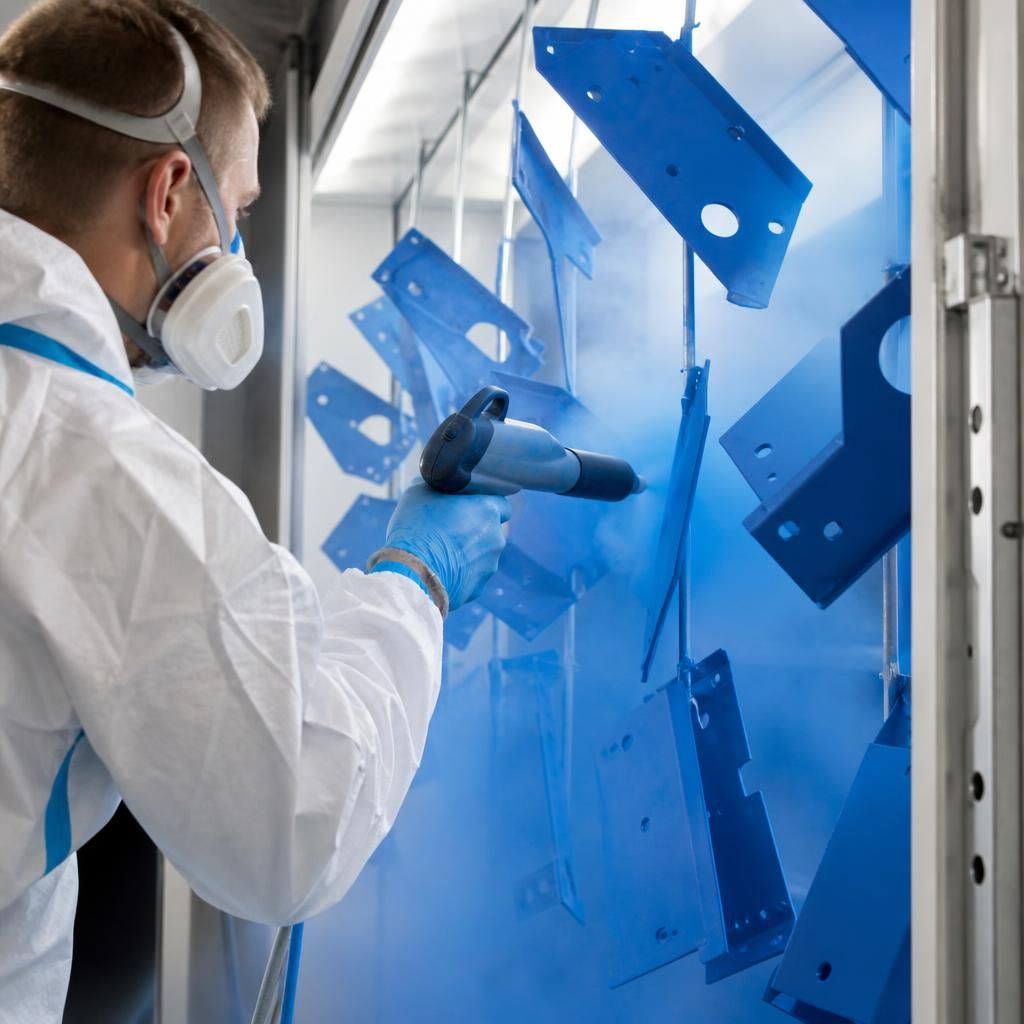
For specialist finishes such as nylon or protective coatings, prioritise equipment compatibility with the powder formulation rather than relying on standard application settings. Check that the feed system, hoses, guns, booth surfaces and cleaning arrangements are suitable for the material, and establish whether recovered powder can be reused without affecting the required finish. Where several formulations are processed, the package should support controlled separation and thorough cleaning between products to prevent contamination. The oven specification should also allow the coating supplier’s required part-temperature profile to be achieved consistently, as the correct air temperature alone does not confirm that the component has cured correctly.
Discuss the right specialised features for your powder coating equipment package
Discuss your component designs, coating specifications and production requirements with the powder-coating.co.uk team to identify which specialised equipment features are genuinely necessary. Sharing sample-part details can help focus the assessment on practical compatibility rather than headline capacity.