

How do mini powder coating machines compare to larger industrial systems in terms of flexibility and precision?
Mini powder coating machines generally offer greater flexibility for smaller components, varied batches and changing job requirements, while larger industrial systems provide more consistent precision through higher-capacity powder delivery, application controls and repeatable settings. A well-adjusted mini machine can produce accurate results within its working limits, but industrial equipment is better suited to demanding production volumes and tightly controlled repeatability.
Mini and larger industrial powder coating systems differ less in whether they can produce a good finish than in how consistently they can control the process across different parts, operators and production conditions. A mini system is usually more adaptable to varied, low-volume work, while an industrial installation offers greater control over repeatability, process stability and integration with handling, curing and powder recovery equipment.
Flexibility of mini systems
Mini machines are often suited to workshops processing mixed batches, prototypes, replacement parts or components that change frequently. Their smaller scale can make it easier to alter gun settings, reposition a part and move between colours or powder types without preparing a full production line. They also allow an operator to work directly around awkward shapes rather than relying on fixed gun positions or a conveyor arrangement.
This flexibility is useful where the parts do not follow one standard route. Components may differ in size, geometry, masking requirements and required finish, so the operator can adapt the application technique from one job to the next. The limitation is that this adaptability depends heavily on operator skill. Manual changes in gun distance, angle, movement speed and overlap can introduce variation between parts.
What larger industrial systems add
A larger system normally provides a more structured process. It may combine a spray booth, automated or reciprocating guns, controlled powder feed, part handling equipment, curing equipment and powder recovery. Once the process has been set up for a particular component, the same sequence can be repeated with less reliance on individual operator movements.
This does not mean that an industrial system is automatically more accurate for every job. Its advantages are most apparent when the same or similar components are processed repeatedly and the equipment can be calibrated around a defined set of conditions. A highly automated system can be less convenient when each item requires a different spray path, masking arrangement or powder change.
How precision should be assessed
Precision in powder coating has several meanings. It can refer to:
- consistent coating thickness across a part;
- reliable coverage in recesses, corners and around edges;
- repeatable colour and surface appearance;
- controlled powder deposition with limited overspray;
- accurate repeatability between batches; and
- correct curing of the applied coating.
A mini machine can achieve controlled results when the part is accessible, the operator uses a consistent technique and the equipment is correctly adjusted. Larger systems generally make repeatability easier by controlling more of the application path and powder delivery. However, automation cannot compensate for poor preparation, unsuitable settings or an incorrect curing process.
Factors affecting the result on either system
The equipment is only one part of the coating process. Clean, correctly prepared metal provides a more reliable base than a contaminated or poorly treated surface. Parts must also be properly earthed so that the electrostatic charge can attract powder effectively. Poor grounding can lead to weak deposition, uneven coverage and powder accumulation in unwanted areas.
Gun voltage and current settings, powder flow, compressed-air quality, gun-to-part distance and spray angle all influence deposition. Excessive charge can contribute to back-ionisation or uneven coverage, particularly in corners and recesses. Excessive powder flow may reduce control, while insufficient flow can make coverage slow or inconsistent. These settings need to match the powder, component geometry and required finish rather than being treated as fixed values.
Curing is another important distinction between a coating that looks acceptable and one that has developed the required performance. The metal must reach the powder manufacturer’s specified cure conditions, taking account of the part’s mass and heat-up behaviour. A small application unit may still produce a technically sound finish if curing is controlled separately; a large spray system will not deliver a durable result if the oven process is unsuitable.
Part geometry and operator access
For open, straightforward components, automated guns on a larger system can provide highly repeatable coverage. Complex parts can be more demanding. Faraday cage effects may prevent powder from entering internal corners, while recessed areas and shielded surfaces require a suitable spray angle and carefully controlled charge.
A mini system may offer an advantage for one-off or complex items because the operator can change position and approach the part from several directions. That advantage is practical rather than automatic: it still requires a disciplined spray pattern and awareness of areas that are likely to receive too much or too little powder. For repeated complex parts, a larger system can be configured with additional guns or programmed movements, but this requires more process development.
Changeovers and powder handling
Frequent colour or material changes place different demands on the two system types. A smaller arrangement may involve fewer components to clean, allowing a workshop to respond more easily to mixed work. Larger systems may include powder hoses, feed equipment, booth surfaces and recovery paths that need thorough cleaning to prevent contamination between colours.
On the other hand, a larger system can offer more stable powder delivery during sustained production. Consistent fluidisation and controlled feed help maintain an even spray pattern, particularly when the system is operating for long runs. A mini system can provide adequate control for smaller batches, but its powder feed and container capacity must be appropriate for the material being applied and the duration of the job.
Which system is more precise in practice?
For short runs and varied components, a properly adjusted mini machine may provide the more practical form of precision because it permits close operator control and avoids unnecessary automated setup. For repeated production of consistent parts, a larger industrial system is more likely to provide better batch-to-batch uniformity because its settings, movement and powder supply can be standardised.
The most suitable choice should therefore be based on the type of precision required:
- Variable part dimensions and frequent changes: prioritise manual control, accessible equipment and straightforward cleaning.
- Repeated components and defined production routes: prioritise stable powder delivery, programmed movement and consistent part handling.
- Complex geometry: assess gun access, electrostatic control and the ability to adjust the spray path.
- Appearance-critical work: assess grounding, powder consistency, curing control and the process used to prevent colour contamination.
- Higher production demand: assess booth capacity, recovery, oven loading and how reliably the system can maintain its settings throughout the run.
In practical terms, mini equipment is not simply a less precise version of an industrial system. It is a smaller and more operator-dependent method that can be well suited to flexible batch work. Larger systems provide stronger process control where production is repetitive and the cost of setup is justified. The deciding issue is whether the work benefits more from adaptable manual access or from repeatable, integrated control across the complete coating process.
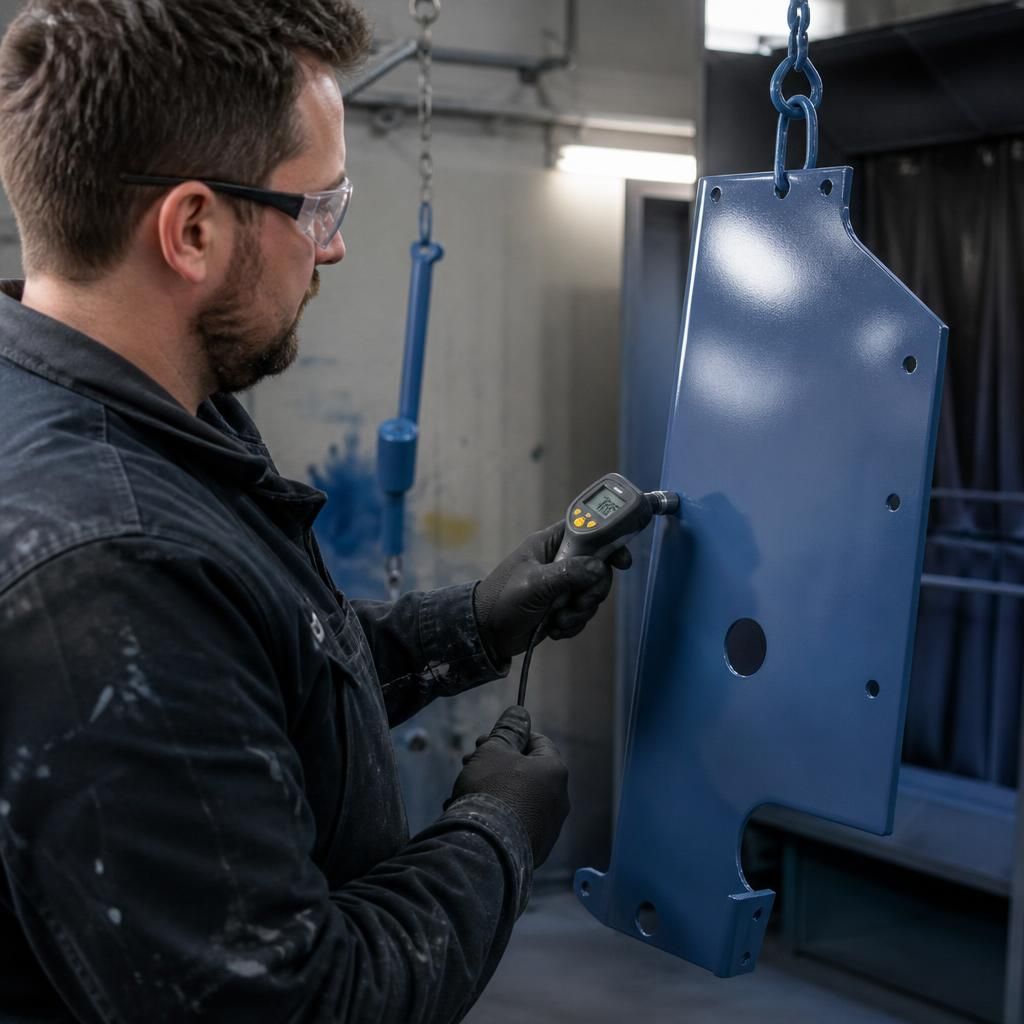
Precision should be verified by measuring the finished coating, not judged solely by the size of the equipment. On work produced with a mini powder coating machine, a coating thickness gauge, visual inspection and checks on representative parts can show whether the manual application is producing the required result. These checks are particularly useful when component shapes or batch sizes vary.
For a larger industrial system, the same principle applies, but the results can be linked to recorded gun settings, powder-feed conditions, part handling and curing information. Keeping these records helps distinguish a genuine process improvement from a finish that happens to look consistent. In both cases, precision comes from checking and controlling the complete process rather than assuming that automation alone guarantees accuracy.