

How can the integration of fluidizing hoppers improve the consistency of powder application in my setup?
Integrating a fluidising hopper aerates the powder so it remains evenly suspended and feeds the gun at a more consistent rate. This helps maintain uniform coating thickness, reduce interruptions caused by powder compaction and support more repeatable results across batches.
Integrating a fluidising hopper improves powder application consistency by creating a controlled, stable interface between the powder supply and the spray gun. Rather than relying on powder moving directly from a static container, the hopper conditions the material before it reaches the pump, helping the coating system respond more predictably to changes in demand.
How the hopper supports a consistent process
- More uniform powder condition: Powder can settle, compact or form denser areas during storage and handling. A correctly adjusted hopper keeps the material in a suitable condition for collection by the powder pump.
- Steadier transfer: The hopper provides a defined feed point, making it easier to maintain the relationship between powder delivery, gun output and the movement of the component through the booth.
- Better control at the gun: Once the powder supply is stable, operators can make meaningful adjustments to gun voltage, current, air settings and spray distance. If the supply is fluctuating, changing these settings may mask the real cause of an uneven finish.
- More repeatable batch work: A hopper makes the powder supply part of a repeatable process rather than leaving feed behaviour to the condition of the container and the way powder has settled inside it.
Integration with the rest of the equipment
The hopper should be selected and installed as part of the complete powder delivery arrangement. Its capacity needs to suit the quantity and type of work being processed, while the pump, powder hose and spray gun must be compatible with the intended feed rate. Excessively long or sharply bent hoses can affect powder transport, so the route from hopper to gun should be kept practical and inspected during commissioning.
The hopper also needs to sit securely and remain accessible for filling, cleaning and inspection. Its position should allow the operator to monitor the powder level without disrupting the application process. Where the system uses automatic or semi-automatic controls, the hopper’s output should be considered alongside gun triggering, conveyor movement and any programmed coating sequence.
Powder condition and material handling
A fluidising hopper cannot correct powder that is contaminated, damp or unsuitable for the application. Powder should be stored in accordance with the coating manufacturer’s instructions and protected from moisture and foreign material. Before it enters the hopper, it may need to be checked for lumps or contamination and passed through the appropriate sieve for the equipment and coating specification.
Fresh powder and reclaimed powder should be handled in a controlled way if both are used. Their proportions and condition can influence spray behaviour, colour appearance and finish. Keeping the material mix consistent helps ensure that changes in the coating result are not incorrectly attributed to the hopper or gun settings.
Setting up the hopper
- Fill the hopper with clean, suitable powder without overfilling it.
- Allow the powder to reach a stable operating condition before assessing the spray pattern.
- Adjust the fluidising air carefully. Too little may leave the powder difficult to collect, while too much can make the material unstable and interfere with controlled transfer.
- Set the pump and conveying air in relation to the required powder output, hose arrangement and gun distance.
- Test the spray pattern on a suitable test piece before coating production components.
- Record the settings that produce the required result so they can be repeated for later batches.
Settings should be changed one at a time where possible. This makes it easier to identify whether a problem comes from powder condition, air balance, gun adjustment, grounding, component preparation or movement through the booth.
Maintenance requirements
Regular cleaning is important because residual powder can affect the next colour or material. Empty the hopper when required, remove deposits from internal surfaces and check the fluidising membrane for damage or blockage. Inspect powder hoses, pump connections and seals for wear, and confirm that air lines are dry and unobstructed. A damaged membrane or restricted air supply can alter the way powder behaves even when the gun settings have not changed.
Cleaning should also be carried out between incompatible powders or colour changes according to the equipment manufacturer’s procedure. Avoid introducing tools or compressed air in a way that damages the hopper components or disperses powder unnecessarily. Maintenance records can help link changes in application quality to worn parts, altered settings or a change in powder batch.
When a hopper will not solve the problem
Uneven coverage is not always a powder-feed issue. Poor preparation, inadequate grounding, unsuitable gun distance, incorrect voltage, blocked nozzles, inconsistent component positioning and unsuitable curing conditions can all affect the final result. A fluidising hopper is most effective when these parts of the process are already controlled.
For that reason, assess the complete setup rather than treating the hopper as an isolated upgrade. The intended powder, component geometry, production volume and level of operator control should all be considered before choosing the hopper size and supporting equipment. Properly integrated, the hopper gives the application system a more controlled powder source, making other process settings easier to establish, monitor and repeat.
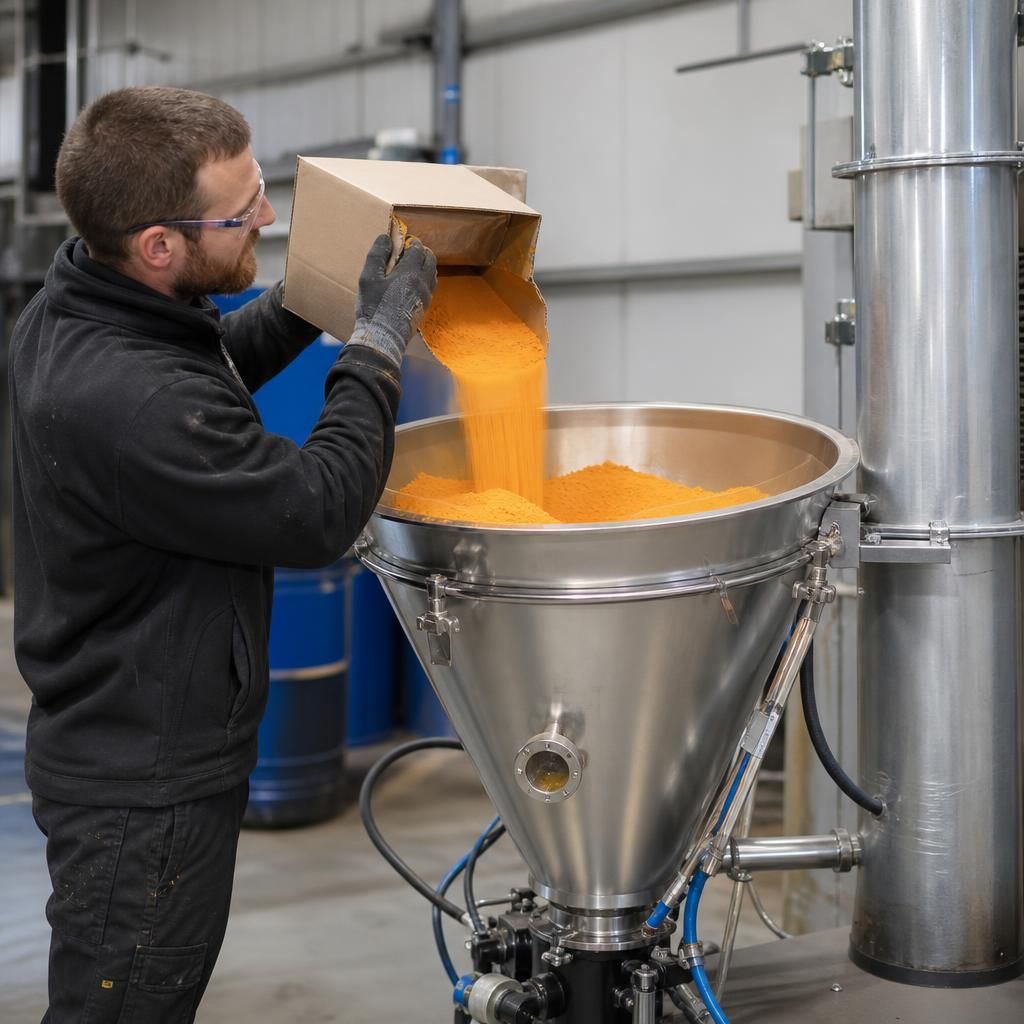
Maintaining a consistent powder level is an important part of integrating a fluidising hopper. The depth and condition of the powder affect how readily it is picked up by the pump, so large changes in level can alter feed behaviour even when the spray-gun settings remain unchanged.
Replenish the hopper in controlled amounts and follow the equipment manufacturer’s specified operating range. Avoid allowing the supply to become excessively low, and check that newly added powder is compatible with the material already in the hopper. Marking the normal operating level can also help operators identify unusual consumption or feed changes before they affect a production batch.