

What specific features should I look for in a fluidising hopper to ensure it integrates seamlessly with my existing powder coating system?
Look for a fluidising hopper with adjustable, even airflow, suitable capacity, compatible powder and feed connections, and controls that integrate with your existing conveyor, pump or spray equipment. Practical features such as accessible cleaning points, removable components, effective earthing, level monitoring and construction suited to the coating material also support reliable, safe operation.
A fluidising hopper integrates effectively when its mechanical, pneumatic, electrical and control interfaces match the existing powder coating line. Beyond airflow and capacity, assess the hopper’s footprint, mounting arrangement, powder inlet and outlet geometry, sensor compatibility, material handling characteristics, cleaning requirements and safety provisions before selecting a unit.
Check the physical layout first. Confirm the available floor space, overall height, access clearances and position of nearby equipment. The hopper must allow operators to fill, inspect and clean it without obstructing the powder pump, spray equipment, conveyor or other line components. Check the mounting points and load-bearing requirements, including the weight of the hopper when filled with powder. A unit that fits the available space but prevents access to filters, valves or inspection covers will be difficult to operate and maintain.
The inlet and discharge arrangements also need to match the existing installation. Compare the hopper’s powder inlet size, outlet position, flange or hose connections and discharge height with the current powder recovery, feed and spray equipment. Avoid relying on adapters unless they are suitable for powder service and do not create ledges, narrow restrictions or areas where material can accumulate. Smooth transitions help reduce residual powder and make colour or material changes easier to manage.
Assess the powder path as a complete system. The hopper should suit the pump, injector or powder feed device already in use. Consider whether the feed equipment requires a particular pickup position, immersion depth, hose diameter or powder consistency. The hopper should provide a stable, repeatable supply without allowing powder to bridge above the pickup point or compact around it. This is especially important where the line handles powders with different bulk densities, particle sizes or flow characteristics.
Material compatibility is another important feature. The surfaces contacting the powder should resist abrasion, impact and contamination, while seals, gaskets and flexible hoses should be suitable for the coating material and operating conditions. Nylon and other specialist powders may require particular attention to moisture sensitivity, static behaviour and cleaning methods. Ask for confirmation that the proposed materials are appropriate for the powders being used rather than assuming that a hopper designed for standard thermoset powder will suit every application.
Review the control interface. A hopper may need to exchange signals with the line’s control panel, powder pump, conveyor or automatic refill equipment. Look for clearly defined inputs and outputs, compatible voltage and signal types, and a control arrangement that allows the hopper to indicate conditions such as low powder level, high level, loss of air supply or a fault. If the existing system uses a programmable controller, confirm how alarms, interlocks and start/stop commands will be handled. A manual control panel may be adequate for a simple installation, whereas a more automated line may require remote status signals and fault monitoring.
Level sensing should be selected according to the powder’s behaviour. A sensor must not give unreliable readings because powder clings to the vessel wall, becomes aerated or varies in density. Confirm the sensor’s position, adjustment range and cleaning access, and establish what the system does when a low-level or high-level condition is detected. The safest arrangement is one that prevents the feed equipment from running without sufficient powder and avoids uncontrolled filling.
Specify the utility requirements before installation. Confirm the compressed-air quality, pressure range, air consumption, electrical supply and control wiring required by the hopper. The existing air preparation system may need suitable filtration, regulation and moisture control. Electrical provisions should include appropriate isolation and cable routing, with the installation assessed for the powder environment and the applicable site safety requirements. Where the system is installed in a potentially explosive atmosphere, the equipment and installation should be checked against the site’s hazardous-area assessment and relevant requirements by a competent person.
Practical safety features include a secure lid, protection against accidental access to moving or pressurised parts, emergency isolation and clearly identified operating controls. The hopper and connected equipment should form part of the site’s powder-handling and static-control arrangements. Confirm that inspection and maintenance can be carried out without exposing operators to unnecessary powder release or requiring them to reach over operating machinery.
Consider cleaning and changeover design as part of integration. Internal corners, welds and fittings should not create unnecessary powder traps. The hopper should permit the removal or isolation of components that need cleaning, such as pickup tubes, screens, valves and transfer hoses. If the line changes colour or coating type, check whether the hopper can be emptied fully and whether its construction supports the site’s approved cleaning process. This reduces the risk of cross-contamination and helps maintain consistent feed conditions.
Before purchase, prepare a compatibility schedule covering:
- Available footprint, height, mounting points and filled weight;
- Powder inlet, outlet, hose, flange and pickup dimensions;
- Powder type, bulk density, particle characteristics and moisture sensitivity;
- Compressed-air quality, pressure, consumption and connection requirements;
- Electrical supply, control signals, alarms and interlocks;
- Level-sensor type, position and connection to the line controls;
- Cleaning access, removable parts and changeover procedure;
- Safety, isolation, static-control and hazardous-area requirements where applicable.
Finally, plan a controlled commissioning test using the actual powder and operating equipment. Check that filling, fluidisation, pickup, conveying, alarm signals and shutdown interlocks work together without causing powder leakage, bridging or unstable feed. Confirm the settings and connections against the equipment documentation, then record the final configuration so future maintenance or system changes do not compromise the integration.
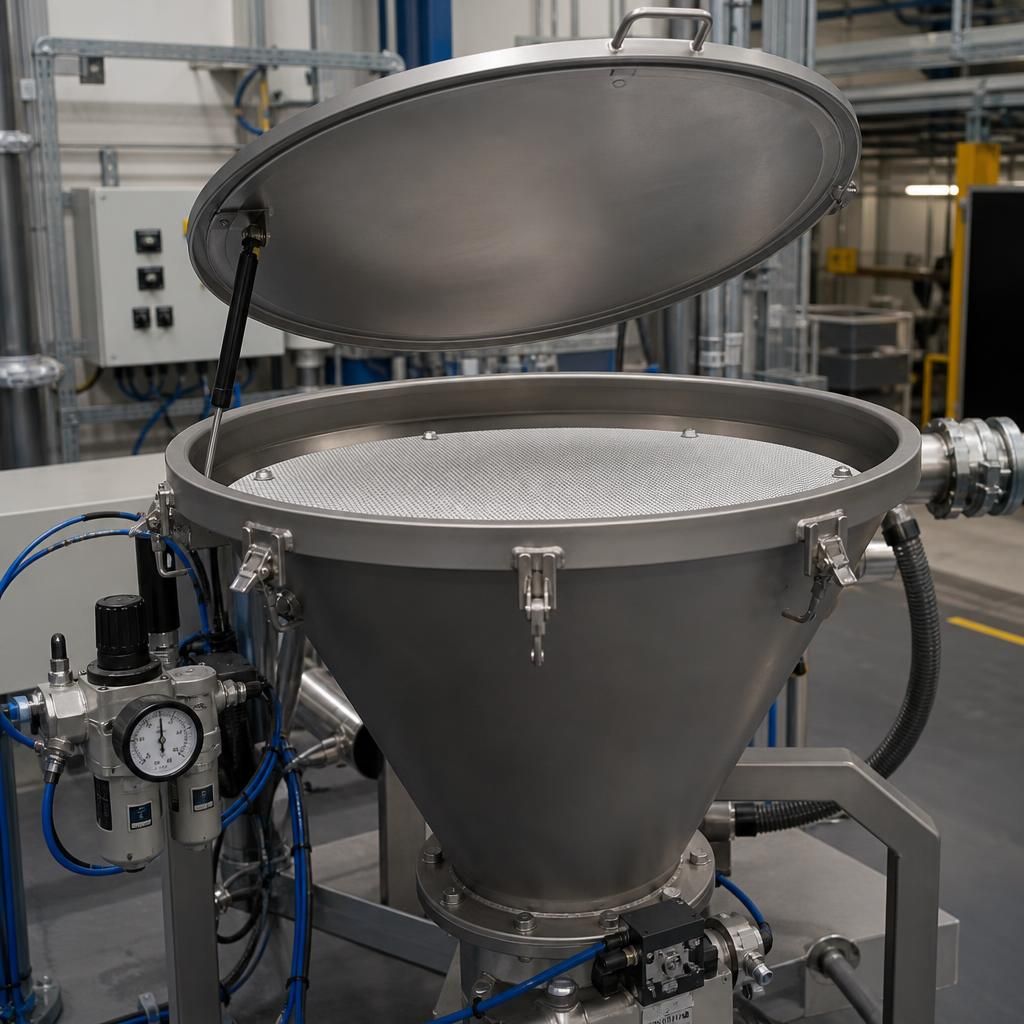
The fluidising base is a key feature because it determines how evenly powder is aerated before it reaches the pickup point. Look for a porous plate or membrane that distributes air across the working area without creating concentrated jets, dead zones or excessive turbulence. A rigid, correctly supported base should remain level during operation and resist powder penetration, as blocked or damaged sections can cause uneven feed and localised powder compaction.
For closer integration with an established system, consider separate airflow adjustment or monitoring for the hopper’s fluidising zones. This allows the air supply to be matched to the powder’s flow characteristics rather than relying on a fixed setting. A pressure gauge or accessible test point can also help operators confirm that the hopper is receiving the expected air supply during commissioning and fault diagnosis, without dismantling the powder feed equipment.
Discuss Your Fluidising Hopper Integration Requirements
Discuss your existing powder coating system with our team to review fluidising hopper compatibility, connection requirements and application needs. Share your powder type and current equipment details so the integration requirements can be assessed before specifying a suitable hopper.