

What considerations should be taken into account for customising a fluidising hopper to suit specialized powder coating applications?
Customising a fluidising hopper for specialist powder coating applications requires matching its capacity, geometry, airflow distribution, materials and control system to the powder’s properties and the coating equipment it supplies. Powders such as nylon or protective formulations may need careful control of fluidisation, contamination prevention, discharge arrangements, grounding and cleanability to maintain consistent flow and finish quality.
Customising a fluidising hopper for a specialised powder coating application means configuring it around the complete powder-handling duty, not simply selecting a vessel of the right size. The specification should reflect the coating line’s feed method, operating sequence, powder changeover requirements, recovery arrangements, operator access, safety controls and the level of process consistency required.
Start with the powder’s operating behaviour. Laboratory or supplier information should be reviewed alongside practical production experience. Relevant characteristics include bulk density, particle-size distribution, moisture sensitivity, tendency to compact and susceptibility to segregation. A powder that appears free-flowing in storage may behave differently after transport, vibration or prolonged residence in the hopper. Where a formulation is prone to bridging, rat-holing or settling, the hopper may need a different internal arrangement or a more closely controlled operating sequence.
The specification should also define how the hopper will be used during production:
- Whether it supplies one spray gun, several guns or an automated reciprocator system.
- Whether powder is added manually, transferred from a larger container or returned through a recovery circuit.
- Whether the line runs in batches, continuously or with frequent colour and formulation changes.
- How much reserve powder is needed to prevent interruptions without leaving excessive material in the vessel.
- Whether the hopper must accommodate reclaimed powder, virgin powder or a controlled blend of both.
These points affect the required feed stability and the way the hopper interfaces with pumps, hoses, sieves, recovery equipment and the spray booth. A hopper intended for a single, stable product may be unnecessarily complex if it is later used for frequent product changes; conversely, a basic arrangement may be unsuitable where several application devices need a uniform supply.
Control philosophy is an important customisation decision. The operator should be able to adjust the process without making uncontrolled changes to powder delivery. Useful provisions can include regulated air settings, level indication, low-level warnings, pressure monitoring and alarms for abnormal conditions. For an automated line, signals from the hopper may need to connect with the coating equipment’s control system so that powder feed, replenishment and line stoppage occur in a predictable sequence. Manual systems still benefit from clear adjustment points and repeatable settings.
Controls should be selected for the application rather than added as standard accessories. Excessive automation can make a small batch operation harder to clean and operate, while insufficient monitoring can leave an automated line dependent on visual checks. Set points should be documented and verified during commissioning, with separate operating recipes where different powders or coating schedules require materially different settings.
Powder transfer and recovery arrangements should be assessed together. Pipe runs, hose lengths, bends and elevation changes can influence the stability of feed from the hopper to the guns. The design should minimise unnecessary restrictions and provide access to points where powder could accumulate. If overspray is recovered, the specification should establish how recovered material is screened, identified and reintroduced, rather than allowing an uncontrolled return stream to affect the coating process.
For applications involving frequent changes, the value of rapid strip-down should be considered against the need for robust construction. Removable contact parts, tool-light access and clearly identified connections can reduce the risk of old powder remaining in the system. This is particularly important where a small quantity of residual material could affect colour, texture or the performance of a specialist coating. A written changeover procedure should accompany the equipment design.
Safety and compliance requirements need to be defined before manufacture or installation. Powder coating materials can create combustible dust risks when dispersed in air, so the assessment should cover ignition sources, static control, ventilation, earthing, electrical equipment and the intended installation environment. The hopper should be compatible with the site’s dust-management arrangements and risk assessment. Access covers, inspection points and interlocks should not create avoidable exposure to moving or pressurised equipment.
Operator ergonomics also influences the specification. Powder loading height, container handling, visibility of the contents, access for inspection and the position of controls can affect safe and consistent use. Where operators must work around the hopper during cleaning or replenishment, these activities should be considered at the design stage rather than treated as maintenance details afterwards.
Before finalising a customised hopper, document the powder types, feed demand, operating modes, changeover frequency, recovery method, control interfaces and site constraints. A trial using the intended powder is preferable where its flow characteristics are uncertain. Commissioning should then confirm stable feed across the normal operating range, satisfactory response to low-level conditions, correct operation of alarms and acceptable performance after a changeover. This process turns a general-purpose hopper into equipment matched to the actual coating application.
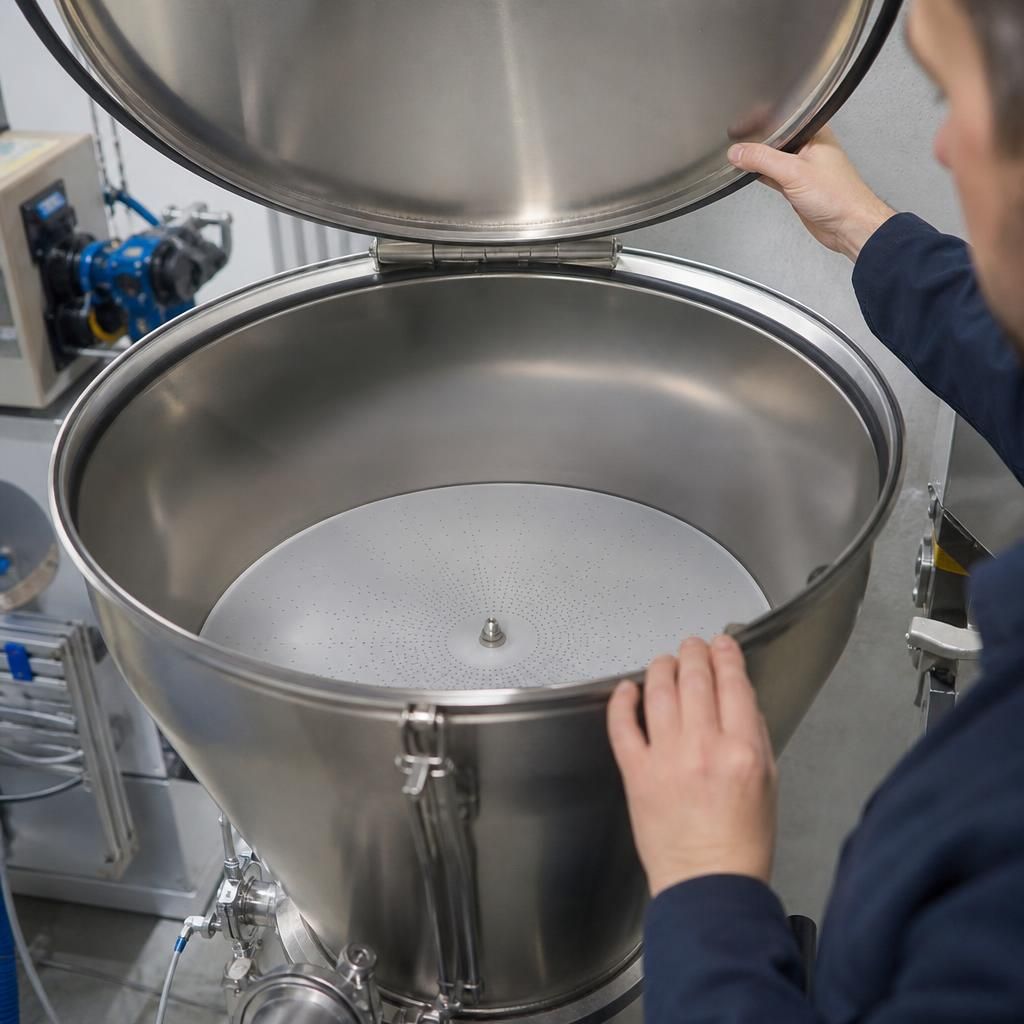
The fluidising plate or membrane should be specified as carefully as the hopper itself because it determines how evenly air reaches the powder bed. Its material, permeability, active area and sealing arrangement need to suit the powder’s particle size, bulk behaviour and cleaning method. An unsuitable plate can create localised aeration, dead zones or unstable discharge even when the air supply is correctly regulated.
For a wide or irregularly shaped hopper, a single air-feed arrangement may not distribute air evenly across the full powder bed. Zoned or separately balanced sections can provide more consistent fluidisation, provided the boundaries do not create areas where powder can settle. The design should also allow the plate to be inspected and replaced without disturbing unrelated components. During acceptance testing, observe the powder surface and discharge behaviour at different fill levels rather than assessing performance only with a full hopper.
Discuss Customising a Fluidising Hopper for Your Powder Coating Application
Discuss your powder characteristics, production requirements and existing equipment with the powder-coating.co.uk team to establish whether a customised fluidising hopper is appropriate. Providing details of the powder, feed arrangement and changeover requirements will support a more relevant specification.