

What are the benefits of using a fluidising hopper for different types of powder coatings, such as nylon and protective coatings?
A fluidising hopper gently aerates powder to keep it mobile and promote a steady, controlled feed during coating. For nylon and protective powders, this can help accommodate differing flow characteristics, supporting more consistent powder application and finish quality.
A fluidising hopper benefits different powder coatings by conditioning the powder before it reaches the application equipment, allowing the system to handle variations in material behaviour more predictably. This is particularly useful when comparing nylon powders with protective coatings, because each may differ in particle size, bulk density, moisture sensitivity and tendency to compact during storage or transfer.
More reliable handling of nylon powders
Nylon powder is a thermoplastic material and can behave differently from many standard thermoset powders. Its physical characteristics may make consistent transfer and metering more dependent on the hopper design and operating settings. A suitable fluidising hopper can help reduce compaction in the feed supply and limit interruptions caused by powder forming a stable mass above the outlet.
The result is a more predictable supply to the spray or application equipment. This helps the operator maintain the required coating build without repeatedly adjusting the feed system to compensate for changes in powder movement. For nylon applications, that can be important where the specified film thickness and coverage must be maintained across complex metal components.
Advantages for protective coatings
Protective powders are selected for purposes such as resisting corrosion, abrasion, chemicals or weathering. They may be applied to fabricated parts, infrastructure components, vehicle items or other metalwork where incomplete coverage can affect the function of the finished coating. A fluidising hopper supports a stable powder supply so that the application equipment can work within its intended operating range.
For heavier, denser or specially formulated protective powders, the hopper may also help reduce separation between particles during handling. This does not replace correct powder formulation, preparation or application settings, but it can help the material reach the application stage in a more uniform condition. That is useful when coating coverage, edge protection and film build need to be controlled across a batch.
Benefits across different powder types
- Reduced bridging and rat-holing: carefully controlled air introduced through the fluidising medium can help prevent powder forming voids or arches above the outlet.
- Improved feed stability: the application equipment receives powder from a more consistent supply rather than relying on material collapsing unpredictably into the discharge area.
- Better control of material usage: a stable feed can make it easier to identify whether variations are caused by the powder, the application settings or the component being coated.
- More suitable handling of specialist materials: powders with unusual flow properties can often be managed more effectively when air pressure, air volume and hopper capacity are matched to the material.
- Fewer process interruptions: reducing compacted powder and inconsistent discharge can limit the need for manual intervention during production runs.
- Greater repeatability between batches: recording suitable hopper settings for each powder can help operators establish a consistent starting point when the same material is used again.
Why the powder must influence the hopper settings
Fluidisation is not a universal setting that can be applied identically to every powder. Excessive air can make some materials too turbulent, encourage dusting or affect the way powder is drawn into the application equipment. Insufficient air may leave denser or compacted material poorly conditioned. The correct balance depends on the powder’s formulation, particle distribution, moisture content, bulk density and intended feed rate.
Nylon and protective powders should therefore be assessed separately rather than treated as interchangeable materials. Where several coating types are used, the operating procedure should identify the appropriate settings and any requirements for conditioning, sieving or storage before the powder enters the hopper.
Changeovers and contamination control
A hopper can support efficient use of multiple powder types only when changeovers are properly managed. Residue from a nylon coating can contaminate a protective coating, and remnants of a strongly coloured or specially formulated powder may affect the appearance or performance of the next batch. Cleaning should include the hopper, fluidising surface, outlet and connected feed lines, with particular attention to areas where powder can settle.
Separate equipment or clearly defined cleaning procedures may be appropriate where the coatings have materially different specifications. The hopper should also be kept dry and protected from unsuitable storage conditions, since moisture and contamination can alter powder flow and affect application behaviour.
Choosing a suitable fluidising hopper
The hopper should be selected according to the powders being processed, the required batch size, the feed equipment and the production pattern. Important considerations include:
- compatibility with the powder’s density, particle size and flow characteristics;
- control over air pressure and air volume;
- the design and accessibility of the fluidising membrane;
- outlet geometry that supports reliable discharge;
- materials and internal finishes that allow thorough cleaning;
- capacity appropriate to the application without leaving powder stored unnecessarily long;
- connections and controls compatible with the existing powder coating equipment.
A fluidising hopper is not a substitute for correct surface preparation, earthing, spray settings, curing or powder storage. Its benefit is to improve the condition and movement of the powder before application, giving operators a better-controlled material supply for both nylon and protective coating work. The strongest results come when the hopper, powder and application system are assessed as one process rather than selected independently.
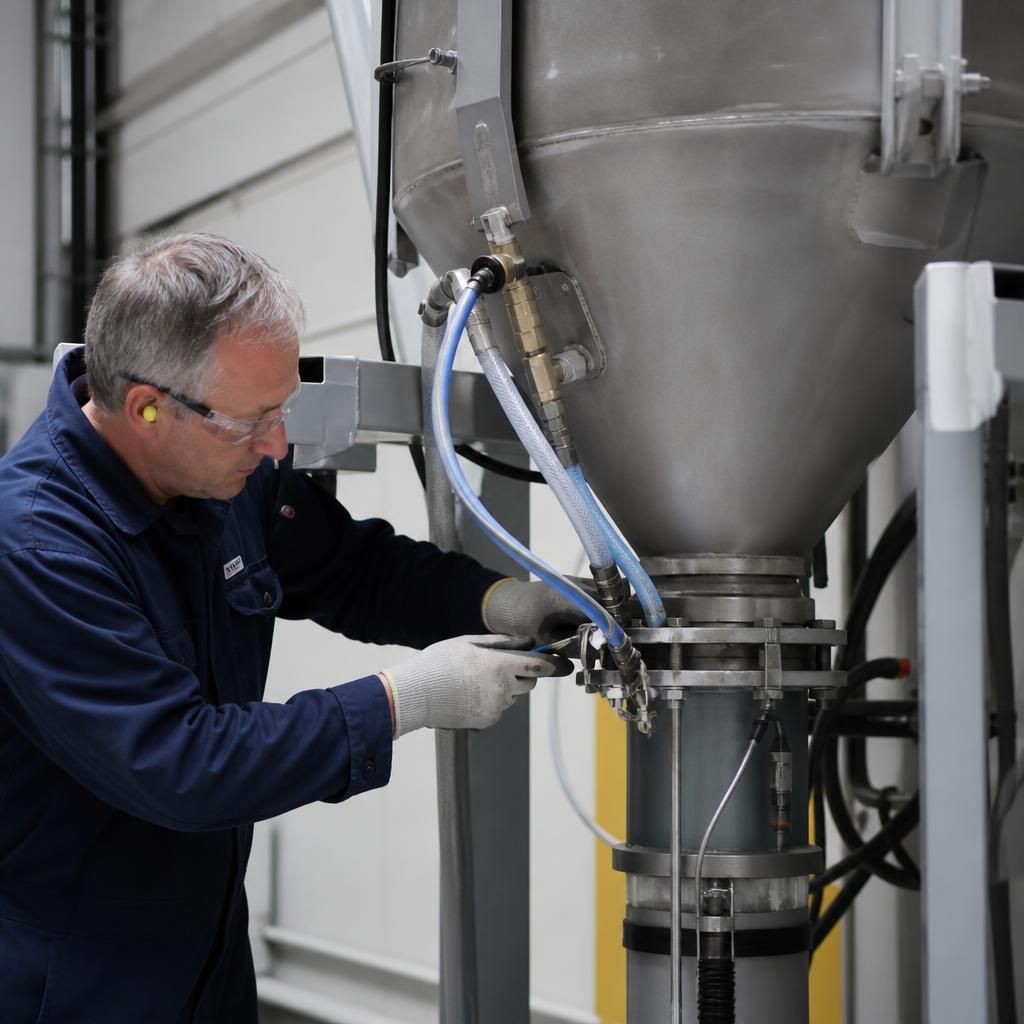
The quality of air distribution within a fluidising hopper can be as important as the powder itself. Clean, dry air introduced evenly through the fluidising membrane helps condition nylon and protective powders consistently across the hopper, rather than creating localised areas of excessive movement or poor powder release.
This supports more stable operation by reducing the risk that material near the outlet behaves differently from material at the surface. The fluidising membrane, air supply and seals should therefore be checked as part of process control. A damaged, blocked or contaminated membrane can undermine the benefits of the hopper even when the powder and application equipment are suitable.
Discuss Fluidising Hopper Options for Your Powder Coatings
Discuss your nylon or protective coating requirements with the powder-coating specialist, including the powder characteristics, component sizes and production volumes involved. This will help establish whether a fluidising hopper is suitable and which configuration best fits your existing coating process.