

How does incorporating a fluidising hopper impact the overall efficiency and quality of my powder coating process?
Incorporating a fluidising hopper can improve powder coating efficiency by maintaining an even powder supply and reducing interruptions caused by settling or inconsistent feeding. It can also support more uniform coating thickness and finish quality, provided the airflow, powder condition and application settings are correctly controlled.
Incorporating a fluidising hopper can improve the efficiency and quality of a powder coating process by conditioning powder for controlled extraction and more repeatable application. Its main effect is on powder handling and feed stability; it does not replace the need for correct surface preparation, earthing, spray-gun settings or curing.
Efficiency gains come from more controlled powder handling. Powder stored in a hopper can compact, bridge or develop uneven density, particularly after transportation or extended storage. Fluidising air passes through a porous membrane or plate beneath the powder, loosening it so that it behaves more consistently during extraction. This can make the feed system easier to control and reduce the need for operators to intervene manually.
- More predictable gun operation: a steadier powder condition helps the pump and spray gun receive material in a controlled way.
- Fewer process adjustments: operators can spend less time correcting feed behaviour and more time maintaining the defined coating settings.
- Improved batch repeatability: consistent powder presentation makes it easier to reproduce application conditions between parts and production runs.
- Better use of production capacity: reliable powder handling helps the rest of the line operate without being limited by avoidable feed problems.
The quality benefit is primarily improved process control. When the powder reaches the gun in a consistent condition, the operator has a better basis for controlling deposition, coverage and visual appearance. This is particularly important on components with different geometries, recessed areas or large surface areas, where fluctuations in feed can contribute to variations in build or finish.
However, a hopper cannot correct every coating defect. Orange peel, poor edge coverage, pinholing, colour variation and adhesion failure may also result from contamination, unsuitable pretreatment, incorrect electrostatic settings, excessive film build, inadequate grounding or an incorrect cure schedule. The hopper should therefore be viewed as one part of a controlled coating system rather than as a standalone quality solution.
Correct fluidisation is essential. Too little air may leave the powder compacted, causing restricted extraction or irregular feeding. Too much air can make the powder excessively agitated, potentially introducing turbulence, dust or unstable conveying conditions. The appropriate air setting depends on the powder’s formulation, particle characteristics, moisture condition and the hopper design. Air should be introduced gradually and adjusted while observing the powder’s behaviour rather than set solely by a fixed pressure value.
Powder condition also affects the result. Moisture, contamination, excessive storage time and repeated exposure to heat can alter how readily a powder fluidises. Sieving or filtering may be necessary where the application requires it, while different powders should be kept segregated to prevent colour or formulation contamination. Nylon and other specialist protective powders may require particularly careful handling because their flow characteristics and application requirements can differ from standard decorative powders.
Integration with the wider system determines whether the potential benefit is realised. The hopper, powder pump, conveying hoses, spray guns, control unit and reclaim arrangement should be compatible in terms of capacity, air supply and powder flow. Hose routing, bends and length can affect conveying behaviour, while poor sealing can allow moisture or contamination into the powder. The hopper should also be positioned so that filling, inspection and cleaning can be carried out without disrupting the surrounding equipment.
To assess the effect on an existing line, establish a consistent baseline before installation. Record the relevant application settings, powder usage, film-build readings, transfer efficiency observations and common defects. After integration, compare like-for-like parts and batches while changing one variable at a time. This helps distinguish the effect of improved powder conditioning from changes caused by gun settings, pretreatment or curing.
Routine checks remain important. Inspect the fluidising membrane for damage or blockage, confirm that the air supply is clean and dry, and remove compacted or contaminated powder before it affects feeding. Keeping the hopper and associated equipment clean is particularly important when changing colours or coating types. A fluidising hopper delivers the greatest practical benefit when its air settings, powder condition and surrounding application controls are treated as one system.
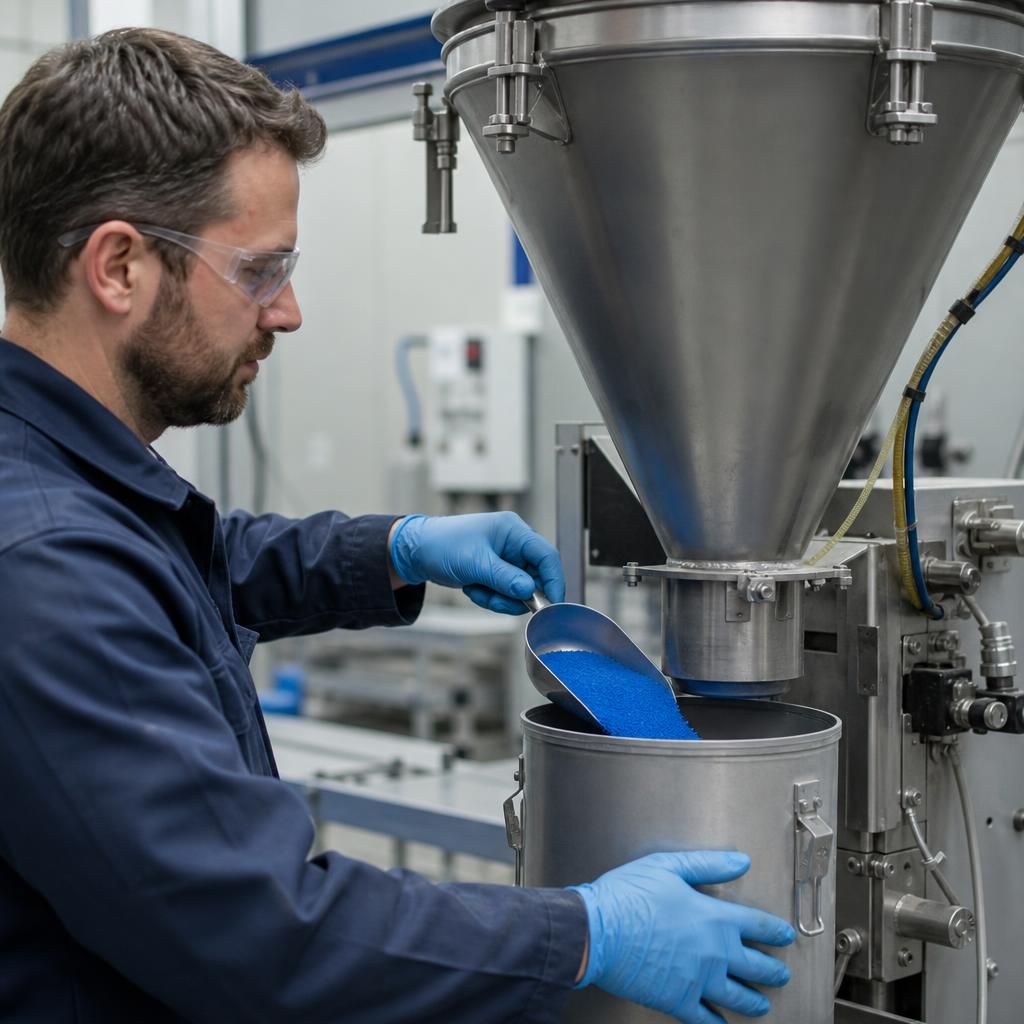
A fluidising hopper can support consistent results when reclaimed powder is returned to the application system, but it does not make reclaimed material identical to virgin powder. Reclaim may contain a different balance of particle sizes, or may have picked up contamination from the booth, filters or previous colours. If it is added without control, the resulting mixture can affect coverage, appearance and coating behaviour even though the hopper is fluidising it correctly.
For reliable quality, reclaimed powder should be screened where appropriate, kept separate by colour or formulation, and blended with virgin powder according to the coating specification. The hopper should then be operated with a consistent material condition and fill level. This allows the equipment to handle the powder predictably while keeping changes in finish attributable to defined process adjustments rather than uncontrolled reclaim variation.
Discuss Your Fluidising Hopper Requirements
Discuss your fluidising hopper requirements with our Midlands powder coating specialists, including the powder types, component volumes and existing equipment involved. We can help identify the practical considerations for integrating a hopper into your process.