

Are there specific types of powders that work best with a fluidising hopper, and how does the choice of powder affect performance?
Dry, free-flowing powders with a consistent particle-size distribution generally work best in a fluidising hopper because they suspend and feed more evenly. Powder choice affects fluidisation stability, transfer consistency, coating coverage and final finish, while moisture, excessive fines or agglomeration can cause uneven flow, blockages and defects.
The powders that work best with a fluidising hopper are those formulated for controlled pneumatic transport and consistent suspension, but there is no single powder chemistry that is universally best. Thermoset powders such as polyester, epoxy and hybrid formulations are commonly suited to hopper feeding when their bulk properties match the equipment. Thermoplastic powders, including nylon-based coatings, can also be used, although their particle density, flow behaviour and application requirements may call for different air settings and handling controls.
Polyester powders are widely used for general industrial, architectural and exterior metal-coating applications. Their performance in a hopper depends less on the polyester name itself than on the formulation, particle shape, bulk density and additives used. A well-matched polyester powder should transfer at a stable rate, support even gun delivery and maintain a consistent deposit across a batch. Different finishes, such as textured, satin and fine-smooth products, may behave differently because surface texture and particle geometry influence how the powder responds to air.
Epoxy powders are valued for adhesion and corrosion protection, particularly where the coated component is not expected to have prolonged exposure to sunlight. They can be handled through a fluidising hopper in the same way as other thermoset powders, provided the system is set up for the product’s flow characteristics. Care is needed when changing between colours or formulations, as residual powder in the hopper, hoses or gun can affect the appearance and functional performance of the next coating.
Hybrid powders, usually combining epoxy and polyester properties, are often selected for indoor components and general fabrication work. They may feed reliably through a hopper, but the correct settings should be established for each formulation rather than copied from another powder. A powder that appears similar visually can require different air assistance or feed adjustment because of differences in density, additives and particle structure.
Nylon and other thermoplastic powders are used where the coating needs particular resistance to abrasion, impact, chemicals or wear. Nylon is comparatively dense and may require careful control of fluidising air to achieve a stable suspension without excessive turbulence. The powder must also be kept within the handling conditions specified for the product, because contamination or unsuitable storage can affect transfer and the finished coating. For larger or specialist components, the hopper, feed hose and spray equipment should be assessed as one system rather than treating the hopper in isolation.
Protective and specialist powders can include thicker-film, textured or highly durable formulations. These may need a different balance between conveying air and powder feed to prevent surging or an inconsistent deposit. Coarser or heavier products can place greater demands on the hopper’s air distribution system, while very fine products may be more sensitive to dust control and separation during transport. The manufacturer’s technical data should therefore be checked before deciding whether a standard hopper arrangement is suitable.
Powder choice affects hopper performance in several practical ways:
- Bulk density: Heavier powder requires sufficient air energy to suspend and move it, while excessive air can disturb the feed and carry powder unevenly.
- Particle shape: Rounded particles generally move differently from irregular or textured particles, affecting feed stability and the amount of air needed.
- Surface finish: Smooth, textured and metallic-effect powders can have different application sensitivities. A change in powder can require adjustment of feed rate, gun settings and spray distance.
- Film-build requirement: Products intended for thin decorative films may need more precise metering than protective products designed for a heavier deposit.
- Colour and formulation: Changes in pigment, resin, additives or gloss level can alter transfer behaviour even where two powders have a similar nominal particle size.
- Reclaimed powder content: Reclaim can have different flow characteristics from virgin powder and may need controlled blending and screening before it is returned to the hopper.
For a new powder, the practical selection process should start with the supplier’s technical data and a controlled trial. Check the recommended application method, bulk density, storage requirements, reclaim guidance and suitable film thickness. The trial should examine whether the powder remains stable in the hopper, reaches the gun without surging, produces an even deposit and gives the required cured appearance. It is also important to assess recovery from corners, recesses and larger surface areas rather than judging performance from a single flat test panel.
Fluidising air should be adjusted for the powder being used, not simply set to a permanent value. Too little air can produce intermittent feed and place strain on the extraction and conveying path; too much can cause turbulence, inconsistent pickup or unnecessary powder disturbance. The correct setting is the one that supports a steady feed while keeping the powder bed controlled. Changes should be made gradually, with the effect checked at the gun and on the coated component.
Powder changes also affect colour control and cleaning requirements. Switching between contrasting colours, gloss levels or specialist formulations may require the hopper and associated feed path to be cleaned thoroughly to prevent carry-over. Nylon, protective and textured powders can be especially unsuitable for casual mixing with another product because even small residues may alter appearance, film properties or curing behaviour.
In practice, the best powder for a fluidising hopper is the one whose formulation, density and intended film build are compatible with the hopper’s air distribution, feed arrangement and spray equipment. For industrial batch work, confirming compatibility with a representative production part is more reliable than selecting powder solely by resin type. This approach helps distinguish a powder issue from an equipment-setting issue and supports repeatable coating quality across different metal components.
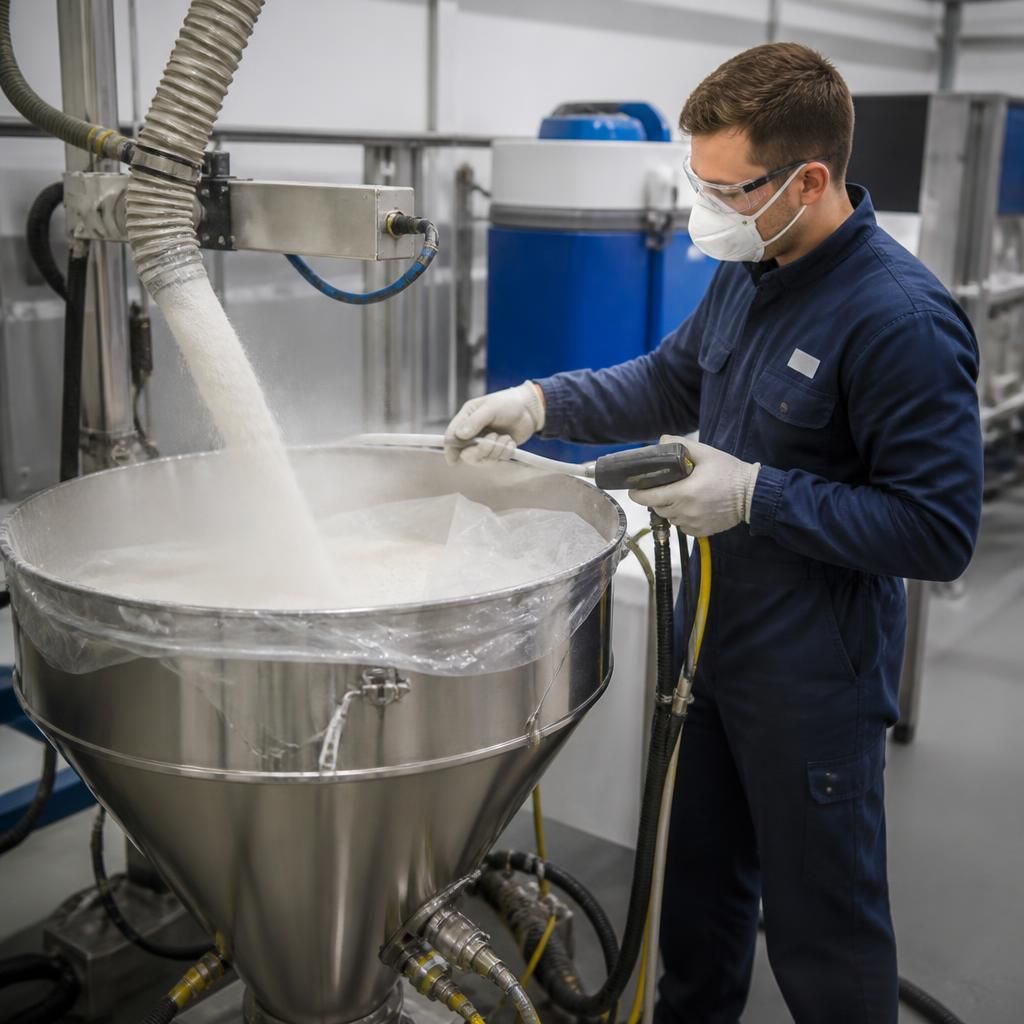
Powder suitability depends not only on how well it fluidises, but also on the application method used after the hopper. A product intended for electrostatic spray application must respond consistently to the charging and conveying conditions in the spray equipment. Powder designed primarily for fluidised-bed dipping may require different handling and application controls, even if it appears to suspend well in the hopper.
This distinction matters when assessing a new coating. Confirm that the powder supplier’s recommended process matches the complete system, including the hopper, feed line, spray equipment and curing conditions. A controlled trial should check charging response, transfer into recesses and the appearance of the cured film, rather than relying on hopper flow alone. This helps identify powders that are technically fluidisable but unsuitable for the intended coating process.
Discuss Powder Compatibility for Your Fluidising Hopper
Share your powder’s technical data and application requirements with Powder-coatings.co.uk to discuss whether the fluidising hopper and spray setup are suitable for your coating process. A representative component can help establish the most appropriate handling and application approach for your batch work.