

What are the key advantages of using epoxy primer compared to other metal priming methods?
Epoxy primer provides strong adhesion to correctly prepared metal, effective corrosion resistance and a durable foundation for subsequent coatings. Compared with many conventional primers, it offers better protection where metal components face moisture, chemicals, abrasion or demanding service conditions, although surface preparation and system compatibility remain essential.
Epoxy primer’s main advantage over many other metal priming methods is its cross-linked film structure. Once correctly mixed and cured, it forms a relatively dense, chemically resistant layer that can be specified as part of a wider coating system. This makes it suitable where a basic adhesion-promoting primer would not provide enough barrier protection or resistance to service conditions.
Compared with thin etch primers, epoxy primers generally offer greater film build and a more substantial separation between the metal and the surrounding environment. Etch primers are formulated mainly to promote bonding, particularly on difficult surfaces, and are not always intended to provide the main protective layer. An epoxy system can therefore be more appropriate for fabricated parts, structural components and equipment exposed to moisture, process chemicals or regular handling.
Epoxy primers also differ from many single-pack alkyd, acrylic or solvent-evaporation primers in how they cure. Two-pack epoxy products react through a chemical cross-linking process between the resin and hardener. This can produce a more cohesive coating film than a product that simply dries as solvent or water leaves the surface. The result is often better resistance to:
- Oils, fuels, cleaning agents and a range of industrial chemicals, subject to the product’s technical data;
- Impact, rubbing and handling during fabrication or installation;
- Water penetration through the coating film;
- Underfilm breakdown where the complete preparation and coating specification are suitable.
These properties can reduce the need to rely on a very thick decorative topcoat to provide all the protective performance. The primer and topcoat can instead be selected as a compatible system, with each layer performing a defined role. Epoxy is particularly useful beneath powder or liquid topcoats when the specification requires an intermediate layer with greater resistance than a conventional general-purpose primer.
Epoxy primer should not be confused with zinc-rich primer. Zinc-rich products can provide sacrificial protection when their formulation, application and electrical contact with the steel are appropriate. Epoxy primer works by forming a barrier and does not provide the same sacrificial mechanism. The better choice depends on the metal, the environment, the required coating system and whether the specification calls for galvanic protection, chemical resistance, or both.
Another advantage is its versatility across prepared metal substrates, although the formulation must match the material. Steel, galvanised steel, aluminium and stainless steel can require different preparation methods and primer products. A primer suitable for one substrate should not automatically be applied to another. Stainless steel and aluminium, for example, may need controlled abrasion or another approved preparation method to remove contamination and create a suitable surface profile without damaging the substrate.
The performance of epoxy primer depends heavily on application control. The metal should be clean, dry and free from oil, grease, salts, loose corrosion and other contaminants. Abrasive preparation or mechanical preparation may be required, depending on the substrate and specification. The mixed components must be combined in the stated ratio, allowed any required induction period, and applied within the product’s pot life. Incorrect mixing, excessive film thickness, condensation or recoating outside the specified window can undermine the advantages of the material.
There are also limitations when comparing epoxy with other methods. Epoxy can chalk or lose colour when exposed to prolonged ultraviolet light, so an exterior system may need a compatible UV-resistant topcoat. It may require more controlled handling than a single-pack product, and its cure can be affected by temperature and humidity. It is therefore selected for the complete service environment rather than simply because it is a two-pack coating.
In practical terms, epoxy primer is most advantageous when the coating specification needs a substantial, chemically resistant intermediate film, controlled compatibility with a topcoat and protection beyond that normally provided by a thin etch or general-purpose primer. The correct choice should be based on substrate preparation, exposure conditions, application method, recoat requirements and the technical data for the proposed primer and finishing coat.
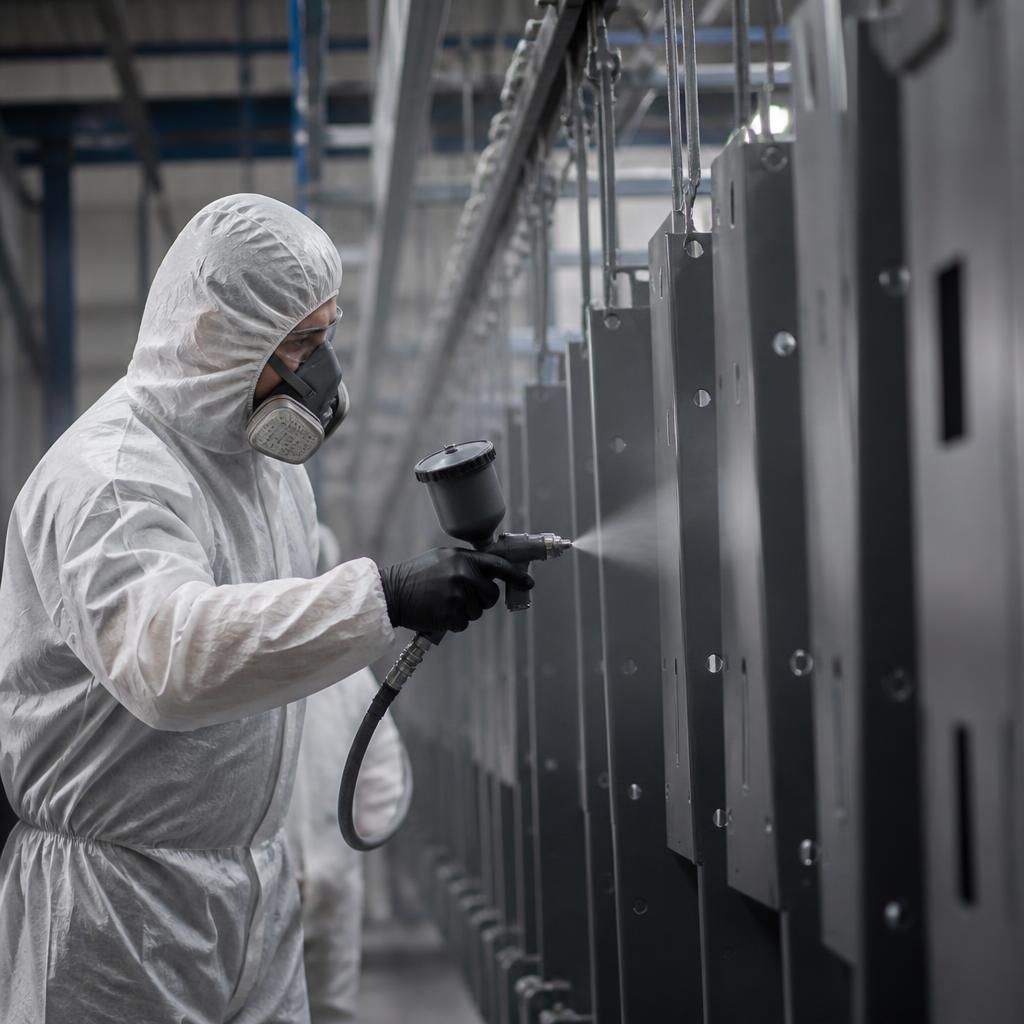
A key advantage of epoxy primer is that it allows corrosion protection to be specified separately from the visible finish. The primer can be selected for the prepared metal and service conditions, while a compatible powder or liquid topcoat provides the required colour, texture and appearance. This is useful where the finished component must meet both practical performance requirements and a defined visual specification.
The approach also helps identify whether the complete coating system is suitable for the component’s intended use. Rather than judging a primer in isolation, the specification can consider the substrate, preparation method, exposure environment, topcoat compatibility and recoating requirements together. Epoxy is therefore most valuable when the project needs a planned multi-layer system rather than a single general-purpose coating.