

What are the environmental and health considerations when using epoxy primer in the powder coating process?
Epoxy primer can present environmental and health risks through solvent or VOC emissions, uncured resin and hardener contact, and dust generated during preparation or sanding. Control these risks with a suitable lower-emission formulation where appropriate, effective extraction and ventilation, correct PPE, safe storage, and disposal in line with the product’s safety data sheet and UK waste requirements.
Epoxy primer in powder coating should be assessed across its whole life cycle: the composition of the uncured product, worker exposure during handling and preparation, emissions during application and curing, energy consumption, waste streams, and the eventual treatment or recycling of the coated component. The safest and most environmentally responsible approach is to select a technically suitable formulation, follow its safety data sheet and technical data sheet, and control each stage through a documented risk assessment.
Environmental considerations begin with product selection. Epoxy primers differ in resin chemistry, hardener package, pigments, additives and application characteristics. A product with a lower environmental burden is not automatically suitable for every substrate or service condition. It must still provide the required adhesion, corrosion protection and compatibility with the subsequent powder coat. Poor compatibility can lead to rework, stripping and replacement of components, increasing material use and energy consumption.
Ask the supplier for current technical and safety documentation before introducing a primer into the process. This should identify relevant hazard classifications, recommended application conditions, curing requirements, ingredients requiring specific controls, and instructions for dealing with residues. Environmental information may also cover volatile substances, aquatic hazards and waste classification. Product documentation should be reviewed whenever the formulation, supplier or process changes.
Application controls affect both health and environmental performance. The process should be designed to prevent primer from spreading beyond the intended work area and to avoid contamination of floors, drains, soil or surface water. Any collected residue, contaminated absorbent material or rejected coating should be segregated and assessed rather than swept into general waste or washed away. Drain protection is particularly important because coating residues and cleaning materials can pollute water and may require controlled disposal.
Good process control also reduces unnecessary material use. Accurate application settings, suitable part positioning and regular inspection can limit overspray, rejects and repeat work. Powder recovery systems may be appropriate for compatible powder-coating operations, but recovered material must only be reused where the equipment, product manufacturer and quality requirements permit it. Primer residues should not be mixed into a powder-recovery stream unless the process is specifically designed for that purpose.
Curing has an energy and emissions dimension. The primer and powder topcoat must be cured within the manufacturer’s specified time and temperature range. Under-curing can leave inadequate performance and create rework; excessive curing wastes energy and may damage the coating or substrate. Oven condition, loading, airflow and temperature measurement should therefore be checked as part of process control. Where a primer produces process emissions during heating, the extraction system should discharge them in accordance with the site’s environmental controls and applicable requirements.
Health risks are not limited to visible coating dust. Epoxy systems can cause irritation or sensitisation in susceptible people, while hardeners and additives may have their own hazard profiles. The risk depends on the specific formulation and the route of exposure, so generic assumptions about all epoxy primers are unreliable. A COSHH assessment should consider the product supplied, the quantities used, the task, duration, equipment and the people who could be affected, including maintenance and cleaning staff.
Controls should follow the hierarchy of control. Where practicable, use a less hazardous suitable product or a process that reduces manual handling. Enclosed or automated application can reduce exposure further. Engineering controls should be maintained and checked for effectiveness, while work instructions should cover mixing, transfer, equipment cleaning, spill response and dealing with defective parts. PPE is an additional control, selected from the product assessment rather than treated as a substitute for effective process design.
Personal hygiene is also important. Workers should avoid eating, drinking or smoking in coating areas, wash thoroughly before breaks and keep contaminated workwear separate from ordinary clothing. Skin contact should be treated seriously because repeated exposure may increase the likelihood of sensitisation. Eye-wash and first-aid arrangements should match the hazards identified in the safety data sheet, and incidents or developing symptoms should be reported through the employer’s occupational health arrangements.
Waste classification must be based on the actual material. Unused primer, residues, contaminated containers, filters, wipes and abrasive media may need different handling. A waste contractor should be given accurate information about the contents and contamination, and waste transfer documentation should be retained where required. Empty packaging should not be described as clean or sent for recycling unless it has been managed in accordance with the supplier’s instructions and the relevant waste rules.
The finished coating can provide a long service life, which may reduce the need for repainting or replacement when the specification is correct. However, epoxy-coated metal can be more difficult to separate into clean material streams at end of life. Designers and asset owners should consider repair, stripping and recycling routes, particularly where components may later be reclaimed. Coating choices should therefore be balanced against the component’s expected use, maintenance requirements and end-of-life pathway.
For a UK powder-coating operation, the practical process is to identify the exact primer, obtain its current safety and technical data, complete a COSHH and environmental risk assessment, define controls for application and curing, train relevant personnel, inspect control measures, and review waste arrangements. The assessment should be revisited after a product, substrate, equipment or process change. This approach addresses worker protection and environmental compliance without assuming that one epoxy primer has the same profile as another.
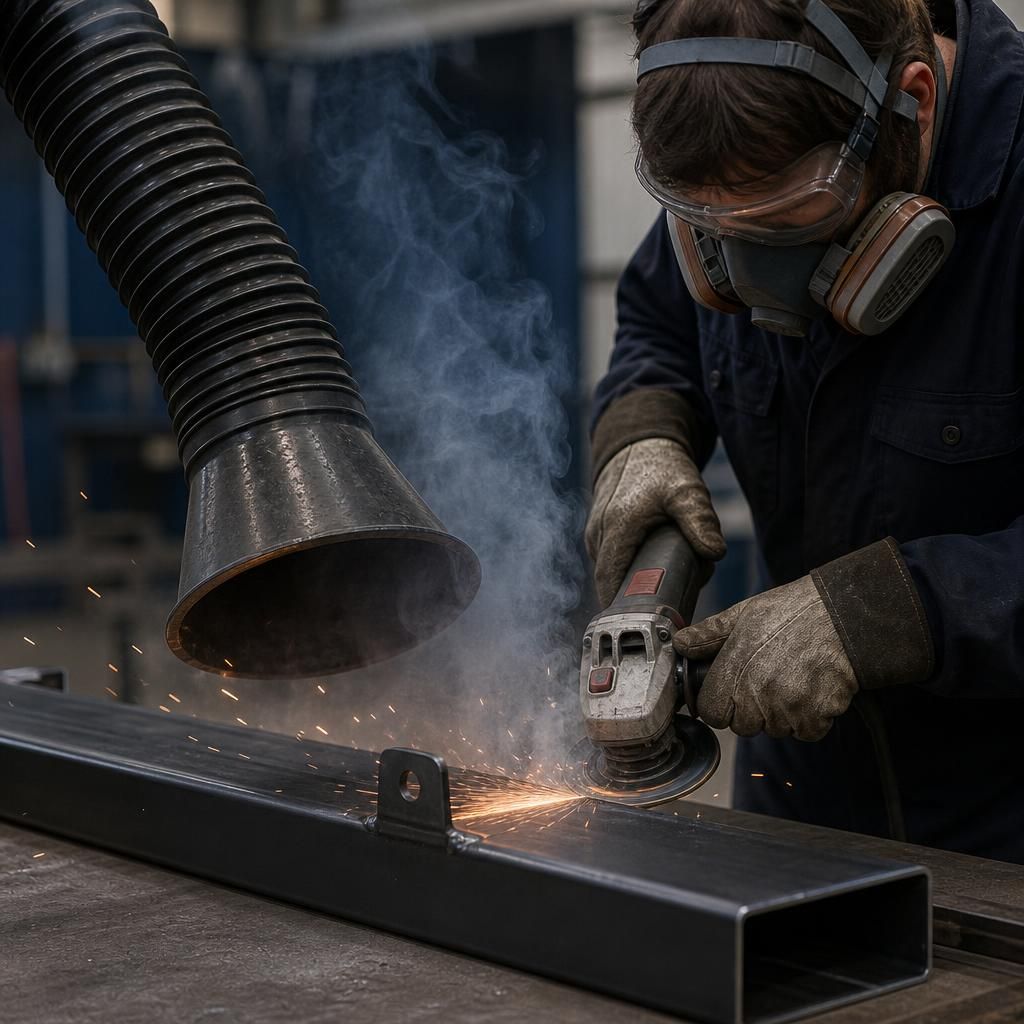
Health risks can reappear when epoxy-primed metal is later welded, cut, ground or thermally stripped. Heating or mechanically disturbing the coating can produce fumes or dust, even after the primer has cured. Before maintenance or fabrication work, identify the coating, remove it from the immediate work area where practicable, and use suitable extraction, respiratory protection and fire controls based on the task risk assessment.
This consideration should be included in the component’s maintenance and end-of-life instructions. Anyone carrying out repair, dismantling or recycling work needs to know that a visually sound coating is not necessarily safe to heat or abrade without controls.