

What are the key differences between thermoplastic powder coating and thermoset powder coating?
Thermoplastic powder coating melts and forms a film without a chemical curing reaction, so it can be reheated and softened; thermoset powder coating chemically cross-links during curing, creating a permanent finish that will not remelt. This difference affects reworkability, flexibility, heat resistance and suitability for particular metal components and operating conditions.
Thermoplastic and thermoset powders are both dry coating systems, but they differ in resin composition, application methods, coating behaviour and service performance. Thermoplastic coatings are generally selected where impact resistance, flexibility, repairability or a heavier protective layer is important, while thermoset coatings are often preferred for hard, consistent finishes, strong adhesion and controlled chemical or heat performance.
Resin structure and coating behaviour
- Thermoplastic powders form a continuous layer when heated and retain a degree of their original plastic behaviour. The finished coating is commonly tough, flexible and resistant to impact, abrasion and corrosion. If the coating is heated sufficiently, it can soften again, which affects both its repair options and its maximum service temperature.
- Thermoset powders use resins that react with curing agents in the oven. This produces a rigid, cross-linked film with a stable shape and consistent hardness. Once cured, the coating cannot be softened and reformed in the same way as a thermoplastic layer.
Typical powder chemistries
Thermoplastic systems include materials such as nylon, polyethylene, polypropylene, PVC and fluoropolymer-based formulations. The appropriate chemistry depends on exposure to chemicals, moisture, abrasion, impact, sunlight and operating temperature.
Thermoset systems commonly include epoxy, polyester, epoxy-polyester hybrid, polyurethane and acrylic formulations. Epoxy-based coatings are often valued for adhesion and corrosion protection, although their exterior durability must be considered. Polyester-based systems are widely used where weathering and colour retention are important. Hybrid, polyurethane and acrylic powders provide further options for balancing appearance, hardness, chemical resistance and outdoor performance.
Application and coating thickness
Thermoplastic powders may be applied by electrostatic spraying, fluidised-bed coating or hot flocking, depending on the component and the required film build. Fluidised-bed and related processes can produce a comparatively thick, continuous layer in a single operation, making them useful for protective coatings on components exposed to impact, moisture or abrasion.
Thermoset powders are most commonly applied electrostatically before being heated in an oven. The powder must be heated sufficiently for the resin and curing agent to react throughout the film. This process generally gives a uniform, controlled finish and is suitable for a wide range of fabricated and manufactured metal parts.
Film thickness is not determined by whether a coating is thermoplastic or thermoset alone. It depends on the formulation, application method, geometry and specification. Excessive build can affect dimensional tolerances, edges, threads and moving interfaces, so these features should be identified before coating.
Mechanical performance
Thermoplastics are usually the stronger choice where a component must tolerate repeated impact, bending or abrasion. Their flexibility can help the coating remain intact when the underlying part moves or receives a mechanical strike. Some thermoplastic systems can also be stripped, repaired or recoated using heat or a compatible process, subject to the material and component design.
Thermosets generally provide a harder film with good resistance to scratching, indentation and everyday wear. Their rigid structure can be advantageous for panels, enclosures, frames, brackets and other parts where dimensional stability and surface hardness matter more than repeated flexing. A cured thermoset coating is not normally reformed by reheating, so damage is typically dealt with by local preparation and recoating or by removing and replacing the affected finish.
Heat and chemical resistance
Neither category has a single universal temperature or chemical-resistance rating. Performance depends on the specific resin, pigmentation, film thickness, cure history and exposure conditions. Thermoplastic coatings can soften or deform if a component operates above the formulation’s heat capability. Thermosets usually retain their shape more effectively at elevated temperatures, but prolonged heat can still cause degradation, discolouration or loss of performance.
Thermoplastics can provide excellent resistance to moisture, salts, many chemicals and abrasion, particularly when a thick, pinhole-resistant layer is required. Thermosets can offer strong resistance to oils, solvents, fuels and other chemicals, but the exact result varies significantly between epoxy, polyester, polyurethane and other formulations. Compatibility should therefore be checked against the actual chemical, concentration, temperature and contact time.
Outdoor exposure and appearance
For external applications, ultraviolet exposure and weathering are important selection factors. Some thermoplastic formulations provide strong outdoor durability, while others are better suited to indoor or sheltered use. Thermoset polyesters and certain other exterior-grade systems are frequently selected for colour retention and weather resistance. Gloss, texture, colour stability and chalking behaviour should be assessed using the coating specification rather than assumed from the broad coating category.
Repair, reuse and end-of-life considerations
A thermoplastic coating may be reheated for certain repair, reshaping or stripping operations, which can be useful where a part is likely to be refurbished. Its ability to soften also means that heat exposure during service, welding or subsequent fabrication needs careful consideration.
Thermoset coatings are more difficult to remove and cannot be remelted into a new coating once cured. Their permanent structure can be an advantage where the finish must remain stable throughout service, but it makes rework and material recovery more involved. In both cases, the environmental profile depends on the powder chemistry, preparation methods, energy used during application and the eventual handling of the coated component.
How to choose between them
- Choose a thermoplastic system when flexibility, impact resistance, abrasion protection, a thicker barrier layer or future heat-based repair is a priority.
- Choose a thermoset system when a hard decorative finish, strong adhesion, dimensional stability or a particular chemical and outdoor-performance balance is required.
- Consider thermoset powder where tight control of appearance, film build and repeatability across production batches is important.
- Consider thermoplastic powder for components that need substantial protection from mechanical damage, moisture or corrosive environments, provided the operating temperature is compatible.
The correct comparison should be made against the component’s substrate, dimensions, masking requirements, operating temperature, chemical exposure, expected impact and required appearance. A coating specification should also define surface preparation, film thickness, cure or heating requirements and inspection criteria. For complex metal components or specialist nylon and protective coatings, these details help determine whether thermoplastic or thermoset powder is the more appropriate finish.
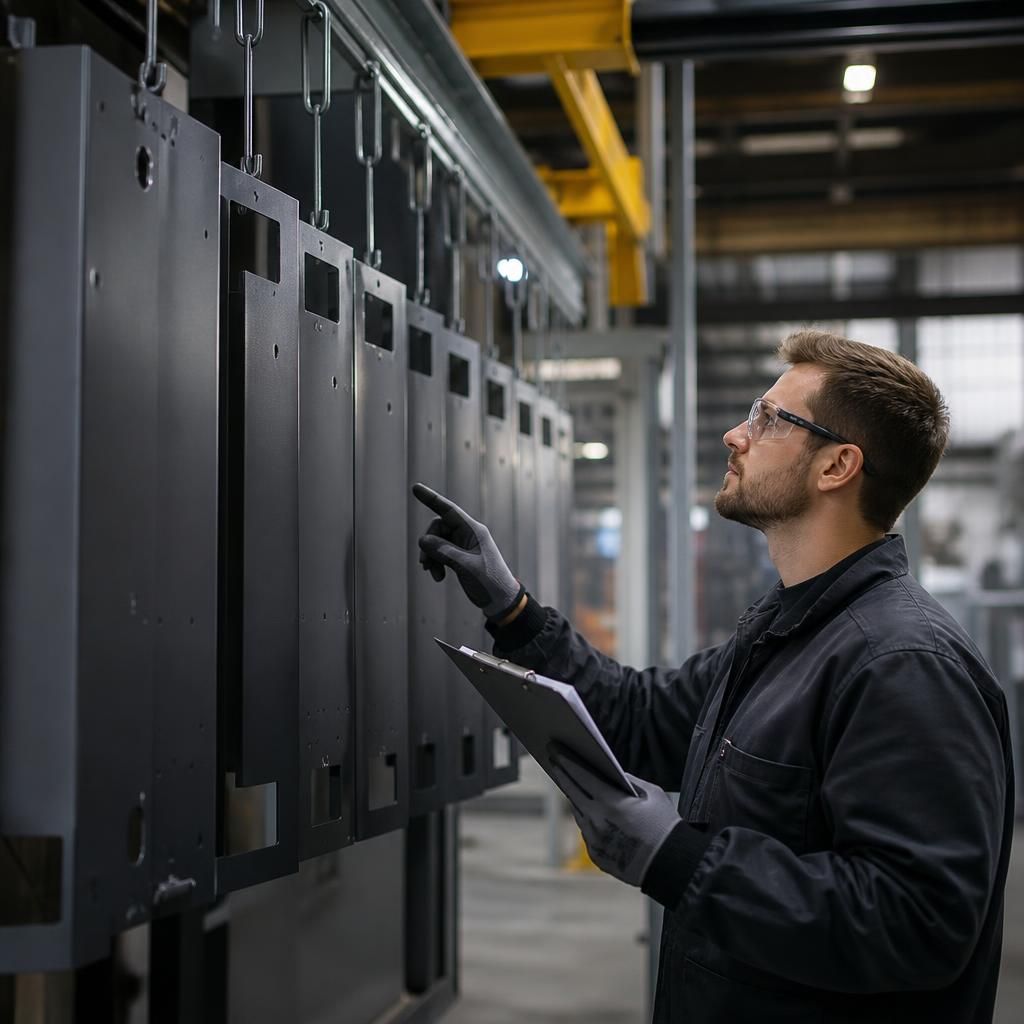
The key process difference is how the coating reaches its final condition. A thermoplastic powder must melt and flow into a continuous layer, so the component’s temperature and the powder’s heating behaviour affect coalescence, coverage and adhesion. A thermoset powder must also complete its chemical cross-linking reaction; a surface may appear finished before the film has achieved its intended cure.
For this reason, quality checks should reflect the coating type. Thermoplastic work is assessed for consistent melt flow, film continuity and specified thickness, while thermoset work requires control of the complete time-and-temperature cure profile as well as checks for appearance, thickness and adhesion. The correct process record is therefore as important as the resin choice when comparing the two systems.
Discuss your thermoplastic or thermoset coating requirements
Discuss your component, operating conditions and finish requirements with the powder-coating.co.uk team to assess whether thermoplastic or thermoset coating is the better fit. Provide details of the substrate, dimensions, exposure and intended use so the coating specification can be considered accurately.