

How does the thermoplastic powder coating process affect the thermal and electrical insulation properties of the coated components?
Thermoplastic powder coating can provide electrical insulation by forming a continuous, non-conductive barrier around a metal component, with performance depending on the polymer, coating thickness and surface coverage. It offers some resistance to heat transfer, but its thermal insulation is limited and should not be treated as a substitute for purpose-designed thermal insulation; the coating must also remain within its specified service-temperature range.
Thermoplastic powder coating can modify a component’s heat flow and electrical behaviour, but it does not automatically turn a metal part into a thermal or electrical insulator. The final effect depends on the selected polymer, coating thickness, continuity, operating conditions and the geometry of the component. For engineering purposes, the coating should be treated as one layer within the complete design rather than as a replacement for dedicated insulation, heat shielding or electrical insulation systems.
Thermal insulation and heat transfer
Metal transfers heat readily, whereas most thermoplastic coating materials transfer heat less efficiently. A coating therefore adds thermal resistance at the surface and can reduce direct heat exchange between the metal and its surroundings. In practice, however, powder coatings are usually applied as relatively thin protective layers, so their effect on overall thermal resistance is limited compared with a purpose-designed insulating layer.
The coating can influence how quickly a component gains or loses heat and can alter the temperature measured at its exposed surface. It may also reduce direct contact between the metal and another item, which can affect heat transfer through contact points. The result is not necessarily a lower temperature throughout the component: heat may still travel through the metal beneath the coating, and heat generated internally may need to dissipate through the coated surface.
Thermal performance also depends on the temperature range. Each thermoplastic has a service range in which it retains its intended mechanical and electrical properties. As temperature rises, the coating may soften, lose stiffness, become more susceptible to indentation or change dimension. Repeated heating and cooling can create expansion and contraction differences between the coating and the metal substrate. If the component experiences substantial thermal cycling, the specification should consider adhesion, flexibility, edge coverage and resistance to cracking or delamination, rather than relying only on the coating’s initial insulating effect.
Electrical insulation and dielectric behaviour
When the coating forms an electrically continuous layer, it separates the conductive metal surface from surrounding components and can prevent ordinary surface contact. This may be useful for coated brackets, housings, frames, guards and other metal parts where accidental contact, short circuits or surface corrosion could affect electrical performance.
Electrical insulation is not defined by coating presence alone. Relevant properties can include volume and surface resistivity, dielectric strength, resistance to tracking and the ability to withstand the voltage, frequency and environmental conditions of the application. Moisture, contamination, absorbed chemicals, pinholes, thin areas and mechanical damage can all reduce insulation performance. A coating that performs satisfactorily in a dry indoor environment may require a different specification where condensation, wash-down, salt exposure or conductive dust is expected.
Geometry is important as well. Sharp edges, corners, welds, recesses and internal surfaces can receive less uniform coverage than broad, accessible faces. These areas may become the limiting points for insulation, particularly where a high electric field is concentrated. Holes, threads, hinges, fasteners and bonding points may also need masking or controlled coating removal so that electrical continuity, earthing or mechanical fit is maintained.
How the application process affects performance
The process affects insulation mainly through the quality and uniformity of the finished film. Cleaning and preparation remove oil, scale, rust and other contaminants that could prevent proper adhesion or leave conductive paths. The powder must then be applied consistently, and the component must receive sufficient heat for the particles to melt and form a coherent layer. Unlike a thermoset coating, a thermoplastic coating is fused rather than chemically cross-linked, so the heating cycle must suit the particular material and component.
Insufficient fusion can leave an uneven or porous surface, while excessive heat may damage the polymer or affect the substrate. Uneven application can produce local thin spots where electrical breakdown or heat transfer occurs more readily. Voids, inclusions and coating damage caused during handling have a similar effect. For critical applications, the required coating thickness should be defined as a controlled specification rather than assessed by appearance alone.
Design and specification considerations
- Identify the expected operating temperature, peak temperature and number of heating and cooling cycles.
- Define whether the coating is intended to provide basic contact separation or a verified electrical insulation function.
- Consider humidity, condensation, chemicals, abrasion, impact and contamination, as these can change both thermal and electrical performance.
- Specify areas that must remain conductive, including earthing points, bonding faces, threads and precision-fit surfaces.
- Assess edges, corners, apertures and concealed faces where coverage may be less consistent.
- Use testing appropriate to the application, such as thickness checks, visual inspection, adhesion assessment, insulation-resistance testing or dielectric withstand testing.
For manufacturers and fabricators, the coating specification should be agreed alongside the component’s electrical and thermal requirements. A thermoplastic powder coating can provide useful surface separation and modest resistance to heat flow, but the component’s substrate, geometry, heat source, voltage and environment determine whether that performance is adequate. Where the part is safety-critical or exposed to high temperatures or voltages, measured coating performance and application controls should support the design decision.
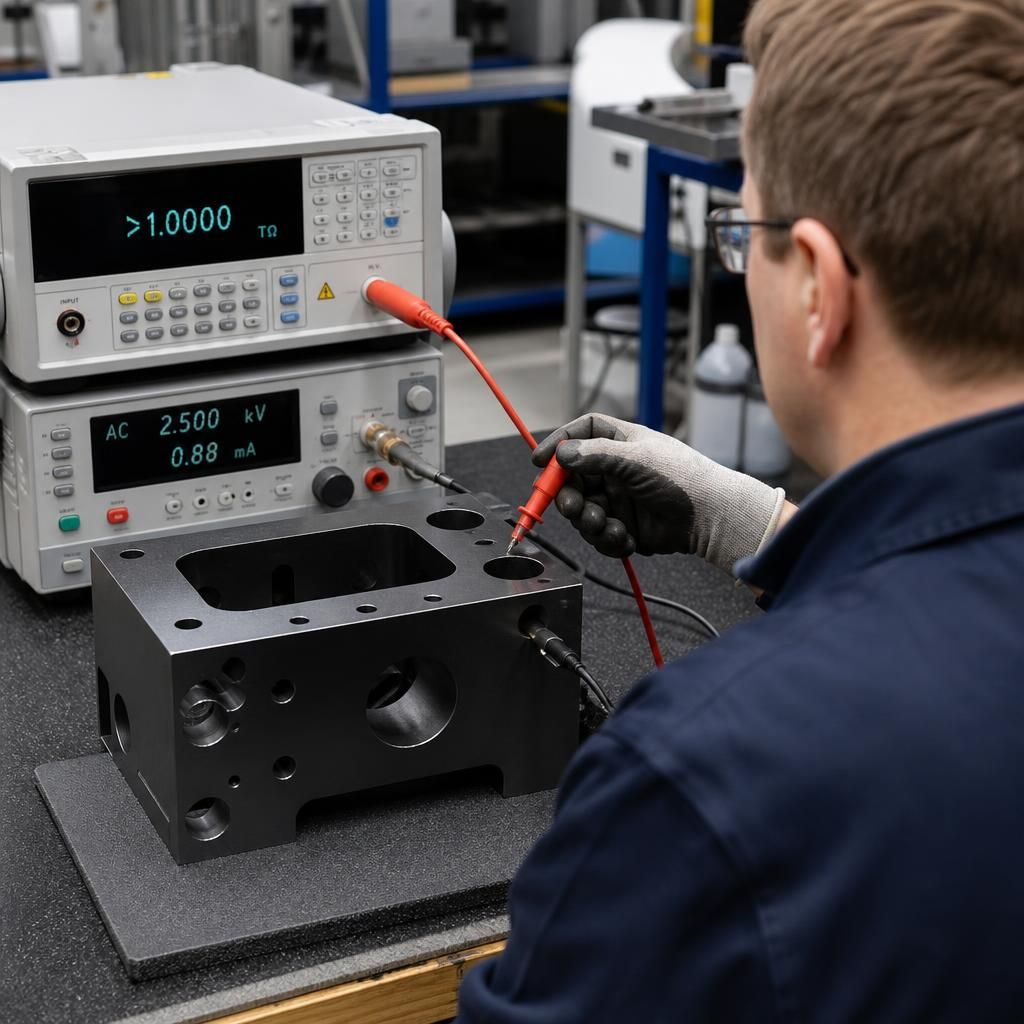
Electrical insulation performance should be verified using a test suited to the component’s function. An insulation-resistance test indicates how effectively the coating limits leakage current under defined conditions, while a dielectric-withstand test assesses whether the coating and component can tolerate a specified voltage without electrical breakdown. These tests answer different questions and should not be treated as interchangeable.
Results should be interpreted alongside the coating thickness, test voltage, temperature and environmental conditions. Testing can also help identify local defects that are not obvious from visual inspection, particularly after transport, assembly or mechanical handling. For components where electrical separation is safety-critical, the acceptance criteria should be agreed during design and applied consistently to representative finished parts.