

What methods are used for stripping existing coatings during preparation?
Existing coatings are typically stripped using chemical stripping, abrasive blasting or mechanical methods, with the choice depending on the coating type, substrate and component condition. The surface is then cleaned and inspected to ensure residues, corrosion and loose material are removed before further preparation.
Coating stripping is the controlled removal of paint, powder coat, plastisol, lacquer, rust scale or other surface deposits from a metal component before it receives a new finish. The most suitable method is selected to remove the unwanted layer without distorting the component, damaging the base metal or creating contamination that could affect subsequent coating stages.
Chemical stripping uses a formulated remover to soften, dissolve or lift the existing coating. The component is exposed to the product for a controlled period, after which the loosened material can be removed. Different formulations are suited to different coating chemistries, so the product must be compatible with the substrate as well as the layer being removed.
- Alkaline strippers are commonly used for some organic coatings and can be effective on robust steel components.
- Solvent-based systems may be selected for particular paints, lacquers or adhesive residues where an alkaline process would be unsuitable.
- Specialist stripping solutions can be considered for intricate parts, delicate profiles or components with areas that would be difficult to reach mechanically.
Chemical processing can reach recesses, holes and internal corners more consistently than a tool used only on exposed faces. However, the process needs careful control. An unsuitable formulation, excessive exposure or inadequate removal of residues may affect aluminium, zinc-coated materials, seals, plastics or other attached components. Following treatment, the part may require thorough rinsing, neutralisation or other residue-control measures before it can move to the next preparation stage.
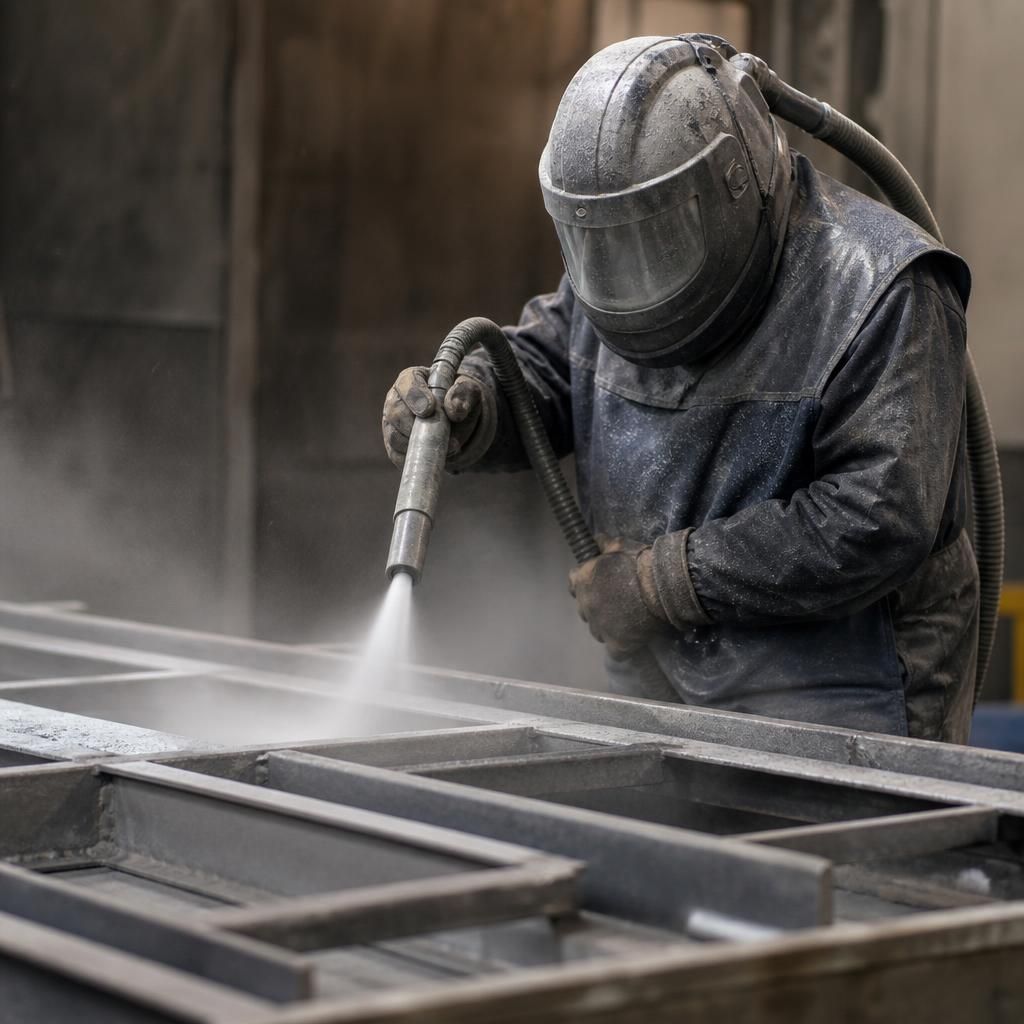
Abrasive blasting removes the coating by directing a controlled stream of abrasive media at the surface. The impact breaks down the existing finish and can also remove light corrosion, mill scale and embedded surface contamination. The operator controls factors such as abrasive type, air pressure, nozzle distance and travel speed to achieve the required result without unnecessarily eroding the metal.
Common blasting approaches include:
- Grit blasting, which provides a more aggressive action for thick or firmly bonded coatings and can produce a defined surface texture.
- Shot blasting, which is often used for suitable robust components and larger batches where consistent mechanical treatment is required.
- Glass bead or other fine-media blasting, which can offer a gentler approach where preserving detail and limiting surface alteration are priorities.
Blasting is particularly useful where a coating has failed unevenly or where corrosion must be removed at the same time. The media and settings must nevertheless be matched to the material. Excessive impact can round sharp edges, close small openings, expose underlying defects or distort thin sections. Blasting can also create a surface profile that is too coarse or too shallow for the next coating system, so the treated finish needs to be appropriate for the specification.
Mechanical stripping removes the coating through direct physical action. Depending on the component, this may involve scraping, sanding, wire brushing, needle scaling, rotary tooling or controlled machining. It is useful for local repairs, heavy deposits, weld areas and sections where chemical or abrasive treatment needs to be limited.
Mechanical methods give the operator a high degree of local control, but they can be labour-intensive and may leave coating in pits, corners or other inaccessible areas. Aggressive tooling can also score the substrate or smear softer metals. For that reason, mechanical work is often used selectively rather than as the sole treatment for complex components.
Thermal removal is a further option for certain steel parts. Heat breaks down an old coating so that the residue can be removed afterwards. This method is restricted to components that can tolerate the process without distortion, loss of dimensional accuracy or undesirable changes to the metal. It is not automatically suitable for thin sheet, aluminium, zinc-coated materials, assemblies containing heat-sensitive parts or components with tightly controlled metallurgical properties.
In practice, more than one method may be used on the same component. For example, a bulk treatment can remove most of a thick finish, followed by local mechanical work in sheltered areas. Alternatively, chemical treatment may be chosen for intricate sections while blasting is used on accessible faces. The sequence is determined by the component’s geometry, the condition of the old finish, the metal specification and the requirements of the replacement coating.
Before stripping begins, relevant details should be established, including the base metal, the number and type of existing coating layers, areas that must remain masked, dimensional tolerances and the presence of threaded holes, bearings, seals or inserts. This information helps prevent a method that removes the old coating but creates a new problem for the component.
After removal, the part should be free from loose coating, treatment residues, abrasive contamination and other materials that could interfere with adhesion. Operators may also check the resulting surface texture, exposed corrosion, edge condition and any defects revealed beneath the old finish. If stripping exposes pitting, cracks, porosity or previous repair work, those findings may need to be assessed before further powder coating preparation proceeds.
Coating removal also has to account for the material being stripped, not only the metal underneath. Existing finishes of uncertain age or composition may require additional controls during removal, particularly where dust, fumes or chemical residues could be produced. Establishing the coating history helps determine suitable handling precautions and prevents an unsuitable process being selected.
Removed coating, spent abrasive and used stripping chemicals must be contained and managed appropriately rather than treated as ordinary workshop waste. This is an important part of preparation because poor control of waste or residues can create contamination risks for the component and the surrounding work area before the replacement powder coating is applied.