

What measures does the preparation service take to prevent common powder coating defects, such as poor adhesion or surface irregularities?
The preparation service prevents common powder coating defects by removing contaminants, correcting surface irregularities and applying suitable pre-treatment before coating. Careful inspection of the prepared metal helps identify residues, damage or areas requiring further attention, supporting consistent adhesion and a smooth finish.
Preventing powder coating defects depends on making the prepared substrate chemically clean, physically suitable and consistently presented for coating. A controlled preparation service therefore combines job assessment, documented process conditions, careful handling and checks at each handover, rather than relying on coating application alone.
Material and process selection: The preparation method is matched to the substrate, existing condition and intended coating system. Different metals can react differently to cleaning and pre-treatment chemicals, while previously coated, galvanised or contaminated components may require different treatment. Reviewing these factors before processing helps avoid using an unsuitable preparation sequence that could interfere with the coating system.
Controlled chemical treatment: Where chemical pre-treatment is used, key conditions such as chemical strength, temperature, contact time and rinse quality need to be controlled. Inadequate treatment can leave reactive residues, while excessive treatment can affect the metal surface. Thorough rinsing and complete drying are particularly important because trapped moisture, chemical carry-over or residues in joints and recesses can later contribute to blistering, staining or loss of coating integrity.
Attention to component design: Parts are assessed for features that can create coating problems, including seams, boxed sections, drainage points, deep recesses, threaded holes and close-fitting interfaces. Suitable racking, orientation and drainage allow treatment liquids to reach the required areas and leave the component without becoming trapped. Masking or plugging may be used where coating would affect assembly, earthing or dimensional fit.
Controlled handling after preparation: Once prepared, components must be protected from recontamination. Clean handling methods, suitable gloves and well-maintained racks reduce the risk of fingerprints, oil transfer, dust and contact marks. Parts should not be dragged across work surfaces or placed where prepared faces can collect debris. Keeping prepared metal separated from untreated or dirty items also reduces the chance of cross-contamination.
Preparation for consistent application: Racking positions and electrical contact points are selected so that the parts can be presented consistently during coating. Reliable contact supports even powder deposition and reduces the risk of thin areas, missed sections or excessive build-up caused by poor positioning. Contact points are placed where they will have the least effect on the finished component while still supporting effective grounding.
Drying and environmental control: Prepared parts need to be fully dry before powder is applied. Moisture retained in folds, cavities or seams can produce surface defects during curing. Clean work areas, controlled movement between stages and protection from airborne dust help preserve the condition achieved during preparation.
Checks before coating: The final release check should confirm that the preparation sequence is complete, the component is dry, masking is correctly positioned and no handling damage or new contamination has been introduced. For repeat production work, recording the preparation method and any adjustments made to the process helps maintain consistency between batches and makes recurring defects easier to investigate.
These controls reduce the risk of defects by managing the complete transition from raw or previously treated metal to a stable, coating-ready component. They are most effective when the preparation requirements are agreed with the coating specification and the part’s use, rather than applying one identical treatment to every metal component.
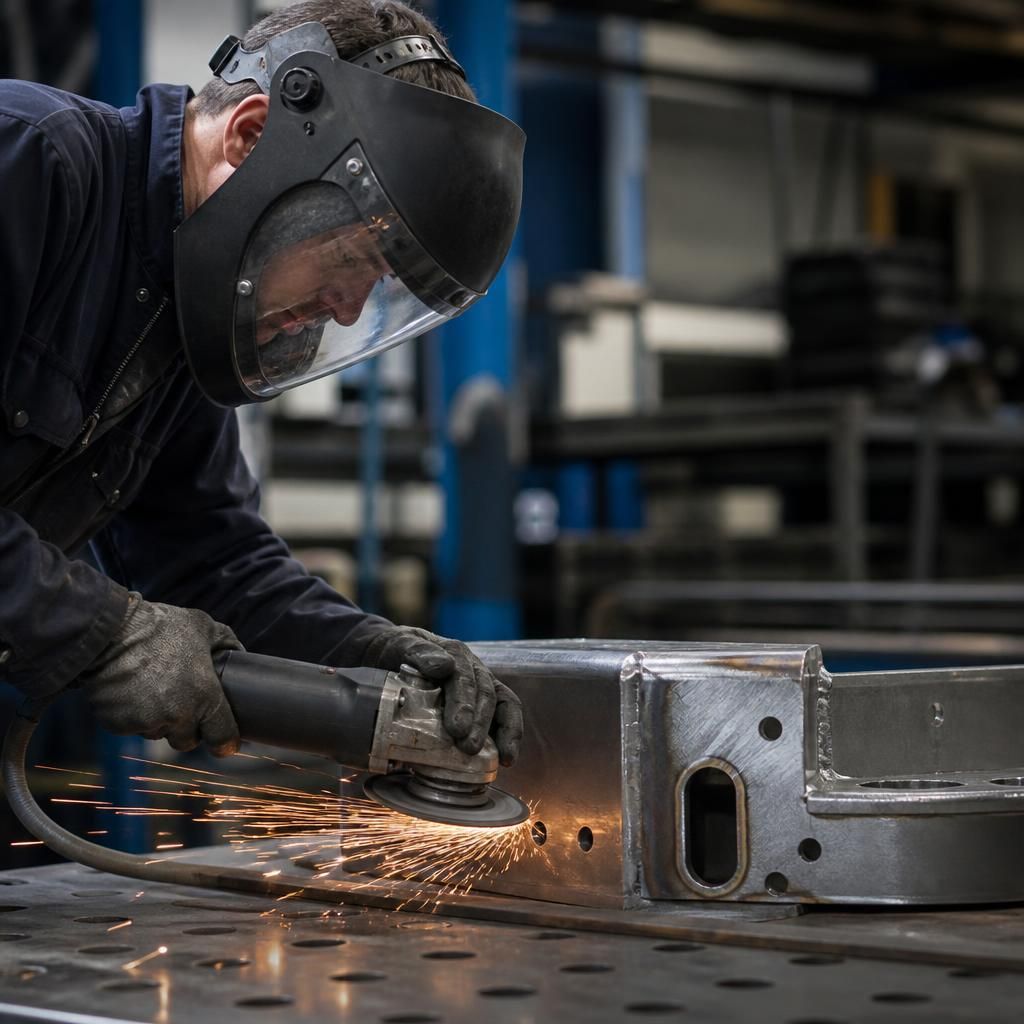
Controlling the metal’s surface profile is a key preparation measure because adhesion depends on more than removing visible dirt. A surface that is excessively smooth may give the powder coating little mechanical key, while an overly rough or uneven profile can remain visible through the finish and create variable coating thickness.
Preparation therefore involves removing burrs, weld spatter, sharp projections and loose corrosion, then producing a consistent surface suitable for the specified coating system. Particular care is needed around welds, edges, pits and repaired areas, where abrupt changes in texture can lead to thin coverage or visible irregularities. Keeping the profile consistent across the component gives the powder a more uniform foundation and helps the finished surface meet the required appearance and performance standards.
Discuss your powder coating preparation requirements
Discuss your substrate, existing finish and coating specification with the preparation team so the required defect-prevention measures can be identified before processing. Providing details of component design and intended use will help establish a suitable preparation approach.