

What are the advantages of using specialised degreasing agents in the powder coating process?
Specialised degreasing agents are formulated to remove specific oils, grease, residues and contaminants from metal surfaces before powder coating. By matching the agent to the substrate and contaminant, they promote a cleaner surface, more consistent powder adhesion and a reduced risk of defects such as peeling, blistering or uneven coverage.
Specialised degreasing agents improve the powder coating process by targeting particular contaminants and substrates rather than treating every metal surface with the same general-purpose cleaner. Their main advantages are more controlled soil removal, better compatibility with the component and pretreatment stages, more repeatable preparation, and reduced risk of residues that can interfere with subsequent processing.
They are formulated for specific contaminants. Metal components may carry machining oils, cutting fluids, pressing lubricants, drawing compounds, waxes, fingerprints or storage residues. These substances differ in how they respond to water, alkalinity, solvents and surfactants. A specialised agent can be selected for the type of soil present, helping it dissolve, emulsify or lift the contaminant so it can be removed during washing and rinsing. This is more controlled than relying on a cleaner that is only broadly effective.
They can be matched to the substrate. Steel, galvanised steel and aluminium do not react identically to cleaning chemistry. A product suitable for one substrate may be unnecessarily aggressive for another, particularly if concentration, temperature or contact time is poorly controlled. A substrate-compatible degreaser helps remove contamination while limiting unwanted effects such as staining, excessive etching or changes to the metal surface. The correct choice is especially important where components include more than one metal or have previously received a treatment.
They support the pretreatment system. Degreasing is often the first stage in a wider preparation sequence. If oil or grease remains, it can interfere with conversion coatings or other pretreatment layers. Specialised agents can be chosen to work with the following stages, including the required rinsing and surface conditioning steps. This reduces the likelihood that the degreaser will leave a film, alter the surface unnecessarily or compromise the chemistry used later in the line.
They provide more predictable process control. A defined product has known operating requirements, such as its working concentration, temperature range, application method and suitable contact time. These parameters give operators a repeatable process that can be monitored through bath checks, solution maintenance and inspection of cleaned parts. Repeatability is valuable for batch work because changes in contamination levels or component geometry can otherwise produce inconsistent preparation from one load to the next.
They are useful for difficult component geometries. Powder coating work may involve folded sections, drilled holes, recesses, joints and fabricated assemblies where oils can collect. Some specialised formulations are designed to improve wetting, allowing the solution to spread across the surface and enter less accessible areas. This does not remove the need for suitable equipment, agitation, spray coverage or rinsing, but it can make the cleaning stage more effective when the agent and application method are properly matched.
They can reduce residue-related problems. Effective degreasing is not simply a matter of making a part look clean. A component may appear acceptable while carrying a thin chemical or oily film. A suitable product should be capable of being rinsed away under the conditions used by the coating process. Rinse quality, water condition, drainage and drying remain important, because cleaner residue or trapped moisture can create problems during later preparation and curing.
They help protect the wider coating process. Excess oil and grease can transfer to tanks, spray equipment, handling tools or other components. Using chemistry designed for the relevant contamination helps control that carry-over and makes cleaning equipment and maintaining process baths more manageable. It also helps separate the removal of organic soils from later stages whose purpose is to condition or protect the metal.
Selection should therefore consider the contaminant, substrate, component design, application method, pretreatment sequence and waste-handling arrangements. A solvent-based product may be appropriate for a particular oil, while an aqueous alkaline or emulsifying formulation may be better suited to a production washing system. The strongest or most aggressive agent is not automatically the best choice; suitability, rinsability and control are more important than strength alone.
Before full production, the degreaser should be assessed on representative parts with the intended concentration, temperature, contact time and rinsing method. The cleaned surface can then be checked for visible residue, water behaviour and compatibility with the next preparation stage. This practical assessment confirms whether the specialised agent is delivering the required level of preparation without introducing a new process issue.
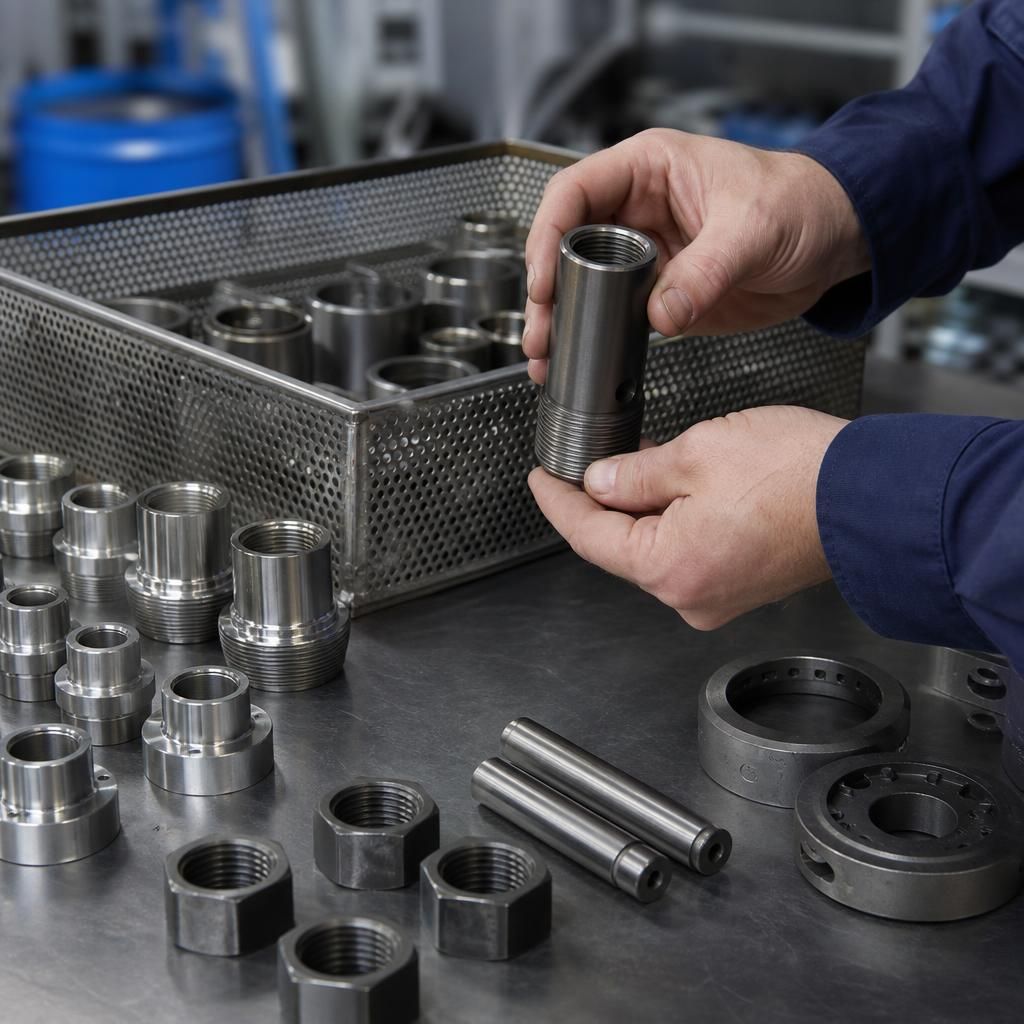
A further advantage of a specialised degreasing agent is greater control over the condition of functional metal surfaces. When the formulation is suited to the substrate and the contaminant, effective cleaning may be achieved without unnecessarily harsh chemical action. This is important for components with fine threads, close-fitting interfaces, sharp edges, machined faces or thin sections, where excessive etching or surface alteration could affect assembly or performance.
For these parts, degreasing should be assessed as part of the component’s specification rather than as a separate cosmetic cleaning step. The selected agent and operating conditions should remove production oils while preserving the features that powder coating must not obscure or alter. Representative components can be inspected after cleaning for staining, attack or changes to critical surfaces before the process is applied to a full batch.
Ask about specialised degreasing for your powder coating process
If you are assessing a degreasing stage for powder coating, discuss your component materials, contaminants and existing preparation sequence with the Powder Coatings team. This can help identify a suitable cleaning approach for representative parts before production processing.