

How does the powder coating process enhance the durability of steel tubes in comparison to alternative coating methods?
Powder coating enhances steel tube durability by forming a fully cured, strongly bonded finish that provides high resistance to impact, abrasion, moisture and weathering. Compared with conventional liquid paint, it is generally less prone to chipping, peeling and premature wear, although performance still depends on thorough steel preparation, correct application and the service environment.
Powder coating enhances the durability of steel tubes by creating a continuous thermoset polymer film that is chemically cured onto the prepared steel surface. Unlike a conventional wet-paint layer, which relies on solvent evaporation or water loss, the powder melts, flows and cross-links during curing. This produces a dense finish with consistent film formation and strong adhesion, helping the tube withstand the mechanical and environmental stresses found in industrial use.
The durability advantage is not simply a result of applying a thicker layer. It comes from the structure of the cured coating and the way it protects the steel. A correctly applied powder coating can provide:
- Resistance to mechanical wear: the cured film is less likely to soften or mark under routine handling, contact and friction than many general-purpose liquid paints.
- Protection from moisture: the coating forms a barrier that restricts water reaching the steel, reducing the conditions needed for surface corrosion.
- Resistance to edge and surface damage: powder can flow over the tube profile to form an even film, provided sharp edges, welds and other difficult areas have been properly prepared.
- More uniform coverage: electrostatic application encourages powder particles to deposit across the accessible surface before curing, reducing some of the unevenness associated with manual liquid application.
- Stable appearance: suitable formulations can retain colour and gloss more effectively than coatings not designed for outdoor or industrial exposure.
Compared with conventional liquid paint, powder coating generally offers a tougher and more resilient finish. Wet paint can remain vulnerable to solvent entrapment, runs, sagging, pinholes and variation in film thickness if application conditions are poorly controlled. It may also require multiple coats and drying stages. Powder coating is applied as a dry film and cured in a controlled oven, which helps create a consistent finish without the same solvent-related drying defects. However, liquid paint remains useful where very large structures cannot be placed in a curing oven, where on-site repairs are necessary or where a specialised multi-layer system is specified.
Powder coating also differs from a simple primer-and-paint system. A primer can improve adhesion and corrosion protection, while a topcoat provides colour and additional resistance. Powder systems can incorporate primers, topcoats or specially formulated single-coat products, depending on the steel tube, exposure conditions and required specification. For aggressive environments, a suitable pre-treatment and compatible coating system are more important than selecting a finish on appearance alone.
Hot-dip galvanising protects steel by applying a zinc layer that acts both as a physical barrier and, when exposed, as a sacrificial metal. It can therefore be highly effective where long-term corrosion protection is the primary requirement. Powder coating provides a broader choice of colours, textures and surface appearance, and is often preferable where visual consistency, component identification or a clean architectural finish matters. Galvanised steel can also be powder coated, but the zinc surface needs appropriate preparation and a compatible system to avoid adhesion problems.
Electroplated coatings use a deposited metal layer, such as zinc or another specified material, rather than a cured polymer film. They can be valuable for smaller components or applications requiring particular electrical, dimensional or friction characteristics. On larger steel tubes, powder coating is often a more practical route to a continuous decorative and protective finish. Its performance is still dependent on the coating specification and on protecting cut ends, drilled areas and damaged sections that expose bare steel.
Powder coating is not automatically the best choice for every service environment. Prolonged immersion, severe chemical exposure, high operating temperatures, intense ultraviolet exposure or repeated impact may require a specialist resin, primer system or an alternative coating technology. The tube’s intended use should be assessed alongside the steel grade, wall thickness, geometry, handling method, exposure conditions and required appearance. Coating suppliers may also need details of welds, enclosed sections and areas that must remain uncoated.
In practical terms, powder coating improves steel tube durability when four controls work together: the surface is clean and suitably pre-treated; the powder is applied at the specified film build; the coating reaches its required curing conditions; and the finished tube is handled and installed without cutting through the protective layer. These controls allow powder coating to outperform ordinary paint in many industrial applications, while recognising that no coating can compensate for unsuitable design, poor preparation or an environment beyond its specification.
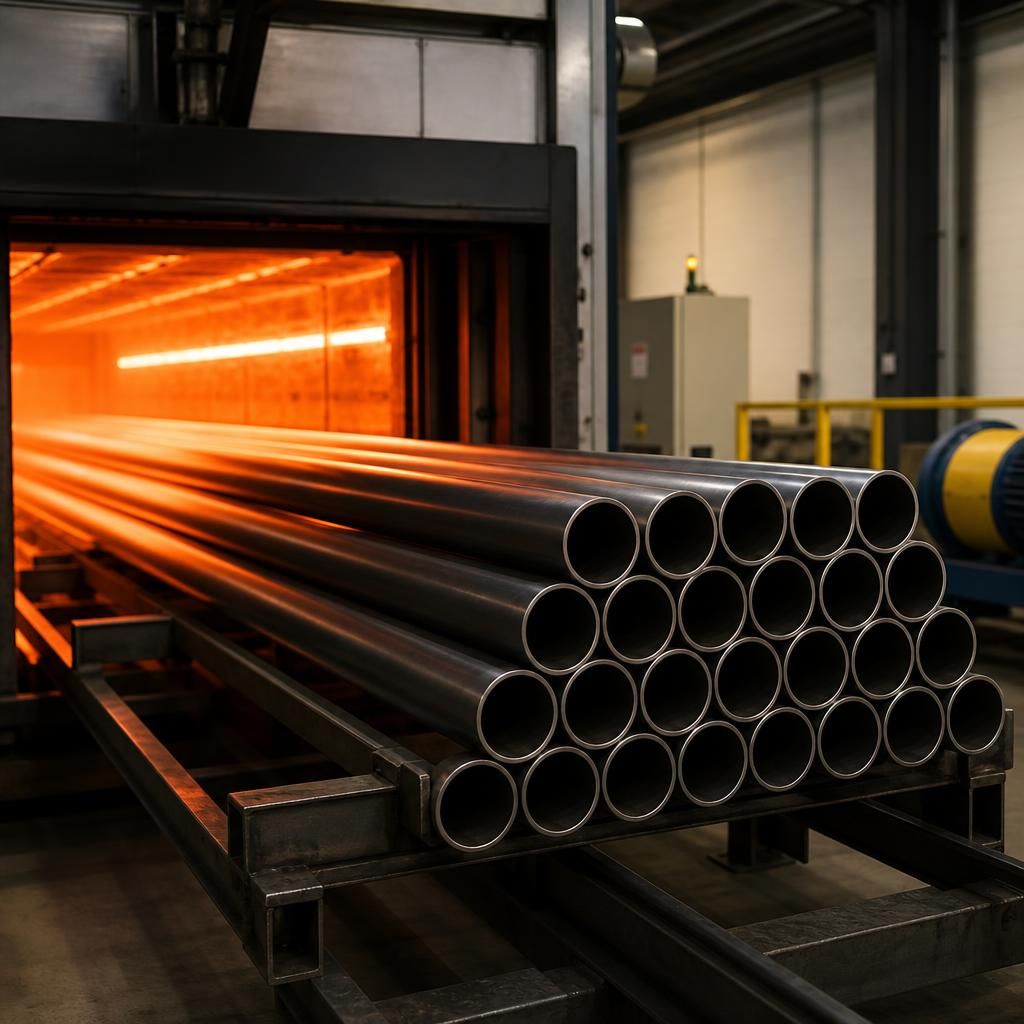
Thermal cycling is another factor in a steel tube’s service life. Outdoor and industrial components may repeatedly heat up and cool down, causing the steel and its coating to expand and contract. A correctly specified, fully cured powder coating can maintain a firmly bonded protective film through these routine changes, reducing the risk of cracking or loss of adhesion associated with an unsuitable coating system.
This advantage depends on matching the powder chemistry and curing specification to the tube’s operating conditions. Where temperatures are unusually high or fluctuate severely, a standard decorative powder may not be appropriate; the coating provider should assess the expected temperature range and select a system designed for that exposure. This makes powder coating more than a colour finish: when correctly specified, it forms part of the tube’s wider protection against service-related deterioration.