

How do powder coated steel tubes perform against chemicals and solvents in industrial settings?
Powder coated steel tubes generally resist many common chemicals, oils and cleaning agents, but performance depends on the powder formulation, cure quality, chemical concentration, temperature and contact duration. Strong solvents, acids, alkalis or prolonged immersion can soften, stain or degrade the finish, so the coating should be selected and tested against the specific substances used in the application.
Powder-coated steel tubes provide chemical protection by forming a continuous polymer film over the steel surface. The coating acts as a barrier, limiting direct contact between the substrate and industrial fluids. Its performance is not determined by colour or film appearance alone: the resin system, coating thickness, cure, edge coverage and service conditions all affect how the tube behaves in use.
Resistance varies by coating chemistry. Epoxy-based powders are often selected where chemical resistance is a principal requirement, particularly for internal or sheltered components. Polyester systems are commonly considered for external applications because they can provide better resistance to weathering, although their resistance to a particular chemical still needs to be confirmed. Hybrid systems combine properties from more than one resin type. The appropriate choice depends on the fluid, exposure pattern and environmental conditions rather than on the generic term “powder coating”.
Industrial exposure can take several forms, each presenting a different challenge:
- Brief splashes: a well-cured coating may tolerate occasional contact when the fluid is removed without delay.
- Repeated wetting: frequent contact can allow the substance to penetrate weak points, particularly around damaged areas, joints and edges.
- Standing contamination: residues left on the surface give the chemical more time to interact with the film and may cause swelling, dulling or loss of adhesion.
- Immersion or trapped fluid: continuous exposure is more demanding than surface contact and should be assessed through application-specific testing.
- Vapour exposure: fumes can affect coatings in enclosed or poorly ventilated areas, especially where condensation forms on the tube.
The condition of the coating is equally important. Powder coating is a protective barrier, so a deep scratch, impact, pinhole or poorly coated weld can become the first point of chemical attack. Once the film is breached, fluid can reach the steel and corrosion may develop beneath the surrounding coating. Tube ends, sharp corners, brackets, fasteners and handling marks therefore deserve particular attention during specification and inspection.
Temperature changes the result. Heat can soften some coating films and increase the rate at which chemicals move through them. Repeated heating and cooling can also create expansion stresses between the steel and the coating. In a process area, the maximum surface temperature should be considered alongside the chemical itself. A finish that is suitable at ambient temperature may not provide the same protection on a heated tube or near hot process equipment.
Compatibility should be checked against the exact substance, not just its broad category. Oils, hydraulic fluids, detergents, disinfectants, fuels, coolants, solvents, acids and alkaline cleaners can vary substantially in formulation and concentration. Additives, contaminants and cleaning methods may alter their effect on the coating. Safety data sheets can help identify the relevant constituents, but the coating supplier or applicator may also need details of concentration, temperature, contact time, cleaning frequency and whether the tube is exposed continuously or intermittently.
Testing is preferable to assumption for critical applications. A representative coated sample can be exposed to the actual chemical under defined conditions and then inspected for:
- softening, swelling or tackiness;
- colour change, staining, blistering or loss of gloss;
- cracking, flaking or reduced adhesion;
- corrosion at a scribe or artificial defect; and
- changes in hardness or film integrity after cleaning.
Testing should reproduce the intended service as closely as practical, including the substrate preparation, coating system, cure and film build proposed for production. A general chemical-resistance chart is useful for initial selection, but it cannot fully represent a mixture, elevated temperature, abrasive cleaning regime or repeated wet-and-dry cycle.
Preparation and curing have a direct bearing on chemical performance. Oil, scale, moisture and residues left on the steel can interfere with adhesion. Inadequate curing may leave the powder film with incomplete cross-linking, reducing its resistance to solvents and cleaning agents. Excessive film build, contamination during application or uneven coverage can also produce defects. Inspection of the finished tubes should therefore include visual checks and, where the application warrants it, tests for cure, adhesion, coating continuity and film thickness.
Good handling and maintenance help preserve the barrier. Tubes should be protected from impact during transport and installation, and cutting, drilling or welding after coating should be avoided where possible. If site work is unavoidable, exposed steel and coating edges need a compatible repair system specified for the service. Spilled chemicals should be removed using the cleaning method approved for the coating; aggressive solvents or abrasive tools may cause more damage than the original contamination.
For a demanding installation, the specification should record the powder type, intended exposure, operating temperature, cleaning regime, acceptable contact duration and required test evidence. A specialist coater can use this information to assess whether a standard finish is appropriate or whether a formulation, preparation method or additional protective treatment is needed. This approach gives a more reliable result than selecting a coating based only on colour, appearance or general claims of chemical resistance.
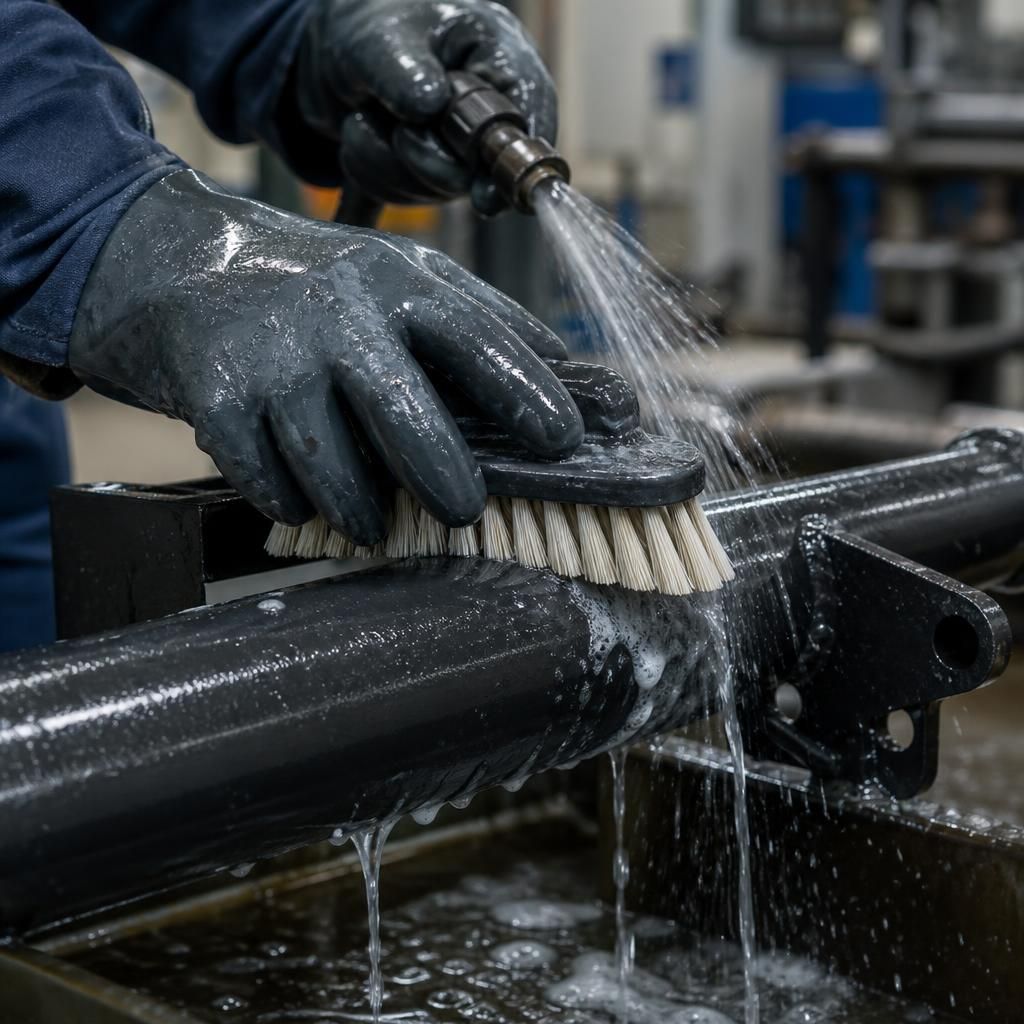
In industrial settings, chemical exposure is often combined with abrasion. Powder coated steel tubes may be affected not only by a fluid itself, but also by rubbing, impact from conveyed materials, contact with tools or repeated washdown. Abrasion can thin or damage the film, leaving areas where the chemical can reach the steel more easily.
For this reason, coating selection should consider the complete exposure rather than chemical compatibility alone. The assessment should include the likely source of mechanical wear, the cleaning equipment used and whether contamination can collect against the tube. A finish that performs well during static contact may be less suitable where frequent handling, friction or abrasive residues are present. Inspection should pay particular attention to high-contact areas and any locations where coating damage could combine with chemical contamination.
Discuss chemical-resistant powder coating for your steel tubes
Discuss the chemicals, solvents, temperatures and cleaning conditions your steel tubes will encounter with a powder coating specialist. This allows the coating system and any application-specific testing to be considered before production.