

What quality assurances does Perfect-It Powder Coating provide to ensure its finishes withstand stringent industrial performance criteria?
Perfect-It Powder Coating provides quality assurance through rigorous testing and checks for finish consistency against the performance criteria specified for each industrial application. This supports durable, uniform coatings on metal components used in demanding manufacturing, fabrication, construction and automotive environments.
Perfect-It Powder Coating’s quality assurance is specification-led: each coating job is assessed against the functional requirements of the finished component, rather than judged solely on appearance. This approach helps establish the appropriate preparation, coating system, application controls and inspection requirements before production begins.
A key assurance is control of the metal surface before powder is applied. Contamination, oxidation, oil, moisture and poorly prepared areas can reduce coating adhesion and shorten service life. Components therefore require suitable preparation for their material, condition and intended use. Particular attention is needed where parts include welds, edges, recesses, joints or mixed substrates, as these areas can create variations in coverage or provide points of premature failure.
Powder selection is also matched to the operating conditions specified for the component. Factors such as exposure, handling, abrasion, moisture, chemicals, temperature and the required appearance can affect the appropriate coating system. Where a specialist finish is required, including protective or nylon coating, the process must be assessed against the relevant performance expectations rather than treated as a standard decorative application.
During application, quality assurance focuses on achieving an even, complete finish across the whole component. This includes checking visual uniformity and identifying issues such as inconsistent coverage, pinholes, inclusions, contamination, runs or damage. Complex geometries and batch work require particular care because changes in component shape can influence how powder reaches edges, internal sections and recessed surfaces.
Curing is another important control. The coating must receive the conditions required to form a properly bonded and durable film. Inadequate or uneven curing can affect hardness, adhesion, flexibility and resistance to the environment, even where the surface initially appears acceptable. For this reason, finish assessment considers the coating as a functional protective layer as well as a visible surface.
For industrial orders, useful quality assurances include:
- reviewing the component design, substrate and service conditions before processing;
- using preparation and coating methods suited to the metal and the specified finish;
- checking the completed surface for consistent coverage, appearance and visible defects;
- assessing the finish against the performance criteria relevant to its intended application;
- maintaining clear production information so that requirements can be checked consistently across a batch; and
- identifying and addressing any finish that does not meet the agreed specification before the component is released.
These controls are especially relevant where coated parts form part of a larger manufactured assembly. A finish that looks acceptable but has weak adhesion, incomplete coverage or unsuitable resistance may create problems during installation or service. Quality assurance therefore links the finished coating to the component’s actual industrial use, giving manufacturers, fabricators, construction firms and automotive businesses a clearer basis for evaluating conformity with their requirements.
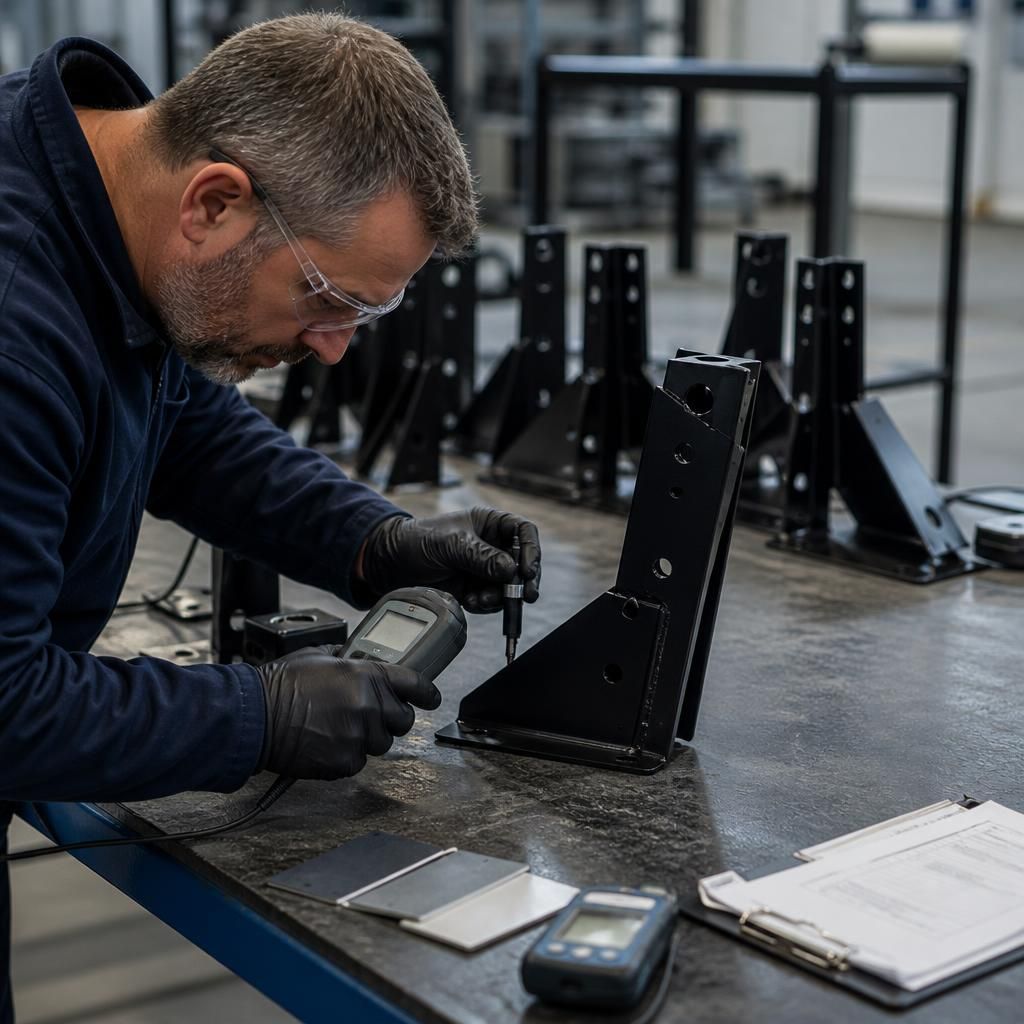
Industrial powder coating quality assurance can include performance testing in addition to visual inspection, so the finished coating is assessed against how the component will be used. The relevant checks depend on the agreed specification and may examine adhesion, film thickness, hardness, flexibility, impact resistance or resistance to moisture, chemicals and abrasion.
These tests help identify defects that may not be visible on the surface. A coating can appear uniform yet fail to provide the required bond or protection if its film properties are unsuitable for the operating environment. Results can therefore be considered alongside the component’s substrate, service conditions and required finish when confirming whether the coating meets the specified industrial criteria.
Discuss Your Industrial Powder Coating Quality Requirements
Discuss your component specification and service conditions with Perfect-It Powder Coating to establish the quality checks relevant to the required finish. Providing details of the substrate, operating environment and performance criteria helps ensure the coating requirements are clearly defined.