

How does Perfect-It Powder Coating ensure quality and consistency in large-scale batch applications?
Perfect-It Powder Coating supports quality and consistency in large-scale batch applications through controlled preparation, powder application, curing and inspection at key stages. This repeatable process helps produce an even, durable finish across batches of metal components, including parts with differing sizes and geometries.
Perfect-It Powder Coating ensures quality and consistency in large-scale batch applications by treating each batch as a controlled production specification rather than as a series of unrelated coating jobs. The required finish, substrate, component geometry, powder type, colour, film characteristics and curing requirements are established before processing, then applied consistently across the full production run.
For repeat orders, maintaining a clear specification is particularly important. Components may be produced at different times or in separate batches, so the coating requirements need to remain unambiguous. A defined specification can cover the agreed colour, gloss level, surface appearance, coating system, areas to be coated and any masking or uncoated zones. This gives production staff a consistent reference and reduces the risk of variation caused by assumptions or informal instructions.
Batch planning also affects the finished result. Parts are assessed according to their size, weight, profile and surface area so that they can be handled and presented appropriately during coating. Components with deep recesses, apertures, edges or complex profiles may require a different hanging or positioning arrangement from flat or straightforward parts. Considering these details before processing helps the powder reach the intended surfaces and supports a more uniform appearance throughout the batch.
- Consistent job information: specifications identify the finish and treatment required for each component or batch.
- Suitable batch grouping: compatible parts can be processed together where their material, geometry and coating requirements allow.
- Controlled handling: parts are arranged to support reliable access to the surfaces being coated and to minimise avoidable contact damage.
- Repeatable settings: agreed process conditions can be maintained across the production run rather than adjusted inconsistently from one item to the next.
- Defined acceptance criteria: the finished work can be assessed against the relevant specification for appearance and coverage.
Powder application needs to account for the differences between individual components. A large panel, a narrow bracket and a fabricated assembly do not present the same electrical and physical conditions during coating. Edges, corners and recesses can behave differently from broad faces, while assembled parts may create areas that are difficult to access. A consistent batch process therefore depends on selecting an appropriate application approach for the parts being handled, rather than assuming that one arrangement will suit every geometry.
Film thickness is another important consideration. An excessively light deposit may provide an uneven appearance or insufficient coverage, while an excessively heavy deposit can affect the finish and the way adjoining surfaces fit together. Monitoring the coating against the agreed requirements helps balance coverage, appearance and the functional needs of the component. This is especially relevant where coated parts form part of an assembly and excessive build-up could affect clearances, threads or mating faces.
Large-scale work also benefits from traceable batch control. Keeping components, specifications and processing stages associated with the correct job makes it easier to identify which parts belong together and to investigate any discrepancy. Clear identification is valuable where a customer supplies several component types, uses more than one finish or requires different treatment within the same delivery. It also supports more reliable repeat production because the relevant requirements can be referred to when a similar order is processed again.
Quality checks should be applied to representative parts as well as to the wider batch. A suitable check may consider colour and visual uniformity, coverage of relevant surfaces, finish defects, edge treatment and any areas that were intentionally masked or left uncoated. Components can also be checked for damage caused during handling, packing or movement between stages. These checks help separate a coating issue from a fabrication, preparation or handling issue and make any necessary corrective action more focused.
Where a component does not meet the agreed requirements, it should not simply be mixed back into conforming production. The item can be identified and assessed so that the cause is understood before deciding whether it requires rework, further treatment or customer clarification. Separating non-conforming parts protects the consistency of the remainder of the batch and avoids creating uncertainty when finished components are returned for assembly or installation.
Consistency is not limited to achieving the same appearance on one production run. It also means producing a finish that remains aligned with the specified requirements across different component sizes, shapes and repeat orders. By combining clear job specifications, planned batch handling, suitable application arrangements, traceable production information and structured checks, Perfect-It Powder Coating provides a controlled basis for large-scale powder coating where uniformity matters across the complete batch.
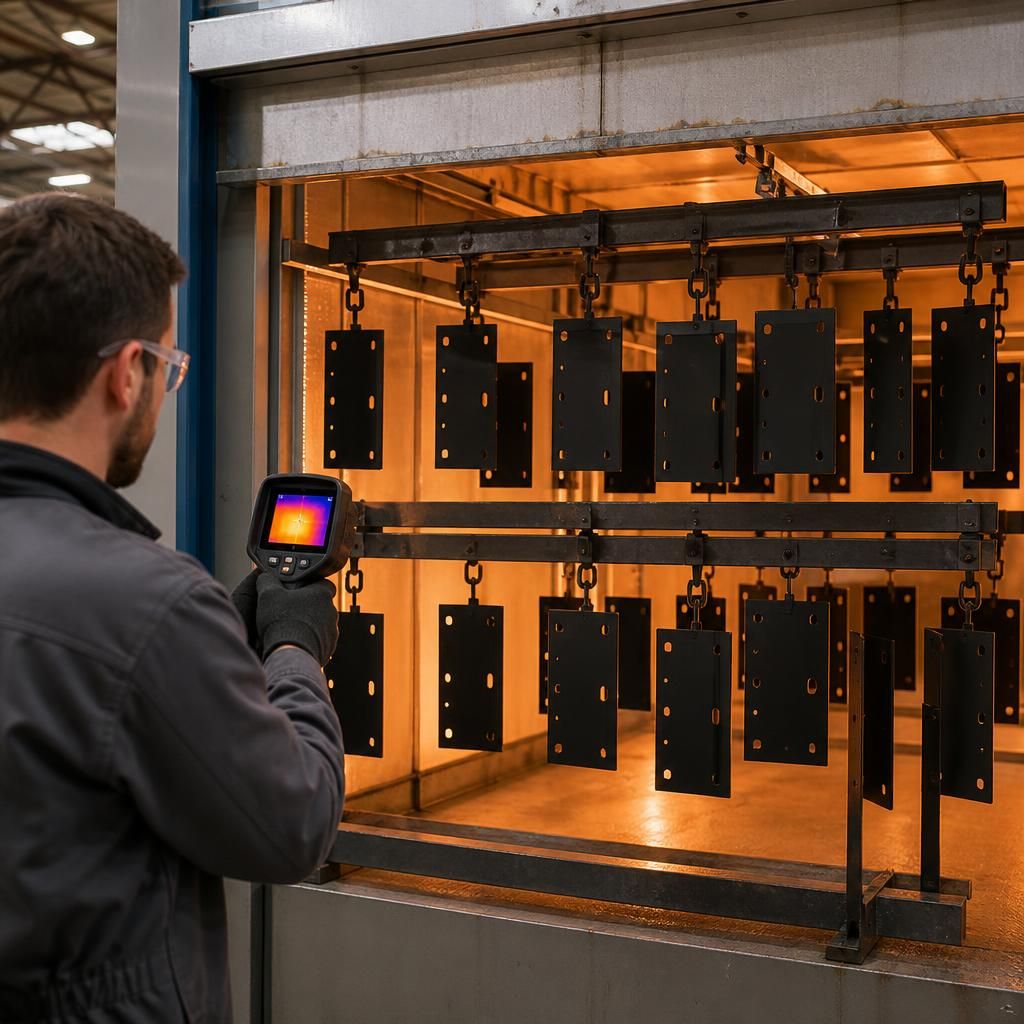
Curing is a critical control point in large-scale batch powder coating. The powder must reach its specified metal temperature for the required dwell time so that it flows, bonds and develops the intended finish. Oven air temperature alone does not confirm this, because heavier components heat more slowly than lightweight parts.
Where a batch contains different component sizes or material thicknesses, the loading arrangement and cure schedule must account for these differences. Controlling the thermal cycle helps prevent under-cured areas, excessive heat exposure and variation between parts. This supports consistent coating performance and appearance across the complete production run, including repeat batches processed to the same specification.
Discuss your large-scale batch powder coating requirements
Discuss your large-scale batch powder coating requirements with Perfect-It Powder Coating, including component materials, dimensions, finish specifications and production volumes. The team can help establish a suitable coating approach for your application.