

Is it necessary to degrease metal surfaces prior to applying an epoxy primer for powder coating?
Yes. Metal surfaces should be degreased before applying an epoxy primer to remove oils, grease and other contaminants that can interfere with adhesion and compromise the powder-coated finish.
An epoxy primer should only be applied to metal that has been cleaned to an oil-free condition. Degreasing is therefore a required preparation stage, not an optional finishing step. It removes contamination that may be invisible but can still prevent the primer from wetting and bonding consistently to the substrate.
Metal parts can carry cutting fluids, stamping oils, grease, polishing compounds, fingerprints and residues from handling or storage. Fabrication may also leave hydraulic oil, drawing lubricant or protective film on the surface. If these substances remain, the primer can form a weak boundary layer rather than contacting the metal directly. This may lead to localised adhesion failure, blistering, cratering, pinholes or premature corrosion beneath the coating system.
Degreasing should be considered separately from abrasive preparation. Abrasive blasting, scuffing or other mechanical methods can create a suitable surface profile, but they do not reliably remove every contaminant. In fact, working an oily surface mechanically can spread contamination across the part or drive it into surface irregularities. A typical preparation sequence is:
- Initial inspection: identify visible oil, grease, old protective coatings, weld residue and areas that need a different treatment.
- Degreasing: use a suitable cleaning method and a product compatible with the metal and the subsequent primer system.
- Rinsing or residue removal: where the cleaner requires it, remove dissolved contamination and cleaner residue rather than allowing it to dry on the part.
- Mechanical or chemical preparation: produce the required surface condition for the particular substrate and coating specification.
- Final inspection and drying: confirm that the metal is clean, dry and free from cleaning residue before applying the epoxy primer.
The correct degreaser depends on the substrate, the type of contamination and the rest of the preparation process. A cleaner that is suitable for carbon steel may not be appropriate for aluminium, stainless steel or zinc-coated components. The product must also be compatible with any subsequent pretreatment; some cleaners leave alkaline, surfactant or solvent residues that can interfere with adhesion if they are not properly removed.
Cleaning is not complete merely because the surface looks bright. A visual inspection should check for oily patches, streaking, water marks, dust and handling contamination. A surface that allows water to spread evenly is generally more indicative of consistent cleanliness than one where water pulls away into beads, although this type of check does not replace the agreed preparation specification. Clean gloves and suitable handling practices are important after degreasing, since bare hands can reintroduce oils to the prepared surface.
Parts should be thoroughly dry before epoxy primer is applied. Trapped moisture, cleaner residue or condensation can affect the primer film and may contribute to corrosion or adhesion defects. Particular care is needed around joints, folded sections, drilled holes, welds and recesses, where liquid can remain after washing. If contamination is discovered after preparation, the affected area should be cleaned again rather than simply coated over.
For industrial work, the preparation method should be selected alongside the primer manufacturer’s technical data and the required coating specification. Where the components are heavily contaminated, have previously been coated, or contain complex geometry, a simple wipe may be inadequate. Proper degreasing, followed by the appropriate preparation and inspection, gives the epoxy primer a clean and stable surface on which to bond and helps the finished powder coating system perform as intended.
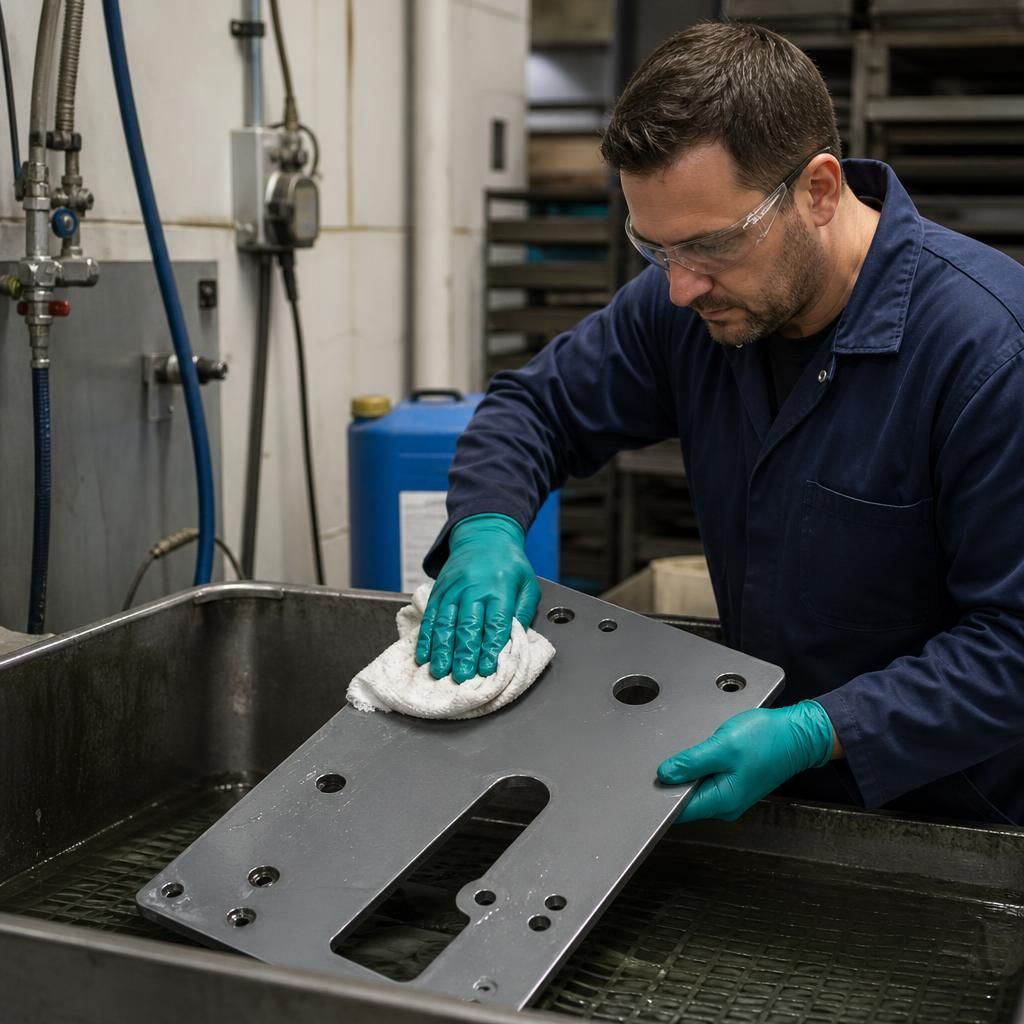
Degreasing should be controlled as part of the coating specification rather than treated as a final wipe before priming. For batch work, the substrate, likely contaminants, cleaning method and acceptance condition should be agreed before components reach the epoxy primer stage. This helps maintain consistent preparation when parts come from different fabrication, storage or handling conditions.
Where contamination levels vary across a component or production batch, checking representative prepared parts can identify whether the chosen cleaning method is suitable before the full coating run begins. This is particularly useful for components with changing oil types, protective films or difficult-to-reach areas, where a method that works on one batch may not provide the same result on another.
Ask About Degreasing Before Epoxy Powder Coating
Before commissioning a batch, provide details of the substrate, existing coatings and intended service conditions so the coating team can review the proposed preparation and epoxy primer system. This helps establish whether the specification is appropriate for the components.