

What specific environmental conditions or stressors should be considered when selecting an epoxy primer for stainless steel?
When selecting an epoxy primer for stainless steel, assess exposure to moisture, salt, chemicals, UV radiation, temperature changes and mechanical abrasion. The primer should be compatible with the intended powder coating system and provide suitable resistance for the component’s operating environment, particularly where condensation, corrosive contaminants or thermal cycling may challenge adhesion and protection.
The environmental suitability of an epoxy primer for stainless steel depends on the complete service profile of the component, not simply on whether it will be used indoors or outdoors. Selection should account for the way the part is exposed, how long each exposure lasts, whether the coating is continuous or intermittent, and whether the stainless steel is connected to other metals or incorporated into a difficult-to-drain assembly.
Consider the exposure pattern. A component subjected to continuous immersion requires a different primer system from one exposed only to occasional splashing or airborne contamination. Immersion can place sustained pressure on the coating interface and reveal small pinholes, pores or poorly prepared areas that may not be evident in a dry-service application. Parts used in wash-down areas, drainage channels, tanks or enclosed plant should therefore be assessed against the actual exposure cycle rather than a broad description such as “industrial use”.
Assess crevices and retained deposits. Joints, folded sections, threaded connections, lap areas and recessed features can create localised conditions that are more aggressive than the surrounding surface. If the design allows liquid or process residue to remain trapped, the primer must be selected as part of a system capable of protecting these areas. Good drainage, sealed joints where appropriate and suitable edge coverage can be just as important as the resin chemistry. A primer cannot compensate fully for a geometry that continually retains contaminants at the coating boundary.
Check for galvanic interaction. Stainless steel may be assembled against aluminium, carbon steel, zinc-coated parts or other conductive materials. If an electrolyte reaches the joint, differences in electrochemical potential can encourage localised attack, particularly at exposed edges, fasteners and damaged coating areas. The specification should state whether the primer and powder coating are expected to provide electrical isolation at the joint, and whether additional sealing, compatible fasteners or an altered assembly detail is required.
Account for immersion media and cleaning regimes. The relevant question is not only what substance contacts the part, but also its concentration, temperature, frequency of contact and method of removal. A coating exposed to a brief rinse may face a different challenge from one subjected to repeated sanitation, solvent wiping or pressurised cleaning. Confirm that the complete primer and powder coating system has been evaluated for the intended regime. Resistance of the epoxy primer alone does not prove that the finished coating will remain sound.
Consider biological and hygiene-related conditions. Food-processing, pharmaceutical, agricultural and waste-handling equipment may be exposed to organic residues, microbial growth or cleaning cycles designed to remove them. These environments can place extra demands on smoothness, edge coverage, cleanability and resistance to repeated decontamination. The selected system should not create a rough or porous finish that allows deposits to remain in service-critical areas.
Review radiation and weathering beyond direct sunlight. Outdoor components can experience reflected radiation, sheltered and exposed zones, and different rates of surface ageing across one assembly. The epoxy primer is normally protected by the powder topcoat, but any area left exposed at a chip, cut edge or fixing point may age differently from the covered surface. Where long-term appearance or exposed-edge stability matters, choose a system in which the primer and topcoat have been assessed together rather than relying on the primer’s individual data.
Allow for unusual operating conditions. Pressure changes, vacuum service, vibration, flexing of thin sections and repeated impact can stress the coating interface even when the surrounding environment is otherwise moderate. These factors are particularly relevant to fabricated panels, enclosures, pipework supports and assemblies that move relative to one another. Where the substrate or joint can deform, a rigid primer may be unsuitable unless the full system has adequate flexibility and adhesion.
Examine the stainless steel condition. Weld scale, heat tint, embedded iron, polishing compounds and residues from fabrication can alter the surface beneath the primer. The environmental specification should therefore be linked to the required preparation standard and inspection process. A primer selected for severe service will still underperform if the stainless steel has not been cleaned, profiled and checked for residues before application.
Use the whole-system evidence. Ask for technical information covering the intended substrate, powder topcoat, film build, cure schedule and relevant exposure testing. Where the service conditions are unusual, representative test panels or sample components can be conditioned and inspected for blistering, delamination, cracking, softening and loss of adhesion. Testing should reproduce the actual assembly details, including welds, edges, fixings and joints, because a flat test panel may not show the areas most likely to fail.
For industrial stainless-steel work, the final choice should be recorded as a coating system specification: service environment, exposure pattern, preparation requirement, primer, powder topcoat, application limits and inspection criteria. This avoids treating epoxy primer as a universal barrier and makes the selection traceable to the conditions the finished component will actually encounter.
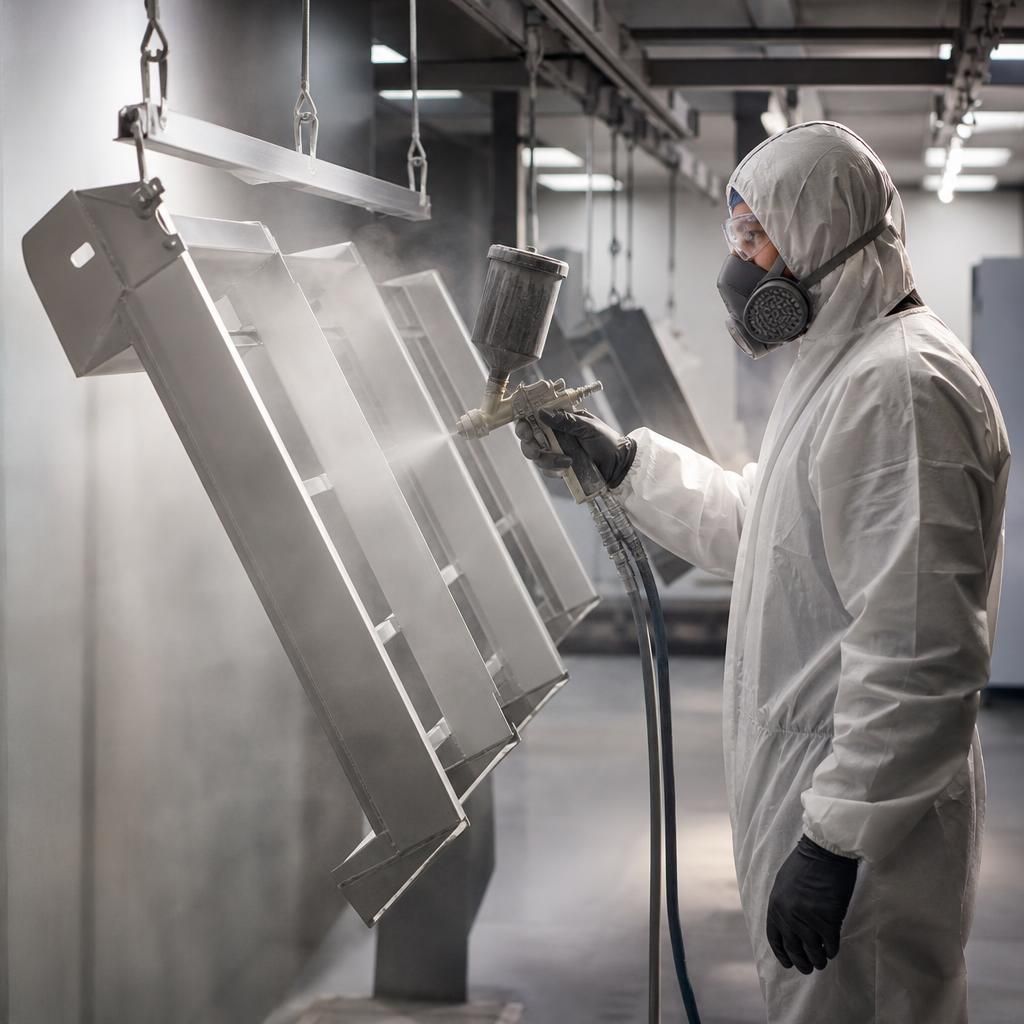
Environmental conditions during application can be just as important as those encountered in service. Stainless steel must be dry and sufficiently above the dew point, because invisible condensation can form between preparation and priming. Excessive humidity, low substrate temperature or poor ventilation may also slow epoxy curing and leave the film vulnerable before the powder topcoat is applied.
When selecting the system, check the primer’s application limits, recoat window and curing requirements against the coating facility and component size. Large or enclosed fabrications may have different temperatures across their surfaces, so inspection should confirm that the primer has formed a continuous, properly cured film before subsequent coating.
Discuss Your Stainless Steel Primer Requirements
Discuss your stainless steel components and intended service conditions with our team to help identify a suitable epoxy primer and compatible powder coating system. Provide details of the exposure, substrate condition and assembly design so the coating specification can be assessed against the actual application.