

What considerations should be made when assessing the compatibility of an epoxy primer with subsequent powder coating applications on stainless steel?
Assess compatibility by confirming that the epoxy primer is designed to accept the chosen powder coating, withstand its curing temperature and provide adequate intercoat adhesion. Also consider stainless-steel preparation, primer film thickness, full or partial cure before overcoating, and the chemical, thermal and mechanical conditions the finished component will face.
Compatibility means that the epoxy primer and powder coating form a stable coating system, rather than two separate layers that merely appear to bond after application. Assessment should therefore cover the primer’s formulation, the powder coating’s chemistry, the complete application sequence, the component’s geometry and the conditions it will encounter in service. The decision should be based on the relevant technical data sheets and, where the combination is not already validated, a representative trial panel or production sample.
Check the primer’s intended overcoating use
An epoxy primer selected for stainless steel is not automatically suitable beneath powder. Confirm that the manufacturer specifies compatibility with powder coating or with the intended type of powder coating. Some primers are designed for liquid topcoats and may contain additives, solvents or surface characteristics that interfere with powder deposition or bonding.
Review the primer’s recommended recoat interval, minimum and maximum overcoating windows, required surface condition and permitted application thickness. A primer that has remained exposed beyond its stated window may require additional preparation before powder is applied. The technical documentation should also identify whether the primer is intended to be fully cured, partially cured or overcoated within a particular stage of its cure.
Compare the complete coating system
Compatibility needs to be assessed as a system comprising stainless steel, pretreatment, epoxy primer and powder topcoat. The powder supplier’s guidance should be checked alongside the primer documentation, particularly where the powder has a different resin type or contains additives that could affect the primer surface.
Consider the finished appearance as well as adhesion. Differences in gloss, texture, colour, flow or shrinkage between the layers can produce visible defects even when the coating remains attached. The primer may also alter the final colour or texture if it is visible at edges, around apertures or through a thin powder film.
Review the cure schedule in practical terms
The specified powder cure should be compared with the primer’s temperature tolerance and cure requirements. Oven air temperature is not the same as the temperature reached by the stainless component, particularly where parts have substantial mass, complex geometry or are loaded closely together. A recorded process trial can help establish whether the complete component reaches the required metal temperature for the required time.
Insufficient curing may leave the primer mechanically weak or chemically vulnerable. Excessive heating can cause degradation, loss of adhesion, discolouration or other coating defects. The assessment should also consider the number of heat cycles, including any reheating caused by rework, because the coating system may not respond to repeated exposure in the same way as it does to a single cure.
Consider application and assembly details
The primer and powder application methods must allow the intended coverage without creating areas of excessive build. Recesses, internal corners, welded joints, perforations and sharp edges can collect material or receive less even coverage. These areas should be included in the compatibility trial rather than assessing only a flat test panel.
Masking requirements should be agreed before coating. Primer and powder on threads, mating faces, earth points, bearing surfaces or close-tolerance interfaces can affect assembly. The total coating build may also alter clearances, so critical dimensions should be checked after the complete system has been applied.
For electrostatic powder application, the part must provide a suitable electrical path. Primer on contact points, insulating residues or poor masking can affect powder deposition and produce uneven coverage. Contact locations should be selected so that they can be cleaned or repaired without compromising important coated surfaces.
Look for defects caused by the layered process
Residual solvent, moisture or contamination in the primer can lead to pinholes, bubbling, cratering, loss of flow or blistering during powder curing. The primer’s drying and handling requirements should be followed, and components should be protected from contamination between stages. Any sanding, abrading or repair work must be followed by suitable cleaning before powder application.
Welds and fabricated areas deserve particular attention. Welding can leave heat tint, flux residue, spatter, embedded contaminants or uneven profiles that behave differently from the surrounding stainless steel. If these areas are not represented in the trial, a flat-panel result may give a misleading assessment of the finished coating system.
Define suitable verification tests
Before approving the process, inspect representative coated samples for visual defects, coverage and uniformity. Adhesion can be assessed after the complete system has cured using a suitable test method, with results considered alongside the intended service conditions rather than treated as a universal pass or fail.
Where the component will experience handling, vibration or impact, mechanical testing should reflect its design and use. Where it will be exposed to moisture or chemicals, environmental exposure testing may be appropriate. Testing should include edges, welds, recesses and other locations that are more vulnerable than a broad, flat surface.
Keep a record of the stainless-steel grade and condition, pretreatment, primer batch and application method, primer thickness, powder specification, cure profile and test results. This makes it possible to distinguish a material incompatibility from a process variation if defects occur during production.
Assess repair and future maintenance
The proposed system should have a defined repair method. Establish how damaged areas will be cleaned, abraded, primed and recoated, and whether the repair coating will remain compatible with the existing epoxy and powder layers. If the component may later be stripped or recoated, consider whether the combined system can be removed without unacceptable damage to the stainless steel.
In practice, the most reliable assessment combines documented product compatibility with a controlled trial using the actual stainless component or a representative sample. Approval should follow satisfactory inspection and testing of the complete layered system, not solely the primer in isolation.
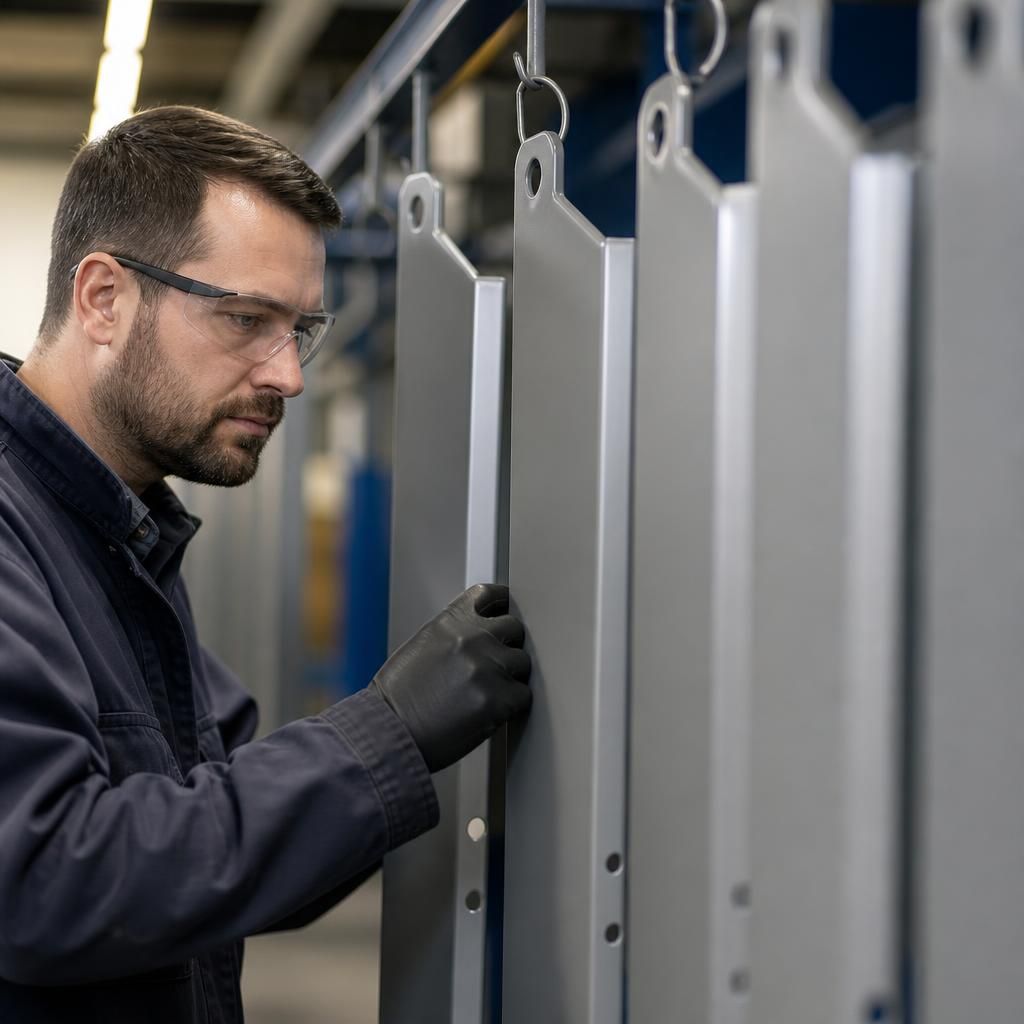
A fully cured epoxy primer does not automatically provide a suitable bonding surface for powder coating. Once cured, the primer may have low surface energy or a smooth finish that limits wetting and mechanical interlock as the powder melts. Compatibility assessment should therefore establish whether the powder can flow across the primer evenly and form a continuous bond during curing.
Where the primer has exceeded its specified overcoating period, the surface may need controlled abrasion and cleaning before powder application. The treatment must be sufficient to remove contamination and create a consistent key without cutting through the primer to expose stainless steel. Any exposed areas should be assessed separately, as they may behave differently from the surrounding primed surface.
Discuss Epoxy Primer Compatibility for Powder Coating on Stainless Steel
Share the stainless-steel component details, proposed epoxy primer and powder specification with the powder-coating team so the complete coating system can be reviewed before production. A representative sample can then support practical assessment of adhesion, finish and process suitability.