

What specific environmental factors should influence my choice of epoxy primer for metal in industrial projects?
Choose an epoxy primer for metal according to the exposure it must withstand: moisture and humidity, salt or corrosive chemicals, operating temperature, abrasion, and the level of ultraviolet exposure. Match the primer’s chemical and environmental resistance to the site conditions, while considering whether it will be overcoated with powder coating or another finish for additional protection.
The correct epoxy primer for metal is determined by two environments: the conditions during application and the exposure the coated component will face in service. A suitable specification should therefore consider condensation risk, pollution, immersion or splash exposure, temperature cycling, chemical contact, mechanical loading, the intended topcoat and the expected maintenance conditions, rather than selecting a primer by name alone.
Assess the actual exposure category
Indoor and outdoor locations can present very different risks. A dry, enclosed factory may expose steel to manufacturing dust, oil mist or cleaning products, while an external structure may experience rain, condensation and airborne contaminants. Coastal or heavily industrial areas can be more aggressive than sheltered inland sites because deposits remain on the surface and create an electrolyte when damp.
Also establish whether the component will experience:
- continuous contact with water or only intermittent wetting;
- standing water in recesses, joints or hollow sections;
- condensation caused by changes between warm and cold conditions;
- chemical splash, vapour or wash-down;
- buried, enclosed or poorly ventilated conditions; or
- frequent cleaning, disinfection or exposure to process fluids.
Intermittent wetting followed by drying can be more damaging than a consistently dry environment, particularly where contaminants are left behind. If a component will be immersed or exposed to persistent dampness, the primer specification should be based on that condition rather than on ordinary atmospheric exposure.
Consider condensation and application conditions
Environmental suitability applies before and during coating as well as after curing. Metal can be colder than the surrounding air, allowing invisible condensation to form even when the room itself feels dry. Moisture on the substrate can interfere with adhesion and contribute to early corrosion beneath the coating.
Before work begins, assess the substrate temperature, air temperature, relative humidity, ventilation and the likelihood of condensation. These conditions should be compared with the primer manufacturer’s technical data sheet. The coating should not be applied when the surface is damp, visibly contaminated or likely to collect moisture before the specified cure has been achieved.
Low temperatures may slow curing, while excessive heat can shorten working time and affect flow. Poor ventilation can also retain solvent or moisture and delay the development of the intended film properties. On large or complex fabrications, the conditions may vary between exposed faces, internal corners and enclosed areas, so one reading may not represent the whole component.
Match the primer to the chemical environment
Identify every substance likely to contact the coating, not only the principal process chemical. Oils, fuels, detergents, acids, alkalis, salts and cleaning agents can have different effects, and resistance to one chemical does not establish resistance to another. Concentration, contact time, temperature and whether exposure is continuous or occasional are all relevant.
Request chemical-resistance information for the cured primer system and check whether it applies to the complete coating build-up. A primer may perform adequately beneath a compatible topcoat but may not be intended to provide the final exposed surface. Where several substances are present, assess the most severe credible exposure, including spill retention in joints, trays or drainage areas.
Account for temperature changes and heat transfer
Service temperature should be considered alongside the rate and frequency of temperature change. Repeated heating and cooling can create movement between the metal, primer and finish, particularly where sections have different thicknesses or where one side is heated while the other remains cool. This may increase stress at edges, welds and joints.
Components near ovens, engines, exhaust systems or heated process equipment require a primer system whose cured properties remain appropriate at the operating temperature. Conversely, outdoor or refrigerated applications may demand reliable curing and adhesion at lower service temperatures. The specification should cover normal operation, cleaning cycles, start-up and shutdown conditions, and foreseeable excursions rather than relying on a single nominal temperature.
Review ultraviolet exposure and the complete coating system
Epoxy primers are commonly selected for adhesion and barrier protection, but prolonged sunlight can alter an exposed epoxy surface. Where the primer will remain visible, consider a finish designed for the required light exposure. Where it will be covered by powder coating or another compatible topcoat, confirm that the complete system provides the necessary protection and that the primer will not remain exposed at edges, fixing points or damaged areas.
Compatibility should be checked for substrate preparation, recoat timing, curing method and the selected finish. The primer’s technical documentation should specifically support the proposed coating sequence; a general statement that two products are both suitable for metal is not enough.
Consider geometry, drainage and mechanical exposure
Environmental risk is often concentrated at details rather than broad flat surfaces. Crevices, lap joints, sharp edges, welds, bolt heads and poorly drained sections can retain moisture and contaminants. The design and preparation of the component should allow the primer to reach these areas and avoid creating pockets where exposure is more severe.
Where the coating will face impact, rubbing, vibration or abrasive particles, select a system whose cured film is appropriate for that duty. This is not only a question of primer chemistry: edge coverage, film continuity, preparation quality and the protective topcoat also influence the result. Areas subject to repeated damage may need a repair and inspection procedure as part of the specification.
Use a documented selection process
- Map the component’s locations and identify the wettest, hottest, coldest and most contaminated areas.
- List the chemicals, cleaning agents and process materials that may contact the coating.
- Distinguish atmospheric exposure from splash, immersion, condensation and trapped moisture.
- Record application conditions and confirm that the primer can cure within them.
- Check compatibility with the intended powder-coated or liquid finish, including edges and repair areas.
- Obtain written technical guidance where the exposure is unusual, combined or more severe than ordinary atmospheric service.
This approach produces a specification based on the real operating environment rather than a generic corrosion category. It also helps the applicator identify where preparation, drainage, masking, curing or subsequent inspection needs particular attention.
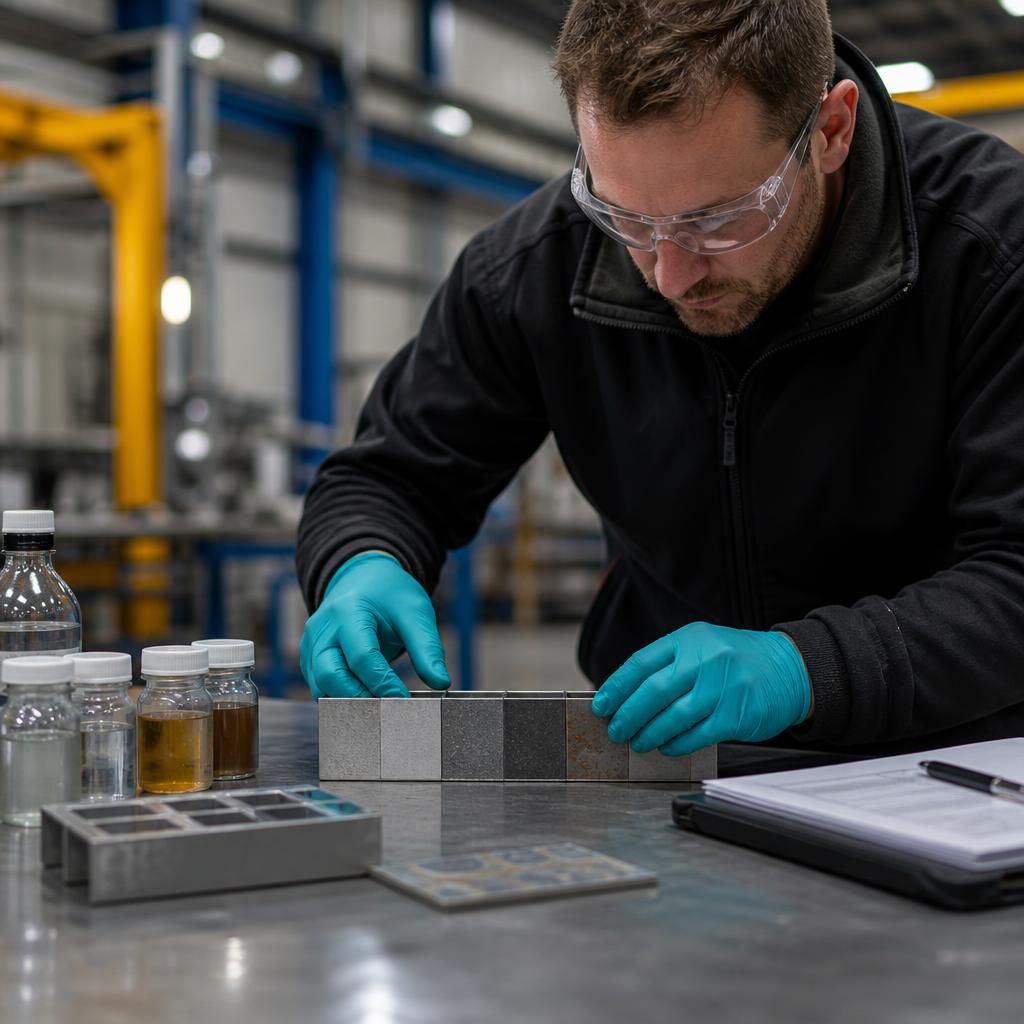
Where several environmental stresses occur together, select the epoxy primer by assessing the complete coating system rather than relying on separate resistance claims. For example, moisture, chemical cleaning and temperature cycling may place greater demands on the cured film than any one exposure considered in isolation.
For unusual or severe service conditions, a representative trial panel can help verify the proposed preparation, primer, topcoat and curing sequence. Expose the panel to the relevant cleaning process, fluids and temperature changes, then inspect for blistering, softening, loss of adhesion or visible corrosion. This provides a more meaningful indication of suitability than a generic statement that the primer is suitable for metal.
Discuss Your Environmental Requirements for Epoxy Primer
Discuss your project’s environmental conditions, substrate and intended finish with a powder-coating specialist before specifying an epoxy primer. This allows the proposed coating system to be assessed against its actual exposure and application requirements.