

How does the application method of epoxy primer for metal impact its protective qualities and longevity?
The application method of epoxy primer for metal directly affects adhesion, film uniformity and corrosion protection. Thorough surface preparation, accurate mixing, even application at the specified thickness and complete curing help produce a continuous primer layer that remains protective for longer; poor preparation or curing can cause premature failure.
The application method determines how consistently an epoxy primer forms a sealed, well-adhered barrier on metal. A suitable method can improve coverage around edges, joints and recesses, while an unsuitable method may leave thin areas, pinholes, runs, dry spray or trapped solvent. These defects create routes for moisture and contaminants, reducing corrosion protection and shortening the service life of the coating system.
Spray application is generally preferred for production work because it can provide a more uniform film across larger or more complex components. Airless, air-assisted airless and conventional spray equipment each transfer the primer differently. The nozzle, pressure, spray pattern and operator technique must be matched to the product and the component. Incorrect settings can produce excessive overspray, dry spray or an uneven film. Dry spray leaves partially fused particles with a rough, porous surface, whereas excessive application can cause sagging, solvent retention or delayed curing.
Electrostatic spray can improve transfer to suitably conductive metal parts by attracting charged primer droplets towards the component. This may help reduce variation across accessible surfaces, but it does not remove the need for correct gun positioning. Recesses, internal corners and areas shielded by the component can receive less material because of the Faraday cage effect. These locations may therefore need deliberate spray-angle changes or a controlled supplementary pass to achieve consistent protection.
Brush and roller application can be appropriate for small components, local repairs, complex details or areas where spray application is impractical. It gives the applicator direct control over individual sections, but it is more vulnerable to brush marks, roller texture, missed edges and inconsistent film build. A brush can work primer into corners and around fasteners, while a roller can cover broad flat sections efficiently; neither method is automatically suitable for every epoxy formulation. The product data sheet should confirm whether the primer is intended for brush or roller use and specify any permitted thinning.
Manual application also makes technique important. Repeated brushing after the primer has started to set can disturb the film and create ridges or weak areas. Overworking a coating may draw material away from edges, while insufficient working into a profile can leave discontinuities around welds, folds and apertures. On large fabricated parts, manual methods may therefore be best reserved for detail work or repairs rather than used as the sole production method.
Dip or flow application can coat parts with awkward external geometry, provided the primer is designed for that process. Its effectiveness depends on drainage, air release and the orientation of the component. Liquid retained in cavities can lead to runs, pooling or incomplete drying, while trapped air can create uncoated pockets. Components need to be positioned so that the coating drains predictably and does not collect at seams or low points.
The shape of the metal affects the result as much as the equipment. Sharp edges tend to receive less coating than adjacent flat areas, while corners, welds, threaded sections and overlapping joints can disrupt the film. Application plans should account for these features rather than treating the component as a simple flat surface. Spraying from more than one direction, using suitable passes and checking difficult areas before the primer sets can reduce local weaknesses.
Application speed and the interval between passes also influence performance. Moving too quickly can create a thin or discontinuous layer; moving too slowly can cause runs and sags. If successive coats are applied outside the specified recoat window, the layers may not bond as intended. Applying the next coating within the permitted window, or carrying out the specified preparation when that window has been exceeded, helps preserve intercoat adhesion.
The method must also suit the primer’s curing mechanism. Two-pack liquid epoxies require the components to be combined in the specified proportions and then used within their usable working life. As the mixture advances towards the end of that period, viscosity and flow can change, making it harder to achieve a consistent film. Heat-cured systems require the metal and coating to reach the stated temperature for the required period; the temperature of the surrounding air alone may not indicate that the coating has cured fully.
For industrial work, application quality is best assessed through process controls rather than appearance alone. Useful checks include:
- verifying that the chosen equipment and application method are approved for the primer;
- checking the wet film during application where the product allows this;
- inspecting edges, welds, recesses, holes and concealed faces for missed or weakly covered areas;
- looking for runs, pinholes, craters, dry spray, blistering or visible contamination;
- checking dry film thickness at representative locations with a suitable gauge; and
- confirming that the primer is sufficiently cured and compatible with the intended topcoat before further processing.
In practice, the most durable result usually comes from selecting the application method according to part size, geometry, production volume and primer formulation. Spray application is often efficient for repeatable coverage, while brush or roller work remains useful for small parts and controlled detail areas. The method does not compensate for an unsuitable product or poor process control, but a well-matched method reduces film defects and helps the epoxy primer maintain its barrier and adhesion properties throughout the coating system’s service life.
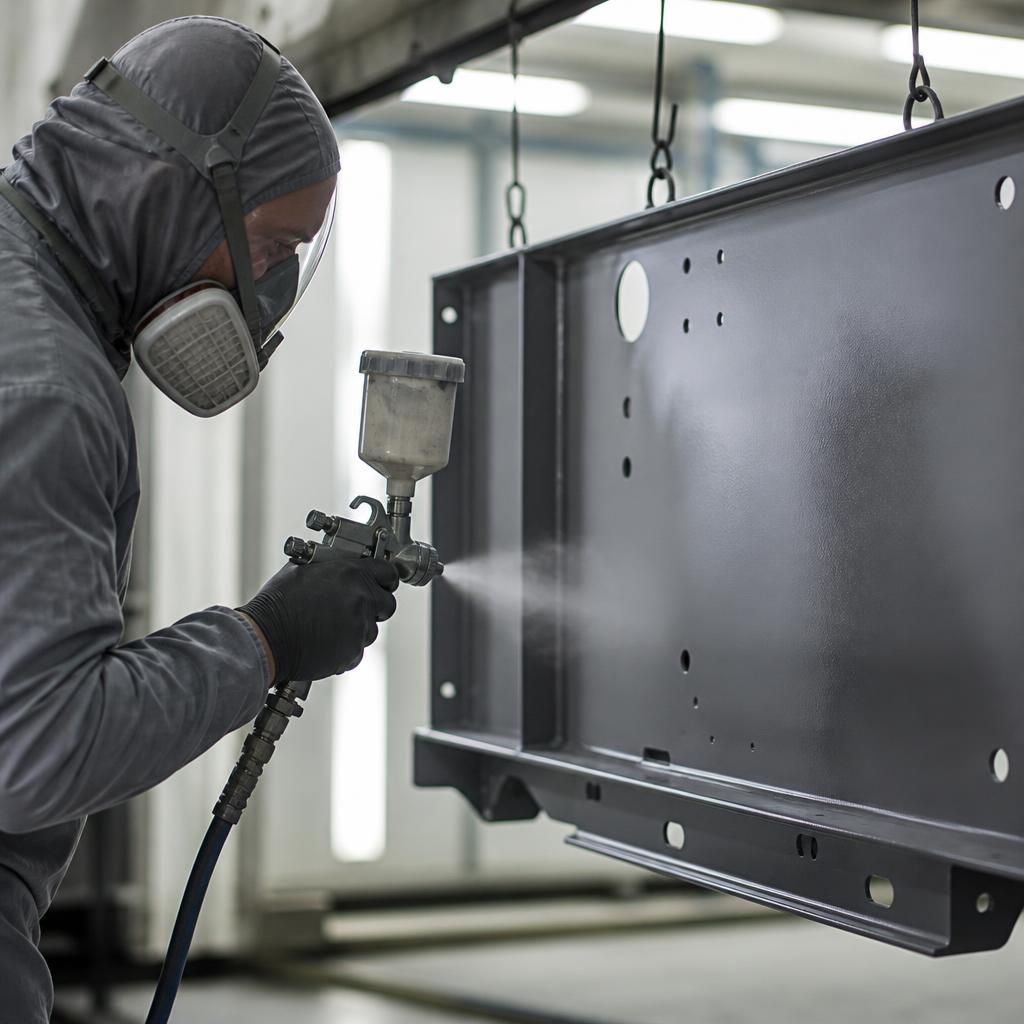
Environmental control during application can determine whether an epoxy primer develops its intended protective barrier. Metal that is at or below the dew point may acquire a microscopic film of condensation, which can interfere with adhesion and become a pathway for underfilm corrosion. Checking the component temperature, air temperature and relative humidity before and during coating helps identify this risk; the product data sheet should define the permitted limits.
Ventilation also affects longevity, particularly with liquid two-pack systems. Insufficient airflow can slow solvent release and leave the film vulnerable to solvent retention or delayed curing, while excessive airflow or unsuitable conditions may promote uneven drying. Controlled conditions allow the applied primer to level and cure consistently before the next coating is added, helping preserve the adhesion and corrosion protection designed into the coating system.