

How does epoxy primer for metal enhance the corrosion resistance of metal components?
Epoxy primer for metal enhances corrosion resistance by forming a dense, strongly adherent barrier that limits the movement of water, oxygen and corrosive contaminants towards the metal surface. It also provides a stable foundation for subsequent powder or protective coatings, helping reduce the risk of underfilm corrosion when the coating system is correctly prepared and applied.
Epoxy primer enhances corrosion resistance by controlling the electrochemical conditions that cause metal to deteriorate. A correctly selected and applied primer reduces the metal’s exposure to moisture and dissolved salts, improves adhesion around the component, and can include pigments that inhibit corrosion at vulnerable areas. Its performance depends on the complete coating system, including substrate preparation, primer formulation, film thickness, topcoat compatibility and service conditions.
It interrupts the corrosion process. Corrosion requires an electrolyte, usually water containing dissolved contaminants, together with anodic and cathodic areas on the metal surface. When these conditions allow electrons and ions to move, metal is gradually converted into corrosion products. Epoxy primer helps restrict this movement by producing a continuous, low-permeability film. This reduces the likelihood that water and contaminants will remain in contact with the substrate long enough to sustain the electrochemical reaction.
Some formulations provide additional inhibition. Corrosion-inhibitive epoxy primers may contain pigments that help make the metal surface less favourable to anodic dissolution or support passivation when moisture reaches a small damaged area. This is different from the barrier effect of the resin itself. The precise mechanism depends on the primer chemistry, pigment package and metal being coated, so the product technical data sheet should be checked rather than assuming that every epoxy primer provides the same level of inhibition.
Adhesion is central to corrosion control. Strong bonding prevents the primer from lifting, blistering or separating from the substrate when the component is exposed to humidity, temperature changes or mechanical handling. Good adhesion also reduces the size of pathways through which moisture can travel beneath the coating. Abrasive preparation, removal of oil and salts, suitable surface roughness, and control of flash rust are therefore as important as choosing an epoxy product.
Particular attention is needed at welds, cut edges, corners, holes, joints and areas with sharp profile changes. These locations can receive less coating during application and may retain abrasive residue or contaminants. Weld spatter, alkaline residues, embedded media and soluble salts can create local defects that become starting points for underfilm corrosion. Appropriate preparation and careful coverage of these features help make the protective layer more uniform across the whole component.
Epoxy primer also helps protect the metal when the outer coating is locally damaged. A scratch or impact may expose a small area of substrate, but the surrounding primer can continue to restrict moisture access and maintain adhesion around the defect. This does not make damage harmless: exposed steel, aluminium or other metals should be assessed and repaired in accordance with the coating specification, particularly where the component is exposed to salt, chemicals or persistent condensation.
Corrosion resistance is affected by the substrate itself. Steel, galvanised steel and aluminium have different surface chemistries and preparation requirements. A primer intended for one substrate may not provide reliable adhesion or inhibition on another. Galvanised surfaces may require removal of contaminants and treatment of the zinc surface, while aluminium may need a preparation method that controls its oxide layer. The primer must be specified for the actual metal and any existing treatment.
The surrounding coating system determines the final level of protection. The primer should be compatible with the selected powder or protective topcoat, and the recoat interval, curing conditions and surface condition before overcoating must be controlled. If the topcoat is poorly bonded, under-cured or mechanically damaged, moisture can reach the primer and eventually the metal. Conversely, a sound primer and compatible topcoat can work together to provide layered protection, with the primer supporting adhesion and corrosion control while the outer layer resists the service environment and physical wear.
Epoxy products have limitations. Prolonged ultraviolet exposure can cause some epoxy films to chalk or lose colour, although this does not automatically mean that the underlying corrosion protection has failed. For components exposed to sunlight, weathering or demanding chemicals, an appropriate compatible topcoat is usually required. The specification should also consider immersion, condensation, abrasion, operating temperature, cleaning chemicals and contact with salts, as these conditions influence water uptake, adhesion and coating life.
Quality control should include inspection of the prepared surface, environmental conditions during application, coverage of edges and recesses, cured-film condition and adhesion where specified. Areas showing pinholes, blistering, cracking, poor cure or missed coverage should be corrected before the component enters service. In industrial work, coating records and inspection requirements are normally set by the project specification or relevant coating standard rather than by the primer name alone.
In practical terms, epoxy primer improves corrosion resistance most reliably when it is treated as one part of a defined coating system. Selecting the correct formulation for the substrate and environment, preparing the metal thoroughly, applying an even film and protecting the primer with a compatible finish are what convert its corrosion-control properties into durable protection for industrial metal components.
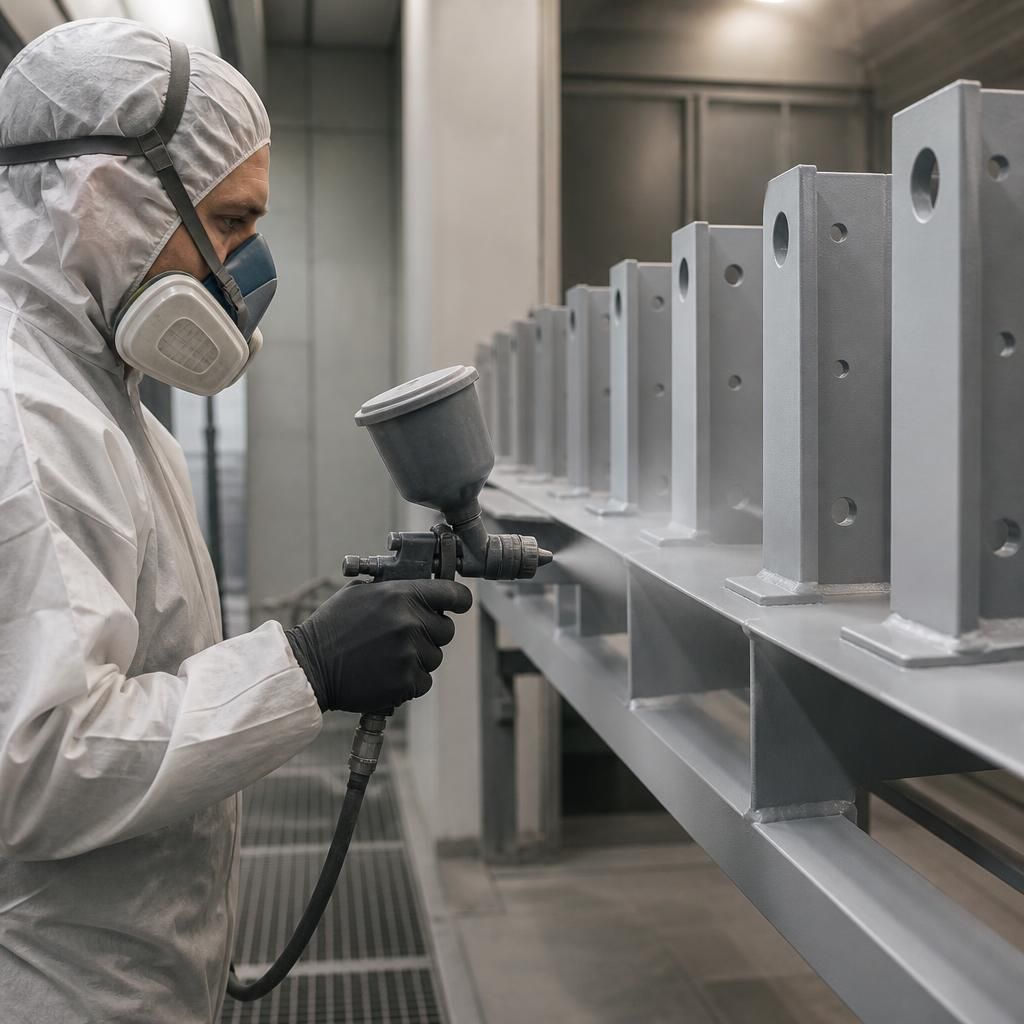
Epoxy primer improves corrosion resistance by reducing underfilm corrosion, where moisture spreads beneath an apparently intact coating. Its tightly bonded film helps limit lateral movement from a small holiday, scratch or coating weakness, so corrosion is less likely to travel unseen between the metal and outer finish. This is particularly important on fabricated components with seams, joints or areas exposed to repeated wetting.
The primer’s effectiveness should therefore be assessed as part of the complete coating build rather than by its presence alone. A sound, compatible topcoat limits water entry, while the epoxy layer provides an additional barrier and supports the bond to the metal. If inspection identifies a breach, repair should restore both the exposed substrate and the surrounding coating system before moisture can extend beneath the finish.
Ask about epoxy primer for your metal components
Discuss your metal components with Powder-coatings.co.uk to assess whether an epoxy primer should form part of the specified coating system. Provide details of the substrate, service environment and intended finish so the coating requirements can be considered accurately.