

What is the most effective method to ensure thorough removal of contaminants from metal surfaces before powder coating?
The most effective approach is a staged process: remove oils and grease with a suitable industrial degreaser, rinse thoroughly, then abrasive blast the metal to eliminate corrosion, mill scale and embedded residue. A final visual and surface inspection should confirm that the substrate is clean, dry and suitably keyed before powder coating.
Thorough contaminant removal is achieved through controlled chemical cleaning, suitable mechanical preparation and documented inspection. The aim is not merely to make the metal look clean, but to remove substances that could interfere with powder wetting, curing or long-term adhesion, including residues hidden in seams, holes, recesses and weld areas.
The preparation method should begin with an assessment of the substrate and the likely contamination. Steel may carry mill oils, corrosion products, welding residues and handling marks, while aluminium and galvanised surfaces can react differently to aggressive cleaners or abrasive treatment. The cleaning chemistry must therefore be compatible with the base metal and selected according to the type of contamination present. A product that removes heavy grease may be unsuitable for a sensitive alloy or may leave an alkaline residue if it is not rinsed correctly.
For greasy or oily components, the cleaning stage is most effective when the degreasing agent is given sufficient contact with the surface and is supported by agitation, spraying or other suitable mechanical action. Particular attention is needed around joints, folded edges, threaded holes and welds, where oil can remain after a quick wipe. Solvent wiping can be useful for localised contamination, but wiping alone may spread dissolved oil across the part rather than remove it. Rinseable aqueous systems can be preferable for larger or more complex components when the process includes effective rinsing and drying.
Rinsing is a critical control point. Cleaner residues, dissolved salts and loosened particles must be carried away rather than allowed to dry back onto the metal. Rinse water should reach enclosed and difficult-to-access areas, and parts should be positioned so that liquid does not collect in cavities. Drying must remove retained moisture as well as visible water; otherwise, corrosion can begin before coating or trapped liquid can affect the finish during curing.
Mechanical preparation should be selected to match the condition of the metal and the required coating system. Abrasive treatment can remove firmly attached corrosion, scale and residues that chemical cleaning may not dissolve, while also producing a more suitable surface texture. The abrasive must be clean and appropriate for the substrate. Excessively aggressive treatment can distort edges or alter dimensions, whereas insufficient treatment may leave tightly bonded contamination behind. After preparation, dust should be removed without reintroducing oil or fibres.
A reliable inspection combines several checks rather than relying on appearance alone:
- Examine the entire component under consistent lighting, including welds, corners, recesses and internal surfaces.
- Use a clean, light-coloured, lint-free wipe where appropriate to identify oil, dust or discolouration that is not obvious visually.
- Check that the surface is uniformly dry and free from visible flash corrosion, abrasive dust, cleaner residue and water marks.
- Where the process requires it, use surface tests such as a water-break assessment or checks for residual acidity, alkalinity or soluble salts.
- Confirm that the prepared texture is consistent with the coating specification and that no areas have been missed.
Handling after inspection is part of contamination control. Clean gloves should be used when moving prepared parts, and contact with bare hands, oily lifting equipment or dirty benches should be avoided. Parts should also be protected from dust, condensation and other sources of recontamination while awaiting coating. For batch work, retaining cleaning and inspection records helps identify process drift, such as a contaminated wash stage, worn abrasive or inadequate rinsing.
For complex fabrications or components with mixed contamination, the most dependable approach is to establish the preparation sequence on representative parts before processing the full batch. A professional powder coating operation can assess the substrate, choose compatible preparation stages and inspect difficult areas before coating, helping ensure that the finish is applied to a genuinely clean and suitably prepared surface.
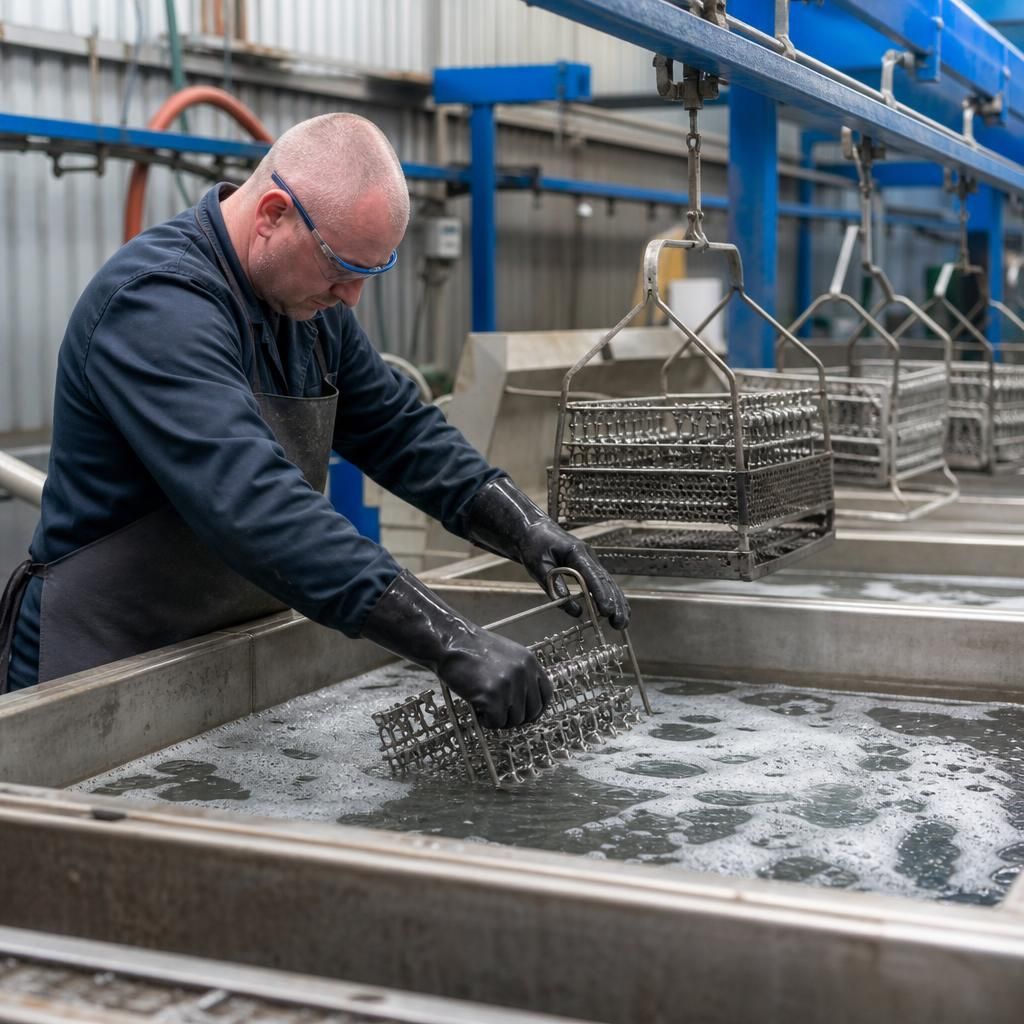
Thorough contaminant removal also depends on preventing redeposition during cleaning. A degreasing bath can become loaded with oil, grease and suspended particles, allowing contamination to transfer back onto parts rather than being removed. The cleaning solution should therefore be maintained according to the product instructions, with its condition, concentration and level of contamination checked as part of the process.
Carry-over between stages must be controlled as well. Parts, baskets, tools and handling equipment should not introduce dirty solution into a final rinse, while rinse water should remain sufficiently clean to remove loosened residues. This is particularly important for batch processing, where contamination from one component can affect subsequent parts. Keeping the cleaning and rinsing stages controlled helps ensure that the prepared metal reaches coating in the same clean condition achieved during treatment.