

What degreasing methods are most effective for ensuring powder coating adhesion on different metal types?
Effective degreasing typically combines an alkaline aqueous cleaner, applied by spray, immersion or agitation, with thorough rinsing and drying; the concentration and alkalinity should be adjusted for the metal, as steel tolerates stronger solutions while aluminium and zinc require milder, non-etching chemistry. Solvent wiping can remove light oils from small or localised areas, but it is usually less suitable than controlled aqueous cleaning for production batches or heavily contaminated components.
The most effective degreasing method depends on the metal, the contaminant, the component’s geometry and the required production volume. Steel can generally withstand more aggressive alkaline cleaning, whereas aluminium, zinc-coated steel, stainless steel and copper alloys require tighter control of pH, temperature and contact time to avoid etching, staining or loss of surface properties.
Carbon steel and mild steel
For carbon steel, alkaline cleaning is usually the most practical choice where parts carry cutting oils, drawing compounds, grease or handling residues. Spray systems suit larger production volumes because they provide consistent coverage, while immersion tanks are useful for batches of fabricated parts. Agitation, either by solution movement or controlled part movement, helps dislodge soil from joints, recesses and drilled holes.
Heavily soiled steel may need a staged process rather than a single extended cleaning cycle. A preliminary removal of bulk grease prevents the main cleaner from becoming overloaded. Where scale, rust or welding residue is also present, degreasing should be treated as a separate stage from mechanical preparation or chemical descaling. Abrasive blasting can expose clean metal, but it should not be relied on to remove thick oil deposits because contamination may be spread across the surface or driven into surface irregularities.
Stainless steel
Stainless steel normally responds well to controlled aqueous cleaning, but the chemistry must not introduce chloride contamination or leave residues that interfere with subsequent pretreatment. Excessively aggressive products can create staining or alter the appearance of a brushed finish. Cleaning equipment should also be managed carefully: tools, tanks or abrasives previously used on carbon steel can transfer iron particles to stainless surfaces.
For stainless components with fine welds, folds or textured finishes, immersion with agitation or an ultrasonic process can be more effective than wiping because it reaches narrow areas where oils collect. Ultrasonic cleaning is particularly useful for smaller intricate parts, provided the solution is compatible with the alloy and the equipment does not damage delicate edges.
Aluminium
Aluminium requires a milder, non-etching approach. Strong caustic solutions or excessive exposure can darken, roughen or dimensionally affect the surface, especially on thin sections and machined components. A cleaner formulated for aluminium is preferable to adapting a steel-cleaning process without trials.
Spray cleaning is effective for accessible panels and fabrications, while immersion or ultrasonic cleaning can improve coverage on complex shapes. Particular attention is needed around lap joints, folded sections and threaded holes, where cleaner can remain trapped. Any residue left in these areas can later cause blistering or poor coating continuity, so the drainage design and orientation of the parts are part of the cleaning process rather than an afterthought.
Zinc and galvanised steel
Zinc surfaces are more vulnerable to aggressive alkalinity, high temperatures and prolonged exposure than ordinary carbon steel. A mild, zinc-compatible cleaner is therefore normally preferable. The process should remove oil without excessively attacking the zinc layer or creating a powdery surface deposit.
Galvanised components can also contain passivation treatments or storage oils. These may require a specific preparation sequence agreed with the coating system supplier, as removing one layer can affect the behaviour of the next pretreatment stage. Avoid treating galvanised steel as bare mild steel simply because the underlying substrate is similar; the zinc coating determines the cleaning limits.
Copper and copper alloys
Copper, brass and bronze need chemistry that removes grease without causing tarnishing, staining or preferential attack on one part of the alloy. Mild cleaners and controlled immersion are commonly more suitable than highly caustic products. Brass and bronze may contain different proportions of copper and zinc, so a process that is acceptable for one alloy should not automatically be applied to another.
Where appearance matters, the cleaned surface should be protected from unnecessary handling before coating. Fingerprints and workshop residues can reintroduce contamination even after an effective cleaning cycle.
When solvent, emulsion or ultrasonic methods are appropriate
- Solvent cleaning: suitable for limited areas, repair work and light oil films where water-based processing is impractical. It is less dependable for porous, recessed or heavily contaminated parts, and solvent compatibility, ventilation and residue control must be assessed.
- Emulsion cleaning: useful for substantial grease and oil deposits, particularly where a water-based process alone struggles. It must be followed by effective removal of the emulsified soil so that an oily film is not left behind.
- Ultrasonic cleaning: effective for small, intricate components with blind holes, grooves or fine profiles. It is a process aid rather than a substitute for selecting suitable chemistry and controlling the bath.
- Electrocleaning: can improve soil removal from some conductive metal parts, especially in controlled industrial lines. Current direction and settings must be suitable for the substrate, since inappropriate conditions can cause surface defects or hydrogen-related concerns on susceptible components.
How to select the process
Begin by identifying the metal and the actual soil: machining oil, wax, drawing compound, polishing residue, adhesive, fingerprints and corrosion products do not respond identically. Then consider part size, surface area, recesses, batch quantity, allowable dimensional change and whether the metal has a coating such as zinc or an existing conversion layer.
A sound process is established by checking representative parts rather than judging the cleaner solely by how quickly it removes visible grease. The cleaned surface should show uniform wetting rather than water breaks, patches or isolated beading. Any cleaning method should also be checked for residues, staining, dimensional effects and compatibility with the following pretreatment and powder coating stages. For mixed-metal batches, separate process settings or separate cleaning routes may be necessary; one aggressive cycle rarely provides the best result for every alloy.
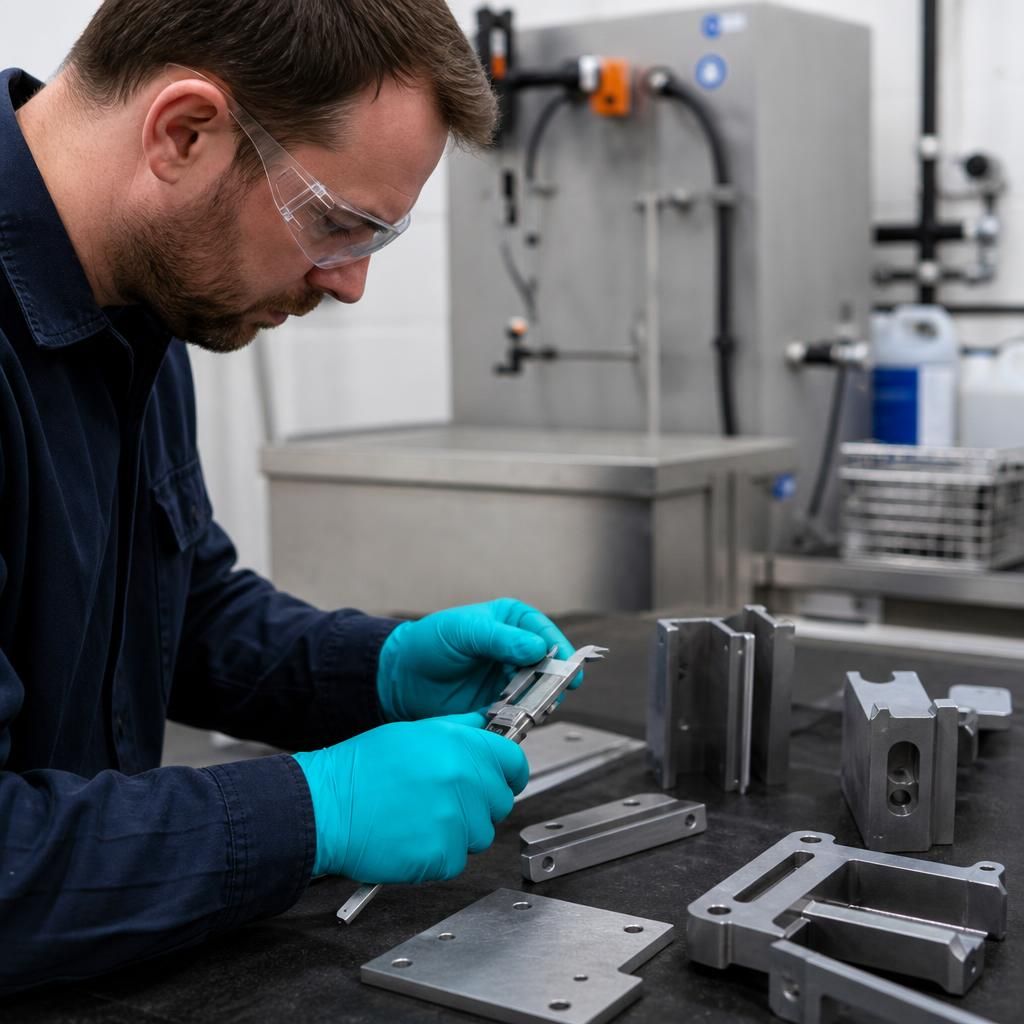
The most effective degreasing method is the one that produces a consistently clean, chemically compatible surface without damaging the metal. A process should therefore be validated on representative components or test pieces, including the same joints, recesses, finishes and surface treatments found in production parts.
Assessment should go beyond visible grease removal. Check for changes in colour, staining, roughness, residue and dimensional condition, then continue through the intended pretreatment and powder-coating cycle to assess coating continuity and adhesion. Recording the selected cleaner, concentration, temperature, contact time and application method creates a repeatable process and helps identify whether a defect originates during degreasing or at a later stage.