

How does the choice of degreasing agent affect the efficiency and outcome of the powder coating process?
The choice of degreasing agent affects how quickly and completely oils, grease and processing residues are removed before powder coating. A compatible agent that cleans the specific metal and rinses without leaving residue supports reliable adhesion and an even finish, while an unsuitable or poorly rinsed product can cause defects and rework.
The degreasing agent determines how effectively the pre-treatment stage breaks down and lifts contamination, how the metal responds during cleaning, and how controllable the preparation line is. Its chemistry influences processing time, operating conditions, surface appearance, waste handling and the consistency of the powder-coated result.
Alkaline cleaners are commonly used for fabricated steel and other robust substrates because they saponify or emulsify oils, drawing them away from the surface. They can be applied by spray, immersion or manual cleaning, depending on the component size and production setup. Their performance depends on factors such as alkalinity, surfactant content, bath temperature, contact time and the level of contamination. If these conditions are too mild, oily films may remain; if they are too aggressive, sensitive metals or existing surface treatments may be attacked.
Solvent-based agents can dissolve certain oils, greases, waxes and adhesive residues rapidly, making them useful for localised contamination or components that cannot be immersed. However, a solvent that dissolves a contaminant can also spread it across the part if cloths, applicators or the working method are not controlled. Solvent evaporation, flammability, worker exposure and disposal requirements also need consideration. They are therefore not automatically the most efficient option for large batches or heavily soiled parts.
Water-based detergents combine surfactants with builders or emulsifiers to loosen contamination so it can be removed by spraying or rinsing. They can provide a practical balance between cleaning capacity and production control, particularly where a repeatable aqueous process is available. Their effectiveness can decline as the cleaning bath accumulates oil and particulate matter, so bath monitoring, filtration or replenishment may be necessary. A cleaner that performs well when fresh may produce inconsistent preparation if its concentration or condition is allowed to drift.
The metal itself is also important. Carbon steel, galvanised steel, aluminium and zinc-based components do not all tolerate the same pH range, temperature or exposure time. Aluminium and zinc can be affected by strongly alkaline chemistry, while some high-strength steels may require careful control to avoid undesirable surface reactions. A degreasing agent should be assessed alongside the intended conversion coating or pre-treatment, because one stage can interfere with the next if its chemistry is not suitable.
Efficiency is not simply a matter of choosing the strongest cleaner. A relatively mild product used at the correct concentration, temperature and contact time may deliver a more stable process than a harsher product that requires extensive correction. Excessive strength can increase rinsing demand, accelerate equipment wear, raise chemical consumption and create avoidable treatment issues. Insufficient strength can leave operators relying on extra passes, longer dwell times or manual rework.
Application method changes the outcome as well. Spray cleaning provides mechanical action that helps dislodge contamination from broad faces and accessible recesses, whereas immersion gives the chemistry more opportunity to reach complex profiles. Neither method guarantees uniform treatment: blind holes, folds, weld areas, threaded sections and overlapping components can retain oils or cleaning solution. The agent should therefore be selected with the component’s geometry and production volume in mind, not just the type of oil involved.
Rinsing and drying are part of the agent’s practical performance. Some formulations are easier to remove than others, and trapped cleaner in joints or cavities can affect subsequent pre-treatment. Inadequate drying may lead to flash corrosion on susceptible steel before powder application, particularly where water remains in seams or hollow sections. The cleaning specification should define how parts are drained, rinsed and dried, rather than treating degreasing as a single isolated operation.
For repeat production, the most useful selection criteria include:
- the contaminant type, including machining oil, drawing compound, protective wax or handling residue;
- the substrate and any existing plating, galvanising or conversion layer;
- the cleaning method, component geometry and required throughput;
- operating temperature, concentration and contact-time requirements;
- the agent’s effect on rinsing, drying and subsequent pre-treatment;
- bath life, monitoring requirements and tolerance to contamination build-up;
- worker safety, ventilation, storage and waste-treatment obligations.
Trial panels or representative components are useful when the contamination is varied or the substrate is sensitive. The assessment should examine visual cleanliness, water behaviour, signs of etching or staining, corrosion after cleaning and the condition of the finished coating after curing. A process record covering chemical concentration, temperature, contact time and bath condition helps identify whether a coating defect originates in cleaning rather than in powder application or oven curing.
In practice, the best degreasing agent is the one that removes the known contamination within a controlled process while preserving the metal and remaining compatible with the following preparation stages. Selecting on chemistry alone is insufficient: application equipment, operating discipline, rinsing, drying and ongoing bath control all determine whether that agent produces an efficient and repeatable powder coating process.
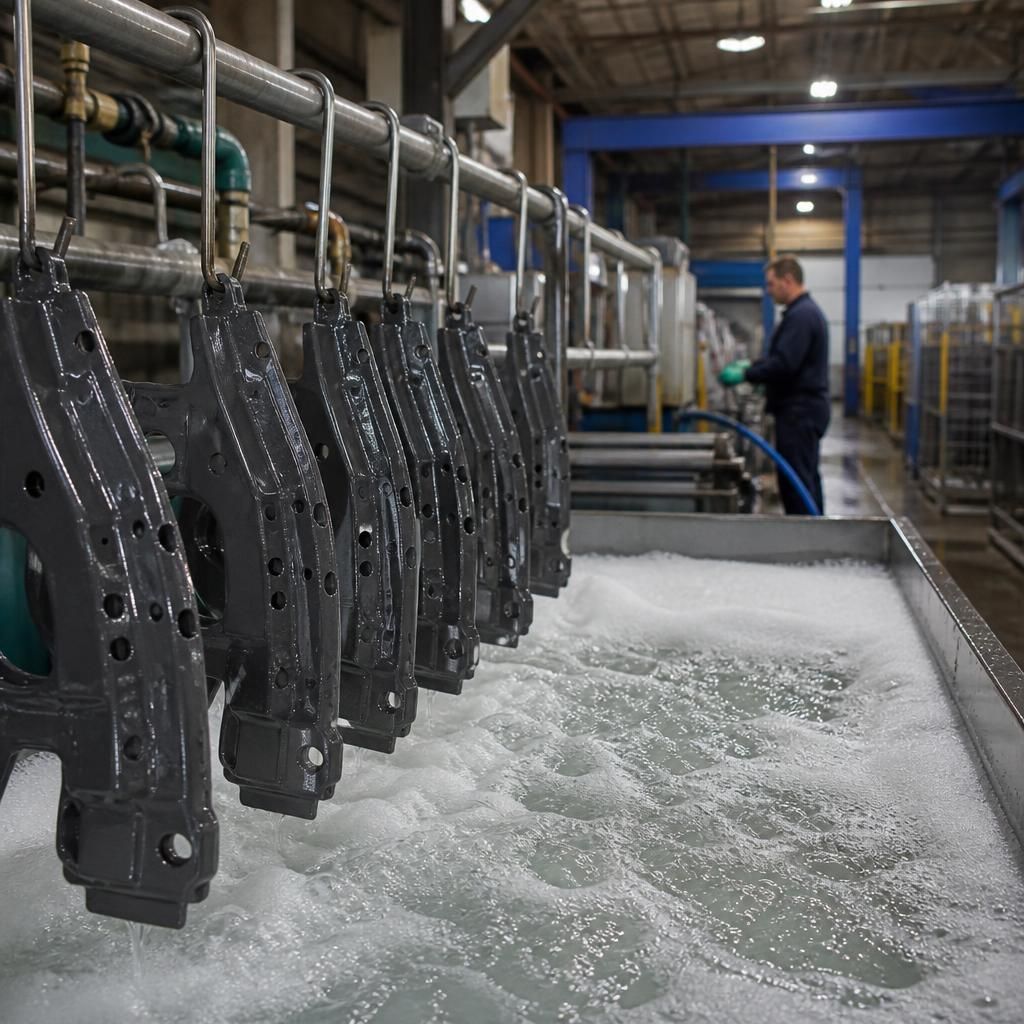
Foaming behaviour is an important but often overlooked property of a degreasing agent. Excessive foam can interrupt spray coverage, obscure the component surface and reduce the effective action of the cleaning solution. It may also increase carry-over between stages, making rinsing and drainage more difficult. A low-foam formulation suited to the equipment helps maintain consistent contact between the cleaner and the metal, particularly in automated spray systems.
The correct choice depends on how the agent behaves under the actual operating conditions, including pump pressure, agitation, temperature and water hardness. A product that performs well in a static test may create excessive foam or unstable application conditions in production. Checking foam behaviour during representative trials therefore helps determine whether the agent supports steady line operation as well as effective contaminant removal.
Discuss the right degreasing agent for your powder coating process
Discuss your component materials, contaminants and proposed cleaning stages with Powder-coating.co.uk to identify a degreasing approach suited to your powder coating process. Representative parts or trial panels can help assess cleanliness and compatibility before production work begins.