

What are the typical steps involved in the powder coating process for industrial applications?
The industrial powder coating process typically involves checking and preparing the metal, applying any required pretreatment, drying the surface, spraying electrostatically charged powder, curing it in an oven, and carrying out final inspection. Each stage helps ensure the coating bonds correctly and provides a consistent, durable finish.
Industrial powder coating is a controlled production process in which a dry polymer powder is bonded to a prepared metal component through electrostatic application and heat. The result depends not only on the spray operation, but also on job assessment, surface condition, component design, coating selection, oven control and post-cure inspection.
- Review the component and coating specification. Before processing, the coater assesses the substrate, dimensions, weight, geometry and intended use of the part. The specification should identify the required colour, gloss level, coating type, target finish and any areas that must remain uncoated. This review also highlights practical issues such as deep recesses, threaded holes, tight tolerances, sharp edges and surfaces that may be difficult to reach with a spray gun.
- Check the incoming surface. Components are examined for oil, grease, rust, mill scale, weld residue, burrs, sharp edges and other contamination. Existing coatings or corrosion may need to be removed rather than covered. Defects in the base metal can remain visible through the finished coating, so fabrication quality and surface condition are considered before the component enters the line. Any required repairs or changes to the preparation method can then be identified at the appropriate stage.
- Prepare the metal mechanically where necessary. Abrasive blasting, cleaning, grinding or other mechanical preparation may be used according to the substrate and its condition. Blasting can remove corrosion and previous finishes while creating a suitable surface profile for adhesion. Grinding may be needed around welds or cut edges, although excessive grinding can alter dimensions or leave marks that remain visible after coating. The selected method must provide a clean, stable surface without introducing further contamination.
- Protect areas that must not receive powder. Masking is carried out before treatment or spraying, depending on the component and production method. High-temperature plugs, caps, tapes or purpose-made fixtures can protect threads, bearing seats, electrical contact points, machined faces and mating surfaces. Correct masking is particularly important where even a small build-up could affect assembly or fit. Racking points are also planned so that the component is safely supported while allowing the powder and heat to reach the required surfaces.
- Apply the appropriate pretreatment. Pretreatment is selected according to the metal, the level of corrosion protection required and the powder system being used. It may include stages that remove contamination, condition the surface and provide a suitable chemical key for the coating. Aluminium, galvanised steel and mild steel do not always require identical treatment. The component must be thoroughly rinsed where the process requires it, and any residual chemicals or moisture must be removed before powder application.
- Confirm that the surface is ready for coating. After preparation, operators check that the component is clean, dry and free from visible residue. Handling is controlled at this point because fingerprints, dust and workshop contaminants can affect adhesion or appearance. The part is then positioned on the line or in the spray area in a way that provides a reliable electrical earth and gives the operator access to the required faces.
- Apply the powder electrostatically. The spray gun charges the powder particles, while the grounded metal component attracts them. Powder is applied in a controlled pattern to achieve even coverage across exposed faces, edges and more difficult areas. Gun distance, powder flow, air settings and charging conditions are adjusted for the part. Recesses and internal corners require particular care because of the Faraday cage effect, where the electrical field can make it harder for powder to reach enclosed areas. Excessive build-up can affect appearance, edge coverage and dimensional fit.
- Transfer the coated component into the curing oven. Uncured powder is vulnerable to impact and contamination, so parts are moved carefully after spraying. The oven cycle is selected for the powder system and component mass. The important control is the temperature reached by the metal itself, not simply the air temperature displayed by the oven. Thicker or heavier components may take longer to reach the required metal temperature than small, light parts. Adequate cure allows the powder to flow, bond and develop its intended mechanical properties; insufficient or excessive heat can affect finish quality.
- Cool and remove masking. Once the cure is complete, the part is allowed to cool sufficiently for safe handling and to avoid damaging the finish. Masking materials are removed with care, particularly around edges and threaded features. Any powder bridging across a masked boundary is dealt with without marking the surrounding coating.
- Inspect the finished coating. Final inspection considers coverage, colour, gloss, texture, edge definition and visible defects such as runs, pinholes, craters, inclusions or areas of thin coverage. Depending on the job specification, checks may also include coating thickness, adhesion and cure. Components are compared with the agreed requirements rather than judged solely on general appearance. Parts that do not meet the required standard may need correction, stripping and reprocessing, or referral for a technical decision where rework could affect dimensions.
- Protect and prepare the completed parts for collection or delivery. Finished components are handled to prevent abrasion, impact and contamination during storage and transport. Packaging is chosen around the shape and vulnerability of the item, with particular attention to coated edges, contact points and machined surfaces. Keeping parts separated where necessary helps preserve the finish until they reach the manufacturing or installation stage.
For batch production, consistency depends on repeating the same preparation, racking, application and curing conditions across the run. Operators also need to account for changes in component geometry, substrate, powder specification and load arrangement rather than assuming that one setting suits every job. Clear drawings, masking instructions and finish requirements help a powder coating service process industrial parts accurately and identify any limitations before work begins.
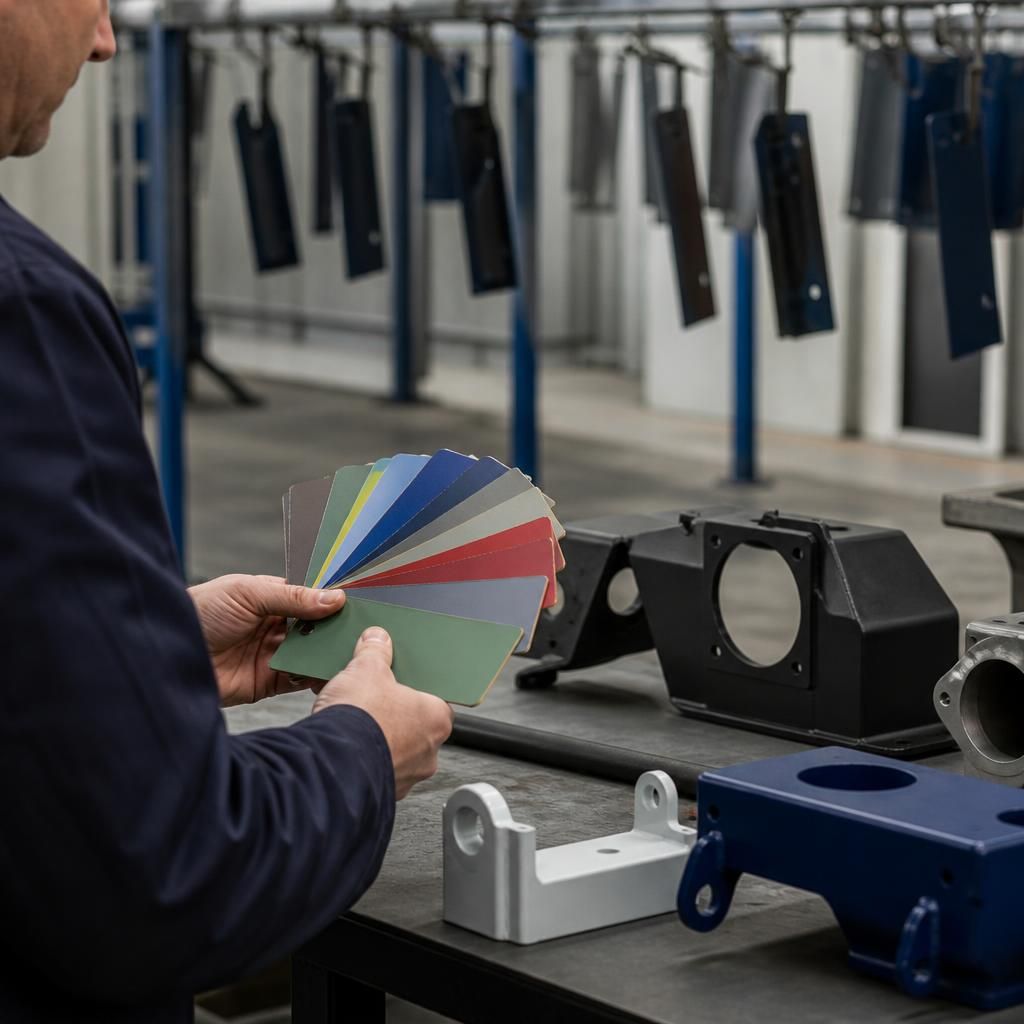
Coating selection is an early process decision. The powder system must suit the component’s substrate and the conditions it will face in service. Factors such as outdoor exposure, moisture, chemicals, abrasion, impact and required appearance can influence the choice of coating type, colour, gloss and texture.
This decision also affects the preparation and curing requirements used later in the process. A specialist coating may be more appropriate where the component needs additional protection or a particular functional surface, while a standard decorative system may be suitable for less demanding applications. Confirming these requirements before processing helps align the finished coating with the component’s intended use, rather than treating colour as the only specification.