

What factors should be considered when selecting the appropriate protective coating for industrial metal components?
Selecting a protective coating for industrial metal components requires assessing the operating environment, including exposure to chemicals, moisture, temperature changes, abrasion and impact, alongside the metal substrate, required finish, coating thickness and application method. The specification should also consider service life, inspection and maintenance requirements, production volume and any relevant industry or regulatory standards so that the chosen coating is technically suitable and practical to apply.
The appropriate protective coating is the one whose performance characteristics match the component’s actual failure risks, while remaining compatible with its design, manufacture and intended use. Selection should therefore begin with the function the coating must perform—such as reducing wear, preventing corrosion, limiting friction, providing electrical insulation or resisting damage during handling—rather than with colour or appearance alone.
Identify the primary failure mode. A coating may be exposed to several types of demand, but one is usually dominant. For example, a component that moves against another surface may need low friction and resistance to repeated wear, whereas a fabricated part used in a harsh industrial setting may place greater emphasis on barrier protection and edge coverage. If impact, sliding contact, particle erosion or repeated flexing is the main concern, the coating must be assessed for the relevant mechanical property rather than selected solely because it is described as protective.
Match the coating chemistry to the duty. Nylon coatings are often considered where a tough, resilient surface, reduced friction or resistance to abrasion is required. They can also be useful where the coating needs to provide a degree of electrical insulation or protect a surface from contact damage. Other protective coating systems may be more appropriate where a particular chemical, temperature range or level of corrosion protection is the controlling requirement. The word “nylon” does not describe one identical performance specification, so the exact grade and formulation should be confirmed against the intended duty.
Consider how the component is used in an assembly. The coating must not interfere with bearings, fasteners, seals, threads, sliding fits, earthing points or moving interfaces. Areas that require electrical continuity may need to remain uncoated, while sealing faces and precision locating surfaces may require masking or a defined allowance. Coating can also affect the fit of mating parts, so finished dimensions should be reviewed before approval, particularly where components are manufactured to close tolerances.
Review the component’s geometry. Recesses, internal corners, holes, narrow slots, sharp edges and deep cavities can make consistent coverage more difficult. Welds, joints and transitions may require particular attention because they can behave differently from broad, accessible surfaces. A practical specification should identify areas that must be coated, areas that must remain free of coating and any locations where visual variation is acceptable. This prevents a coating from being judged against requirements that the part design makes difficult to achieve.
Check pretreatment and surface condition. Adhesion depends heavily on the condition of the metal before coating. Oil, scale, weld residues, corrosion products and contamination can all compromise the result if they are not addressed. The specification should set out how the parts are to arrive, whether fabrication defects must be removed beforehand and whether any pre-treatment is suitable for the metal and coating system. This is particularly important when components have been exposed to processing fluids, storage contamination or previous finishes.
Assess dimensional and visual requirements separately. A coating can meet its protective purpose while still being unsuitable if it changes a critical fit, obscures identification marks or produces an unacceptable appearance. Define which characteristics are functional and which are cosmetic. Relevant considerations may include colour consistency between batches, surface texture, gloss level, visible inclusions, edge appearance and the treatment of masked areas. These requirements should be agreed before production so that inspection is based on measurable acceptance criteria.
Account for handling, packaging and installation. The coating must remain intact not only during use but also while parts are stored, transported and fitted. Components with projecting edges or heavy contact points may need suitable separators, protective packaging or an agreed handling method. If parts are assembled using force, clamps or tools, the coating’s resistance to marking and local damage should be considered. It may also be necessary to specify how damaged areas are identified and dealt with after installation.
Examine repair and replacement requirements. Some components can be removed and recoated easily; others form part of a fixed assembly or are difficult to access once installed. Where field repair is important, establish whether local touch-up is technically acceptable or whether the entire component must be stripped and recoated. The availability of replacement parts, the cost of removing the item and the consequences of a coating failure all influence whether a more robust or easily maintainable system is justified.
Use testing and evidence appropriate to the application. Technical data should be supported by relevant test results, sample panels or trial components where the duty is demanding or unusual. Testing may examine adhesion, abrasion, impact, flexibility, corrosion resistance, chemical compatibility or electrical properties, depending on the component’s function. Test conditions should resemble real service conditions; a generic laboratory result does not automatically predict performance in a specific assembly.
Consider production control and traceability. For repeat orders, the coating specification should record the approved system, colour or finish reference, preparation requirements, masking details, inspection criteria and any agreed sample. Batch records and inspection results help identify variation between production runs and make it easier to investigate a problem. This is especially valuable for manufacturers and fabricators supplying coated parts into larger assemblies or regulated supply chains.
In practice, the selection process is strongest when the component drawing, intended use, known failure risks and acceptance criteria are reviewed together. A specialist powder coater can use this information to assess whether nylon or another protective system is suitable, identify design features that may affect the result and recommend trials before the full production batch is processed.
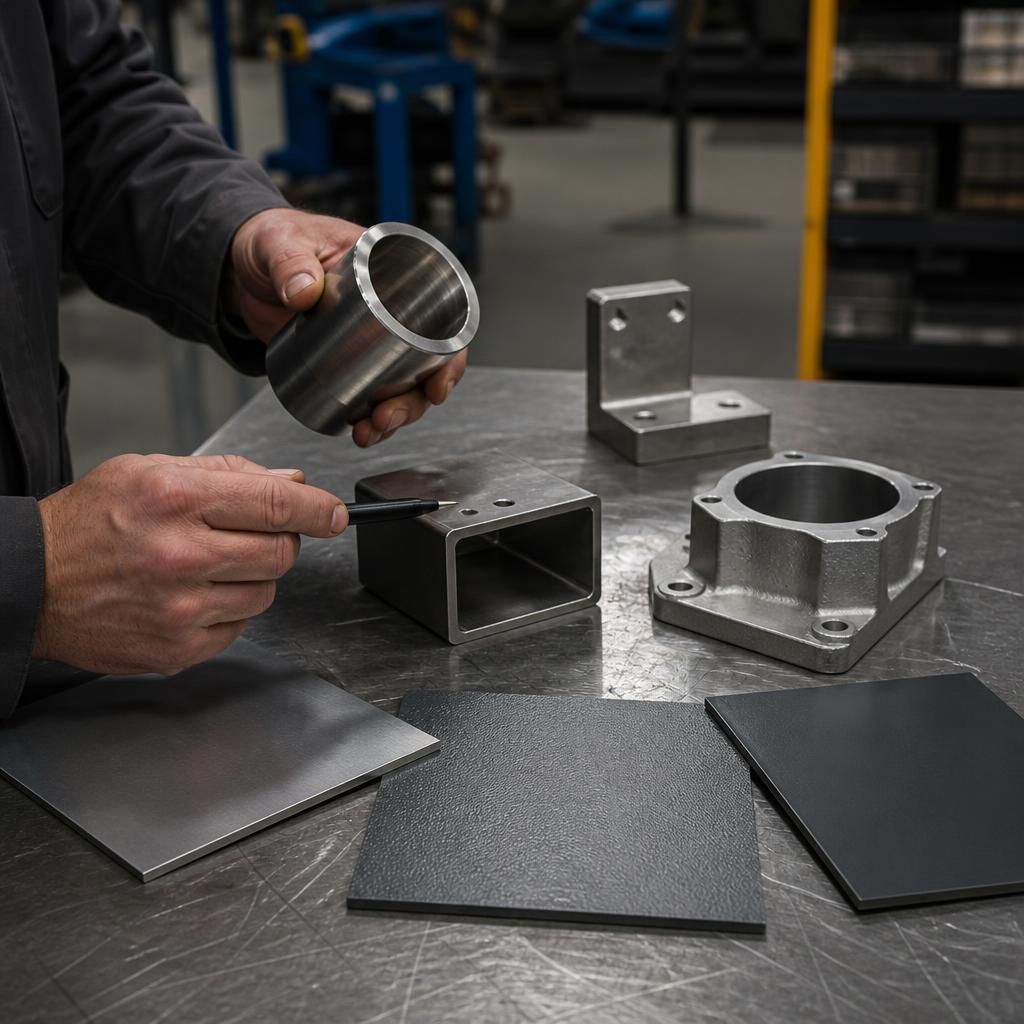
The metal substrate can determine whether a coating system is suitable. Steel, aluminium, galvanised metal and cast components may require different preparation methods because their surface chemistry, porosity and reaction to heat are not the same. Galvanised or previously treated surfaces, for example, may need additional assessment before coating, while cast or porous parts can release trapped air or contaminants during curing and affect the finish.
Thermal movement should also be considered where a coated component operates through changing temperatures or is joined to a different material. Differences in expansion can place stress on the coating interface, particularly around edges, joints and fastener locations. Confirming the substrate, existing surface treatment and operating temperature range before choosing the system helps prevent adhesion problems and premature coating failure.
Discuss the Right Protective Coating for Your Components
Share your component drawings, substrate details and intended service conditions for an informed discussion about suitable protective coating options. Where requirements are demanding or unusual, trial components can help confirm the specification before full production.