

How does the type of metal influence the choice of blasting media for optimal powder coating results?
The metal’s hardness, surface condition and sensitivity to distortion determine the suitable blasting media for powder coating preparation. Steel may require a more aggressive abrasive, while aluminium and other softer metals generally need finer, less forceful media to create a clean, suitably profiled surface without damaging the component.
The type of metal determines which blasting media can clean the surface and develop a suitable key without embedding contamination, removing excessive material or changing the component’s dimensions. The correct choice depends on the substrate, its existing finish, the required surface profile, the component’s geometry and the powder coating specification.
Carbon and mild steel
Steel generally gives the widest choice of abrasive because it can tolerate relatively energetic preparation. Mineral grit, aluminium oxide and steel abrasives can remove mill scale, rust, old coatings and fabrication residue, provided the process is controlled to achieve the required cleanliness level rather than unnecessarily deep roughness. Shot can be useful where a more uniform, peened finish is required, while angular grit is more effective for cutting through tightly bonded corrosion and coatings.
The choice still needs to reflect the component. Thin sheet, sharp edges and precision-machined areas can be damaged by excessive impact, even when the base material is steel. Heavy sections may need a more effective cutting action to reach sound metal, whereas lightly contaminated fabricated parts may only require a less aggressive treatment. The selected profile should suit the powder system: an overly coarse texture can affect coverage, appearance and coating thickness at peaks.
Stainless steel
Stainless steel requires particular attention to cross-contamination. Ferrous particles left in the surface can later oxidise and produce staining that is mistaken for a failure of the powder coating. Dedicated equipment and clean, non-contaminating media are therefore preferable where stainless steel is being prepared. Glass bead or a suitable non-metallic abrasive may be selected when the objective is to clean and provide a controlled key without introducing free iron.
Stainless components may also have a fine, uniform finish that the coating specification is intended to preserve. In that situation, an abrasive that produces a controlled texture is more appropriate than a highly cutting medium. Weld areas, heat tint and embedded fabrication residues may require local treatment before the complete surface is prepared.
Aluminium and other lightweight alloys
Aluminium alloys have a relatively vulnerable surface compared with many ferrous substrates. Media selection must account for the risk of rounding edges, closing fine details, distorting thin sections and leaving an excessively coarse profile. Fine non-metallic abrasives, glass bead or carefully controlled aluminium oxide are commonly considered, depending on whether the priority is gentle cleaning, coating removal or a more pronounced key.
Aluminium oxide and other hard abrasives can cut quickly, but excessive impact may expose defects or alter the appearance of visible components. Glass bead tends to give a more uniform finish, although it may not remove heavy corrosion or firmly bonded coatings as efficiently. The media should also be clean and suitable for non-ferrous work, since embedded ferrous contamination can create corrosion beneath or around the powder film.
Galvanised steel and zinc-coated parts
With galvanised steel, the purpose is often to prepare the zinc surface while retaining a sound protective layer. Aggressive blasting can remove the coating unevenly, expose the underlying steel and create an inconsistent base for powder application. A controlled sweep blast using a suitable fine, non-metallic medium is generally considered where the zinc is sound and only light surface preparation is needed.
Where the galvanising is damaged, poorly bonded or heavily contaminated, the preparation method may need to remove defective material rather than simply key the surface. The resulting exposed areas should be assessed as part of the complete coating system, because zinc surfaces can behave differently from bare steel during curing and service.
Cast iron
Cast iron can contain porous areas, casting sand, graphite residue and corrosion products. A cutting abrasive may be needed to reach a clean, stable surface, but blasting alone does not remove oil held in pores or cavities. Degreasing and, where appropriate, controlled preheating may be needed to reduce the risk of contamination or outgassing affecting the powder finish. Recesses and irregular cast features also need sufficient media access; otherwise, residues can remain in the surface despite an apparently clean exterior.
Copper, brass and other non-ferrous metals
Copper and brass are softer than steel and can be marked or distorted by an unsuitable abrasive. A fine, clean non-metallic medium is often considered where a controlled key is needed. Ferrous media should be avoided unless its use is specifically justified and contamination can be ruled out. Brass may also contain residues from machining, polishing or handling, so cleaning before blasting remains important.
How the component changes the decision
- Thin or delicate sections: use lower impact energy and a finer or less aggressive medium to limit distortion.
- Deep recesses and complex profiles: select media and application settings that can reach corners without leaving excessive accumulation.
- Machined faces and threads: protect areas where dimensional accuracy or fit must be retained.
- Welds and heat-affected areas: check for scale, spatter and residues that may need a different treatment from the surrounding metal.
- Previously coated surfaces: choose a medium capable of removing the old coating without unnecessarily cutting into the substrate.
After blasting, the surface should be checked for uniformity, visible residue, embedded abrasive and the required profile before powder is applied. A trial on a representative area is often the most reliable way to confirm that the media, pressure, nozzle distance and working angle are compatible with the particular alloy and component design. The best blasting media is therefore not simply the hardest or fastest option; it is the one that leaves clean, stable metal with a consistent profile while preserving the component’s function and dimensions.
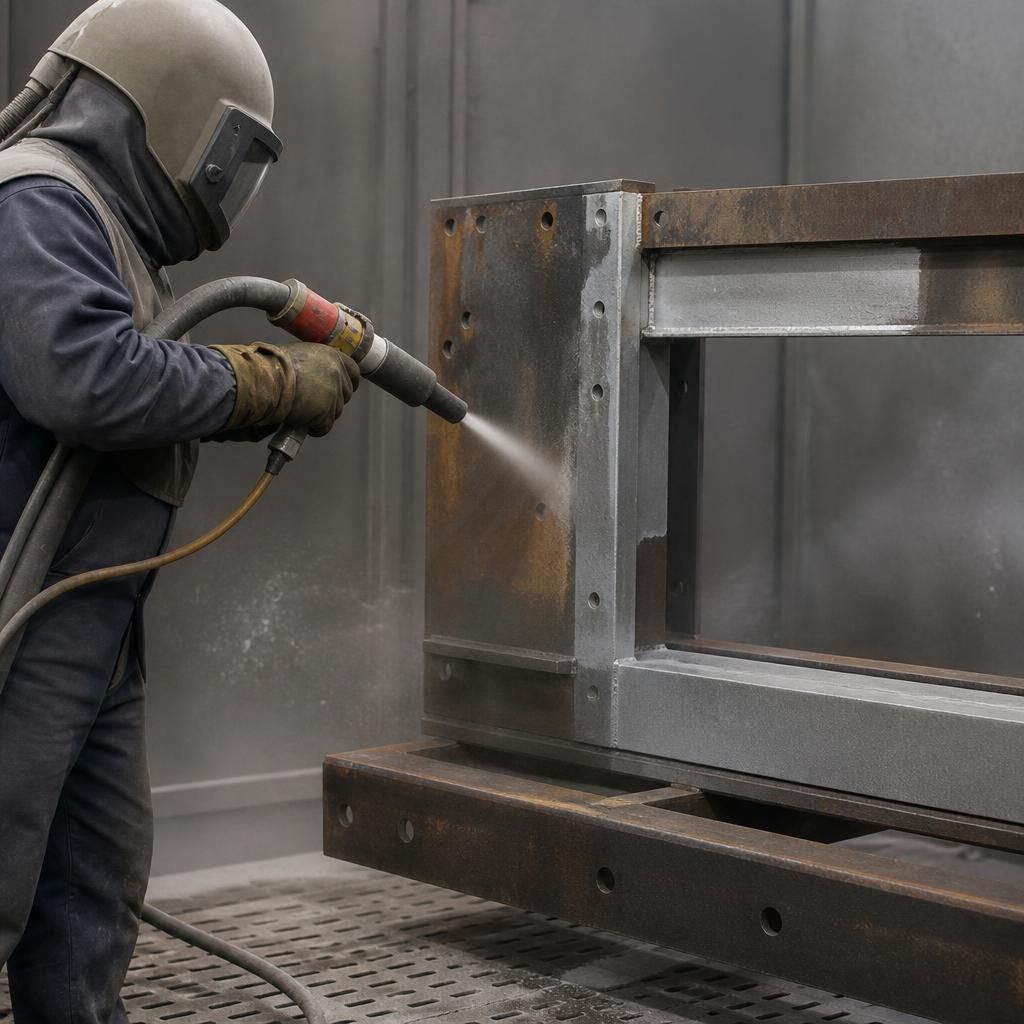
When a component contains more than one type of metal, blasting media must be selected for the most vulnerable substrate rather than the hardest one. A medium and pressure suitable for structural steel may remove too much material from an aluminium section or strip zinc from a galvanised area. Mixed-metal assemblies therefore often require reduced impact, separate preparation stages or protection for sensitive surfaces.
- Identify each exposed substrate before blasting, including coatings and plated areas.
- Use masking or shielding where threads, machined faces or softer sections could be damaged.
- Check transitions between metals for uneven cleaning or profile, as these areas can affect coating coverage.
This approach helps produce a consistent base for powder coating without treating every part of a complex assembly as though it were made from one material.
Discuss the right blasting media for your metalwork
Contact powder-coatings.co.uk to discuss your component’s substrates, existing finish and required powder coating specification before selecting blasting media. This allows the preparation method to be considered alongside the component’s design and final use.