

How does the choice of blasting media affect the environmental impact and sustainability of the powder coating process?
The choice of blasting media affects sustainability through its recyclability, waste generation, dust emissions, disposal requirements and the energy needed to achieve the required surface profile. Selecting a suitable media for the metal and coating system can reduce rework and abrasive consumption while supporting efficient powder coating preparation.
Blasting media affects powder coating sustainability by influencing the complete preparation cycle, from the extraction and manufacture of the abrasive to its use, recovery and final disposal. The most responsible choice is not simply the media with the lowest apparent waste; it is the option that prepares the particular metal effectively with the least unnecessary consumption, contamination, rework and process demand.
Consider the media’s usable life. Some abrasives can be recovered, cleaned and returned to the blast equipment for repeated use. This can reduce the quantity of new material required and limit the amount of spent abrasive leaving the process. However, reuse is only beneficial when the media remains within a suitable size range and does not accumulate coating residue, rust, grease or fragments of the substrate. Media that has broken down or become contaminated can produce inconsistent cleaning and should not be kept in circulation merely to avoid disposal.
Single-use or rapidly degrading abrasives may be appropriate for particular applications, especially where cross-contamination must be tightly controlled. Their sustainability must then be assessed across the whole job. A media that is consumed quickly may create more replacement material, handling and waste, while a reusable option may need recovery equipment and additional separation. The relevant comparison is the amount of usable preparation achieved, rather than the initial purchase volume alone.
Match the abrasive to the metal and existing finish. Media that is too aggressive can remove more substrate than necessary, distort thin components, round edges or create an excessively deep profile. That can lead to additional processing, rejected parts or coating repairs. Media that is too mild may leave corrosion, mill scale or previous coating behind, requiring repeated passes. In both cases, the environmental burden increases because the component, abrasive and equipment are used for longer than necessary.
Media shape and hardness also affect the surface profile. Angular particles cut into the surface, whereas rounded particles tend to peen or clean it with less cutting action. The required profile should be agreed with the powder coating system and the component’s specification. Producing a deeper profile than the coating needs can consume extra abrasive and powder without improving service performance.
Dust control has a sustainability role as well as a health and safety role. Fine particles created by abrasive breakdown can require extraction, filtration and controlled housekeeping. A media that fractures readily may increase the load on these systems and make recovery more difficult. Keeping the abrasive at the correct pressure and using suitable nozzle settings can limit unnecessary breakdown. Effective separation of reusable media from dust and removed coating also prevents usable material from being discarded with the waste stream.
Water-based blasting or wet-abrasive processes can reduce airborne dust in some situations, but they introduce other environmental considerations. These include water consumption, wastewater treatment, corrosion control and the management of residues containing removed paint, oils or metal particles. Wet methods are therefore not automatically more sustainable; their full material and waste pathway needs to be assessed against the dry-blasting alternative.
Waste classification should be established before work begins. Spent abrasive is not environmentally identical in every application. Its composition can be combined with removed coatings, corrosion products, grease or metal residues, and that mixture determines how it should be handled. Separating clean unused media, recoverable abrasive and contaminated waste supports more appropriate treatment and avoids unnecessarily treating all material as one stream. The coating history of incoming components is particularly relevant where older finishes may contain substances requiring controlled management.
A practical sustainability assessment should examine:
- the media’s source, composition and expected service life;
- whether it can be recovered without carrying contamination into later batches;
- the quantity of usable preparation achieved per unit of abrasive;
- the likelihood of substrate damage, excessive profile or repeat blasting;
- dust generation and the demands placed on extraction and filtration;
- how spent media and removed coatings will be separated, classified and handled; and
- whether the chosen method is compatible with the required coating specification.
Process control often delivers more sustainability than changing media alone. Consistent nozzle distance, pressure, angle, dwell time and media flow help prevent over-blasting. Clean, correctly maintained recovery equipment preserves media quality and reduces the risk of transferring debris between jobs. Inspection of the prepared surface before powder application can identify incomplete cleaning early, when correction requires less additional material and energy than rectifying a failed coated component.
For batch production, the best option may also depend on production planning. Grouping compatible components and using a suitable recovery route can reduce clean-down losses and cross-contamination. Where different metals or previous coatings are processed, separate media streams may be justified if mixing would make the abrasive unsuitable for reuse.
There is no universally sustainable blasting medium. Selection should balance technical performance, substrate protection, recovery potential, dust behaviour, contamination risk and end-of-life handling. A media choice that achieves the specified surface condition reliably in one controlled pass, while remaining suitable for responsible recovery or disposal, will generally support a more sustainable powder coating process than an unsuitable alternative selected on purchase cost alone.
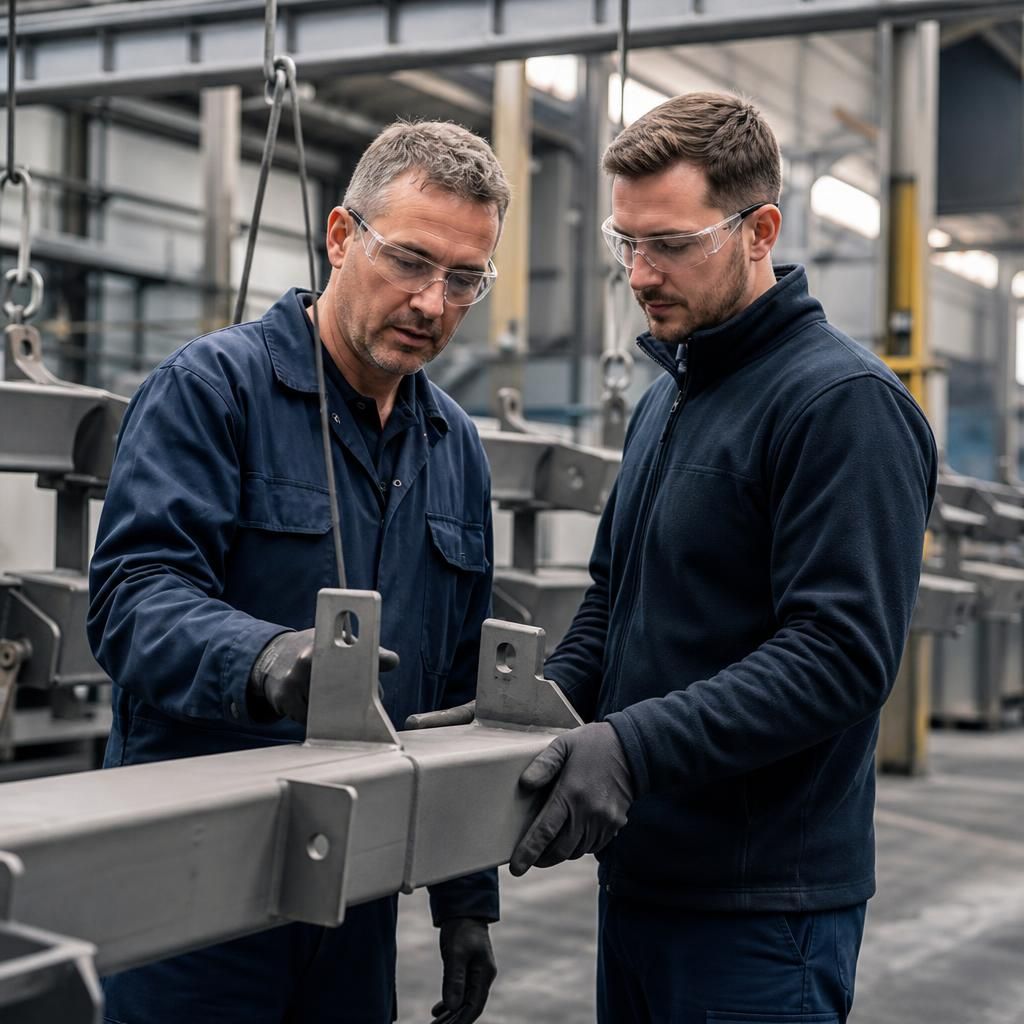
The environmental effect of blasting media extends beyond the preparation stage because the resulting surface condition can influence how long the powder-coated component remains protected in service. A media that produces the specified cleanliness and profile without damaging the substrate supports a sound coating system, helping to reduce premature recoating, replacement work and the associated use of materials and energy over the component’s life.
This makes service-life performance an important part of a responsible comparison. The assessment should consider whether the selected abrasive is compatible with the metal, the required powder coating system and the component’s operating conditions. A lower-impact media choice in the blast room is not necessarily the better option if it contributes to poor coating performance, corrosion recurrence or avoidable maintenance later. Technical suitability and whole-life environmental impact therefore need to be considered together.