

What specific curing process and temperature are necessary for the powder used in my project?
The required curing process and temperature depend on the powder manufacturer’s technical data, the metal substrate and the component’s thickness and mass. After electrostatic application, the coated part must reach the specified peak metal temperature and remain there for the stated dwell time, with the oven schedule verified against the powder supplier’s instructions rather than relying on air temperature alone.
The correct curing process is determined by the powder’s technical data sheet, which specifies the required peak metal temperature (PMT) and dwell time. The coating is not considered fully cured simply because the oven air has reached its set temperature. The component itself must reach the specified metal temperature, and it must remain at that temperature for the required period.
Start with the powder specification
Different powder chemistries react differently to heat. Thermosetting powders form a permanent cross-linked film during curing, while thermoplastic powders melt and form a coating without undergoing the same chemical cross-linking reaction. Epoxy, polyester, hybrid and specialist nylon systems can therefore require different oven conditions and handling methods.
The powder supplier’s technical data should be treated as the controlling document. It normally sets out a curing schedule in terms of metal temperature and time, such as a range of acceptable temperatures matched to corresponding dwell times. A higher metal temperature may reduce the time needed for the cure, while a lower temperature may require a longer dwell. These alternatives are only valid where they are included in the product data; they should not be estimated from the powder’s appearance.
Why peak metal temperature matters
Oven air temperature and component temperature are different measurements. A light bracket may heat rapidly, whereas a thick plate, enclosed section or densely loaded assembly may take considerably longer to reach the same temperature. If the oven cycle is controlled only by the air setting, the surface of the coating may look cured even though the underlying film has not completed its reaction.
For this reason, the curing schedule must take account of the part’s material, thickness, shape, mass and method of hanging. Areas shielded from airflow, joints, folded sections and heavy welded areas can heat at different rates from exposed, lightweight sections. The slowest-heating representative part is important when establishing a reliable process.
Typical process stages
- Confirm the coating system: Identify the powder type, colour, finish, film requirements and supplier cure schedule before production begins. Powder from different systems should not be treated as interchangeable.
- Prepare the metal: Remove oil, grease, mill scale, rust and other contaminants using a preparation method suitable for the substrate and intended service. Residual contamination can affect adhesion and may create defects that are incorrectly attributed to curing.
- Apply the powder: The powder is electrostatically applied to the prepared metal. Film thickness, electrical earthing, gun settings and component geometry all influence how the coating behaves in the oven.
- Load the oven correctly: Parts should be positioned so that heat can circulate around them. Excessive loading or close spacing can change the heating profile and make the validated cycle unsuitable.
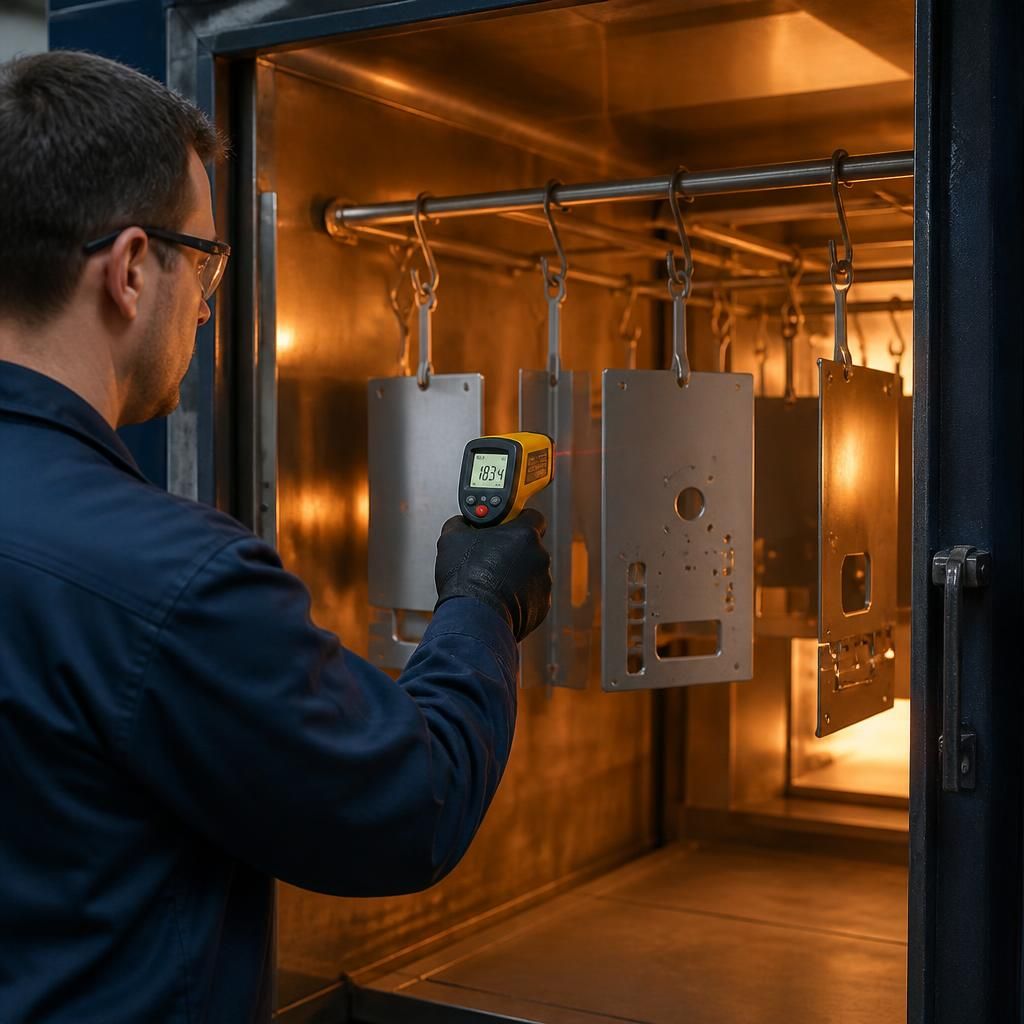
- Measure the metal temperature: Where the job requires confirmation, temperature probes or data-logging equipment can be attached to representative locations, particularly the heaviest or most thermally demanding areas.
- Apply the specified dwell: Timing should be based on the point at which the relevant metal area reaches the required PMT, not necessarily the moment the part enters the oven.
- Cool and inspect: Allow the component to cool in a way that avoids damage, contamination or distortion. The finish can then be checked for appearance, coverage, film consistency and other agreed requirements.
Factors that can change the required oven cycle
- Substrate and thickness: Steel, aluminium and other metals transfer heat differently. Thick or high-mass components generally need more heating time than thin sections.
- Component design: Box sections, recesses, overlaps and assemblies can create cooler areas or restrict airflow.
- Powder film thickness: An excessively heavy or uneven film can affect appearance and may alter how the coating responds during curing.
- Oven loading: A cycle established for a lightly loaded oven may not produce the same result with a large batch of dense components.
- Oven condition: Uneven heat distribution, inaccurate sensors, poor airflow or contamination inside the oven can produce inconsistent curing across a batch.
- Specialist powder requirements: Nylon and other specialist coatings may involve different preparation, application and heating controls from conventional thermosetting systems. Their own technical instructions should be followed.
How an unsuitable cure presents itself
Under-cured powder may show poor mechanical performance, reduced resistance to chemicals or moisture, inadequate adhesion, a surface that remains unusually soft, or a finish that changes during handling. Over-curing can also be undesirable. Excessive heat or prolonged exposure may affect colour, gloss, coating flexibility or the appearance of the substrate.
A change in gloss or colour between parts does not automatically prove that the cure is wrong. Film thickness, contamination, powder batch variation, substrate condition and surface preparation can produce similar symptoms. Investigation should therefore compare the technical data, metal-temperature records, oven profile, film thickness and preparation controls rather than changing the temperature without evidence.
Information needed before selecting a cure schedule
For a project-specific recommendation, the coating team needs the powder technical data, substrate type, dimensions and heaviest section, expected film thickness, component arrangement, batch size and any service conditions that may affect the coating choice. Trial parts or a monitored production run can help confirm that the coldest or heaviest areas reach the required cure without overheating more sensitive sections.
For industrial components, the most dependable approach is to record the agreed powder system and cure schedule, verify the oven against the metal temperature achieved by representative parts, and retain the process information with the job records. This provides a clearer basis for repeat production than relying on the oven display or visual appearance alone.
The powder’s curing temperature is a processing requirement, not a direct indication of the temperature the finished coating can withstand in service. A coating may need a particular heat cycle to develop its intended properties, while its resistance to operating temperature, chemicals, moisture and mechanical wear must be assessed separately from the powder’s technical data and the conditions of use.
This distinction matters when selecting a system for industrial components. If the part will experience elevated temperatures or aggressive environments, those service conditions should be considered alongside the curing schedule rather than inferred from it.