

How do you ensure the surface preparation process meets industry standards for optimal coating adhesion?
We meet industry-standard surface preparation requirements by assessing each metal component, removing contamination such as oil, dirt and oxidation, and applying the appropriate cleaning and pre-treatment before powder coating. Surfaces are inspected for cleanliness, dryness and suitability so the powder can bond consistently and provide a durable finish.
Industry-standard surface preparation for powder coating means using a controlled, documented method that suits the metal, its condition and the specification for the finished component. The aim is not simply to make the surface look clean; it is to establish a chemically and mechanically suitable surface, prevent recontamination and provide evidence that the preparation was appropriate for the coating system.
The process begins with a review of the component and its intended use. Material type, previous coatings, welds, sharp edges, cast or fabricated areas, handling points and any masking requirements can all affect adhesion. The expected service conditions are also relevant: components exposed to moisture, chemicals, abrasion or outdoor conditions may require a different preparation and pre-treatment approach from parts used in a dry indoor environment.
Preparation methods are selected according to the substrate and the condition of the component. Abrasive or mechanical preparation may be appropriate for removing firmly attached scale, corrosion or an existing coating, while a chemical pre-treatment may be required to improve corrosion resistance and promote bonding. Aluminium, galvanised steel and mild steel do not respond identically to preparation, so a method suitable for one material should not automatically be applied to another. Where a component has an existing finish, its compatibility and removal requirements must be established before coating.
Controls are applied to the physical condition of the prepared surface. These can include checking the resulting surface profile, looking for remaining corrosion or coating residues, and confirming that weld spatter, sharp projections and fabrication defects will not compromise the finished film. Crevices, drain holes and enclosed sections also need consideration because trapped preparation chemicals or moisture can lead to defects after coating. Edges and transitions are assessed carefully, as inadequate preparation in these areas can create weak points even when the main faces appear satisfactory.
Pre-treatment stages are controlled for concentration, contact time, rinsing and drying in accordance with the selected system and the relevant project specification. The component must be completely dry before powder application, with no residues that could interfere with bonding. If a prepared part cannot be coated immediately, it is handled and stored in a way that limits contact with bare hands, dust, moisture and other sources of recontamination. Clean gloves, suitable handling equipment and protected storage are simple but important controls.
Quality checks are carried out at defined points rather than relying only on the appearance of the completed coating. Typical checks may include:
- confirming that the preparation method matches the metal and coating specification;
- visually examining the surface for residues, corrosion, flash rust, oil or other defects;
- checking the surface profile or cleanliness where the specification requires measurable verification;
- confirming that masked areas, threads, mating faces and drainage points are protected correctly;
- recording preparation details and any deviations that require approval or corrective work.
Where adhesion needs formal verification, the appropriate test is chosen for the coating, substrate and specification. For example, a cross-cut or pull-off assessment may be suitable in some circumstances, but test selection depends on the component and the required standard. Testing is interpreted alongside visual inspection and process records; a single result should not replace control of the preparation stages themselves.
If inspection identifies contamination, an unsuitable profile, incomplete pre-treatment or damage caused during handling, the part is not treated as ready for coating. It is returned for the necessary corrective preparation and checked again. This combination of substrate-specific method selection, controlled handling, documented inspection and, where required, adhesion testing provides a repeatable basis for achieving reliable powder coating adhesion on industrial metal components.
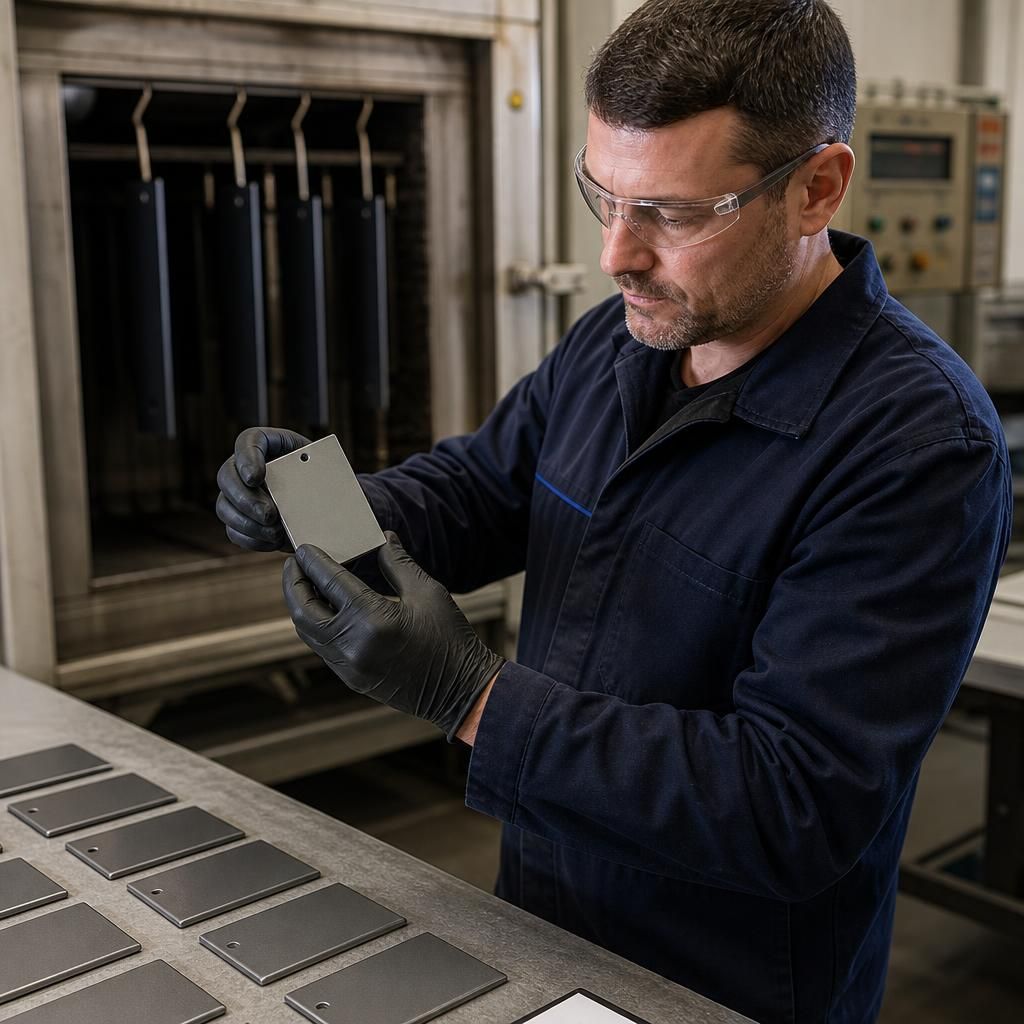
Where a project specification requires additional evidence, a representative test coupon can be prepared and coated alongside the production components. Because the coupon passes through the same preparation, application and curing stages, it provides a practical surface on which adhesion or other coating checks can be carried out without damaging a finished part.
The coupon should be made from a comparable substrate and linked to the relevant production batch. Its preparation method, coating system and inspection results can then be recorded with the job documentation. This creates traceability between the preparation conditions and the coating assessment, while visual checks of the actual components remain essential.