

What types of finishes and colours are available in your powder coating services?
Powder coating services can provide smooth, textured, matt, satin, gloss and metallic finishes in a broad range of colours, including commonly specified RAL shades. Specialist options such as nylon and protective coatings can also be selected where the metal component requires additional resistance or a particular surface performance.
Powder coating finishes are specified by a combination of colour, sheen, surface texture and performance requirements. The available choice can therefore range from a plain, understated surface for industrial equipment to a more decorative or highly visible finish for architectural, automotive or fabricated components.
Colour selection: Commonly specified RAL shades provide a recognised reference for communicating colour requirements between the customer, coating provider and component manufacturer. Bespoke colour matching may also be considered where a standard shade is unsuitable, although the feasibility depends on the powder formulation, the required finish and the component’s intended use. A physical sample is preferable to relying only on an image or screen display, as lighting, surrounding colours and the substrate can affect how a coated surface appears.
Colour should be assessed alongside the required surface effect. A darker or highly saturated colour may show dust, scratches or uneven preparation more readily than a mid-tone shade, while a textured finish can disguise minor visual variation better than a very smooth finish. Metallic powders can produce a distinctive appearance, but their visual uniformity may depend more closely on application technique, component orientation and film thickness.
Gloss level: Gloss, satin and matt surfaces reflect light differently and can change the perceived depth of a colour. Gloss finishes generally give a sharper, more reflective appearance, whereas matt finishes reduce reflection and provide a flatter visual effect. Satin sits between the two. The selected gloss level should be recorded as part of the specification rather than requesting only a colour reference, because the same colour can look substantially different with another sheen.
Texture: Textured powders are available where a more tactile surface or a less reflective appearance is required. Fine and heavier textures can alter both the look and feel of a component, and they may be useful for equipment, frames, brackets and other parts where a completely smooth decorative surface is not essential. Texture also affects how edges, recesses and masking lines are perceived, so sample approval is useful for components with detailed geometry.
Performance-led choices: The coating should be selected for the conditions the metal component will encounter, not simply for its colour. Indoor equipment, external fabrications, frequently handled parts and components exposed to chemicals or abrasion may require different coating characteristics. Protective or specialist formulations can be considered where resistance, insulation, impact performance or another specific surface property is more important than decorative appearance.
For repeat or batch work, the specification should identify the powder reference, finish type, gloss level, texture, any masking requirements and the surfaces that must remain uncoated. Keeping these details consistent helps reduce avoidable variation between production runs. It is also important to identify whether visible faces, hidden faces and edges have different requirements, particularly where parts are assembled after coating.
Before production, the coating requirements should be checked against the component material, design, preparation method and curing conditions. Sharp edges, deep recesses, threaded sections, welds and areas requiring electrical contact may need particular attention when deciding how the finish is applied. A coating provider can use the part drawings, photographs or a representative sample to clarify the intended appearance and identify any areas that need masking or a different treatment.
For businesses specifying powder coating for manufactured or fabricated metal parts, a clear finish schedule is usually the most reliable way to avoid ambiguity. It should state the colour reference, surface finish, texture, visible faces, functional requirements and whether a sample or benchmark part must be approved before the wider batch is processed.
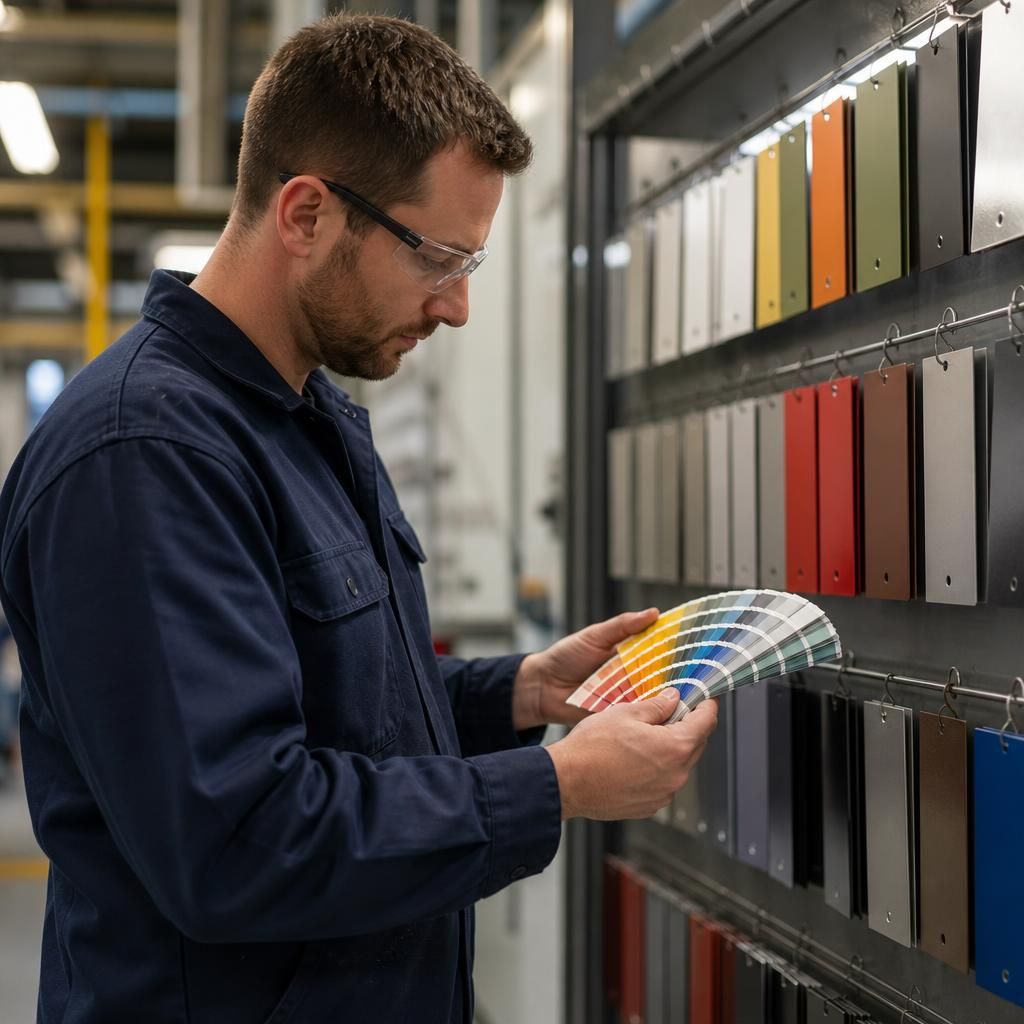
Colour and finish choices are linked to the powder formulation rather than being completely interchangeable. A particular shade may not be available with every texture, gloss level or specialist coating, so the required colour should be checked alongside the intended performance and surface appearance.
For this reason, a specification should identify the acceptable finish options as well as the preferred colour. Where the exact combination is important, approval of a coated sample or benchmark part can confirm that the selected powder delivers the required visual result before production components are processed.