

How does powder coating protect against environmental factors?
Powder coating protects metal components by forming a cured, continuous polymer film that helps resist moisture, UV exposure, corrosion and many chemicals. The level of protection depends on suitable powder selection, thorough surface preparation and correct application and curing.
Powder coating protects metal against environmental factors by creating a continuous, bonded finish that separates the substrate from moisture, oxygen, sunlight, chemicals and physical wear. Its performance is determined by the coating chemistry, film thickness, surface preparation, curing conditions and the environment in which the component will be used.
Moisture and corrosion: Water and oxygen can trigger corrosion when they reach an exposed metal surface. A properly applied powder coating acts as a barrier, reducing the opportunity for moisture to contact the substrate. This is particularly important for components used outdoors, in humid areas or where condensation is likely. Protection can be reduced by scratches, sharp edges, uncoated areas, damaged welds or moisture trapped in joints, so the design and preparation of the component are part of the corrosion-control system.
Corrosion protection is not identical for every metal or application. Steel, galvanised steel and aluminium may require different preparation methods, primers or powder systems. Weld spatter, scale, oil, dirt and existing corrosion must be removed before coating. Areas such as recesses, drilled holes and folded sections also need attention because they can retain moisture and become points of early failure.
Ultraviolet exposure: Sunlight contains ultraviolet radiation that can break down the chemical bonds in some finishes. Over time, this may cause fading, loss of gloss, chalking or a change in surface appearance. Powders formulated for exterior exposure generally provide better resistance to these effects than systems intended mainly for indoor use. Colour choice also matters, as some pigments show visible change more readily than others.
Where appearance must remain consistent across exposed components, the required level of colour and gloss retention should be stated before coating. It is also sensible to consider the component’s orientation, whether it is continuously exposed or sheltered, and whether adjacent parts need to match. A finish may continue to protect the metal even when its gloss or colour has changed, but visual durability and corrosion protection are separate performance requirements.
Chemical exposure: Powder coatings can resist many common contaminants, but resistance varies considerably between formulations. Oils, cleaning agents, fuels, solvents, salts, acids and alkaline substances can have different effects. Contact may cause softening, swelling, staining, loss of adhesion or surface breakdown, particularly where exposure is prolonged or the chemical is concentrated.
For industrial components, the coating should therefore be selected against the actual substances, concentrations, temperatures and contact times involved. Occasional splashes present a different requirement from continuous immersion or repeated chemical cleaning. Compatibility information and, where necessary, sample testing help establish whether the proposed finish is appropriate rather than relying on the general assumption that all powder coatings have the same chemical resistance.
Physical wear and contamination: Environmental protection also involves resistance to handling, impact, rubbing and abrasion. A sound cured film helps prevent routine contact from exposing the metal beneath it. In applications involving sliding parts, repeated loading, grit or frequent cleaning, the coating type and thickness need to be considered alongside the likely wear pattern. Specialist protective coatings, including nylon systems, may be relevant where a tougher or lower-friction surface is required.
Powder coating is durable, but it is not an invisible repair for poor component design or severe mechanical damage. Deep impact, cutting, welding after coating or aggressive abrasion can breach the film. Once the underlying metal is exposed, localised corrosion may develop, especially in a damp or contaminated environment. Components should be handled and installed in a way that avoids damaging edges and contact surfaces.
Temperature and weathering: Heat can affect a coating if the operating temperature is outside the range for which the system was selected. Repeated heating and cooling may also place stress on the coating and substrate because they expand and contract differently. Outdoor components may experience this alongside rain, frost, sunlight and airborne pollutants. The expected service temperature and weather conditions should be included in the coating specification.
Reliable environmental protection starts before powder is applied. The metal surface must be clean, suitably profiled and free from contaminants that could interfere with adhesion. Powder is then applied at a controlled film build and cured so that the particles fuse into a continuous film. Insufficient curing can leave the finish weaker or more permeable than intended, while excessive build or poor coverage can create its own defects.
For a B2B coating specification, the most useful details to provide are:
- the substrate, component dimensions and any existing finish;
- whether the part will be used indoors, outdoors, in a damp area or near salts or pollutants;
- the chemicals, cleaning products and temperatures it will encounter;
- the likely exposure to impact, abrasion, handling and moisture retention;
- the required appearance, including colour, gloss and expected resistance to fading; and
- any areas that must remain uncoated, be masked or receive additional protection.
This information allows the coating system and preparation method to be matched to the environmental duty rather than selected on colour alone. Powder coating can provide long-term protection for metal components, but the result depends on treating the complete system—substrate, preparation, powder, application, curing, component design and service conditions—as one specification.
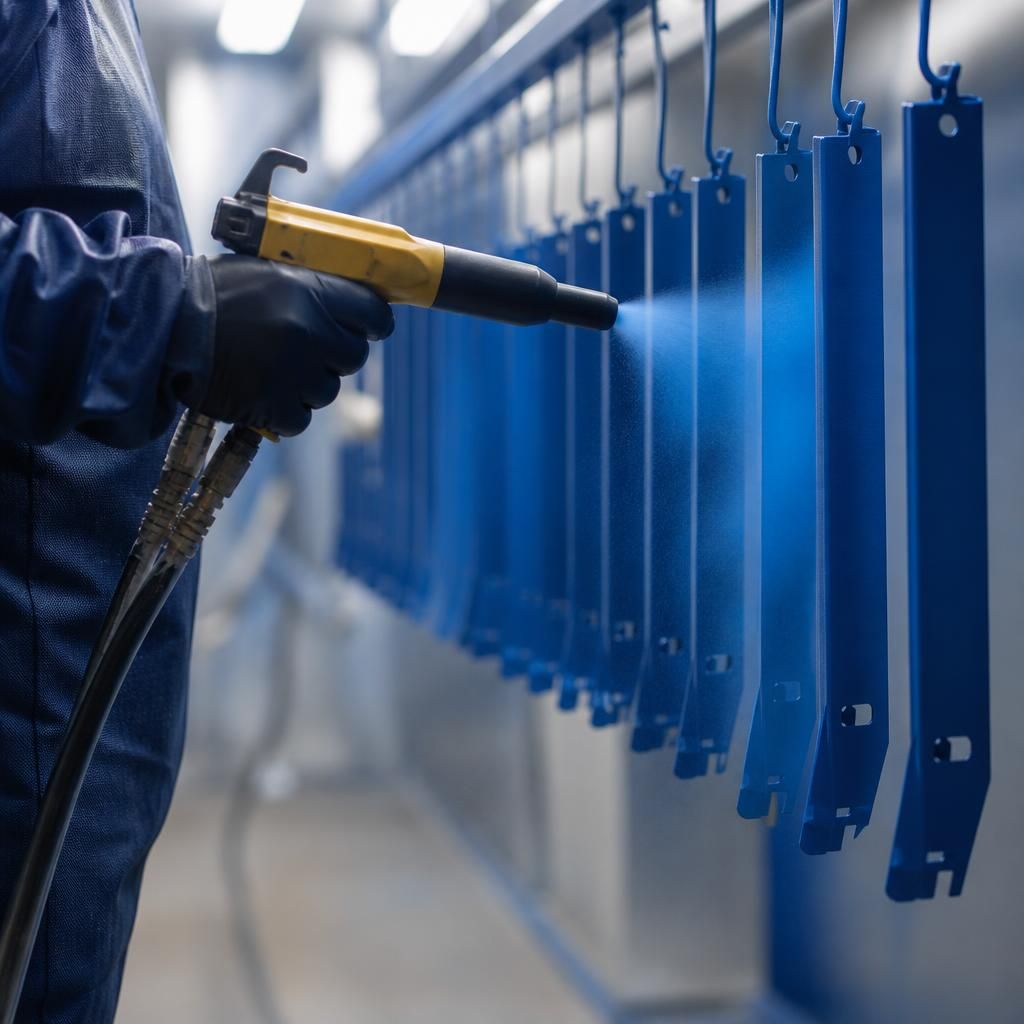
Powder coating protects against environmental factors through the behaviour of its cured film. In many industrial systems, the powder forms a cross-linked polymer layer during curing, creating a stable coating that remains bonded to the prepared metal rather than behaving like a loose or absorbent surface. This helps the finish retain its protective function during normal exposure to weather, handling and contaminants.
The chemistry still needs to match the service conditions. Thermoset powders and specialist thermoplastic systems, such as nylon, have different performance characteristics, so the choice should reflect the component’s expected heat, friction, chemical contact and outdoor exposure. A coating selected for appearance alone may not provide the most suitable environmental resistance.