

What are the potential hidden costs when opting for specialist powder coatings, and how can these be mitigated effectively?
Hidden costs in specialist powder coating can include additional surface preparation, masking, colour changes, handling, transport and rework if the specification or component condition is unclear. Mitigate them by providing accurate drawings and quantities, declaring existing finishes and contamination, agreeing preparation and masking requirements in advance, and requesting an itemised quote covering collection, delivery and any specialist materials.
Potential hidden costs in specialist powder coating usually arise from requirements that sit outside the basic coating application: engineering review, trials, testing, unusual powder specifications, substrate defects, dimensional tolerances, packaging and remedial work. They can be controlled by defining the performance requirement and component condition before pricing, separating one-off development costs from repeat production costs, and agreeing inspection and acceptance criteria in writing.
Specification and design complexity
Specialist work may involve more than selecting a colour and finish. The required coating may need resistance to chemicals, abrasion, impact, corrosion, heat or outdoor exposure. A component with tight dimensional tolerances, close-fitting interfaces, threaded holes or sliding surfaces may also need coating-free areas or controlled film thickness. If these requirements are identified only after production begins, additional engineering review, trial work or corrective processing may be needed.
To reduce this risk, provide drawings, three-dimensional models where relevant, material details, functional surfaces and the intended service environment. State which areas must remain clear, the acceptable appearance standard and whether the finish is decorative, protective or both. A written coating specification gives the applicator a basis for pricing and prevents a general-purpose finish from being compared with a more demanding specialist system.
Specialist powder availability and minimum quantities
Nylon and other functional powders may have fewer readily available options than standard architectural or industrial finishes. A particular colour, texture, gloss level or performance grade may involve a supplier minimum order, a non-standard purchase or material left over after a small batch. The powder itself may therefore represent a disproportionate part of the cost on a limited production run.
Ask whether the quoted material is standard or specially sourced, whether a minimum quantity applies, and how unused material is treated. If the application allows it, selecting an established powder specification and grouping compatible components into one production run can make the material requirement more efficient. Any alternative material should be assessed against the required performance rather than selected solely on its lower purchase price.
Trials, testing and documentation
A specialist finish may require a sample panel, first-off component or process trial before the full batch is released. Testing can include adhesion, film thickness, appearance, corrosion performance or resistance to a specified substance. Inspection records, certificates and traceability documents may also carry an additional charge, particularly where the coating forms part of a regulated or quality-controlled supply chain.
Decide in advance which tests are necessary and who will provide the test method and acceptance limit. Distinguish between a development trial, routine production inspection and independent laboratory testing. This avoids paying for documentation that is not needed while ensuring that genuinely critical evidence is included in the quotation.
Substrate condition and corrective work
Existing weld spatter, sharp edges, porosity, embedded contamination, flash, corrosion or incompatible previous finishes can affect the final result. Some defects become more visible after coating, while contamination can cause cratering, poor adhesion or pinholing. Corrective work may include additional cleaning, grinding, filling, chemical treatment or the rejection of a component that cannot achieve the specified result.
Before the job is priced, identify whether the parts are new, previously coated, exposed to oil or chemicals, or likely to contain contaminants within seams and cavities. If condition varies between batches, agree how exceptions will be recorded and priced. A small sample inspection can be more useful than assuming that every component has the same preparation requirement.
Cure requirements and material compatibility
Powder coating is cured according to the powder manufacturer’s process requirements, but the relevant factor is the component’s metal temperature, not simply the oven’s air temperature. Thick and thin sections may heat at different rates, and heat-sensitive inserts, seals or assembled parts may impose restrictions. Inadequate curing can affect performance; excessive heat can damage components or alter their properties.
Provide the full component construction, including dissimilar metals, inserts and retained parts. Confirm whether parts can be processed as assemblies or must be separated. Where the substrate or assembly is unusual, agree the cure approach and any trial requirement before production. This helps prevent a batch being processed in a way that later requires stripping and recoating.
Rejected parts and recoating
Rework costs are not limited to applying another coat. A rejected component may need stripping, renewed preparation, masking of newly defined areas, inspection and another cure cycle. Recoating can also affect dimensions, edges and the appearance of adjacent surfaces. If the defect results from a change in the approved standard rather than a process failure, responsibility for the additional work can become difficult to establish.
Agree an approval sample or reference finish for appearance-sensitive work. Define acceptable levels of texture, shade variation, inclusions and edge coverage, while recognising that powder coating is a manufactured finish rather than a guarantee of absolute visual uniformity. Set out who authorises rework and whether approval applies to visible faces only or to the complete component.
Packaging, storage and return condition
Finished parts can incur additional costs if they require separators, protective wrapping, purpose-made stillages or special packaging to prevent contact damage. Long, heavy or delicate components may need a different packing method from small batchwork. Poorly protected parts can arrive with scratches or impact marks even when the coating process itself was satisfactory, creating avoidable inspection and remedial costs.
Include the required delivery condition in the specification. State whether packaging is returnable, whether stillages are supplied by the customer or coater, and how finished parts should be unloaded and stored. Components should be protected from abrasion, moisture and contamination after coating, since unsuitable storage can compromise the finish before installation.
How to make the quotation comparable
- List the component material, dimensions, weights, quantities and batch structure.
- State the coating type, colour, gloss, texture, required performance and acceptable appearance.
- Identify any coating-free surfaces, critical dimensions, inserts and assembly restrictions.
- Separate recurring production charges from one-off trials, sample approval, testing or documentation.
- Ask which assumptions apply to preparation, powder supply, inspection, rework and packaging.
- Confirm how variations in component condition or quantity will be handled before work starts.
An itemised quotation should show which costs are fixed, which depend on inspection or material availability, and which are excluded. Comparing quotations on the total stated price alone can make a technically unsuitable option appear cheaper. Comparing the included process, evidence, acceptance standard and risk allowances gives a more reliable view of the eventual cost of a specialist powder coating project.
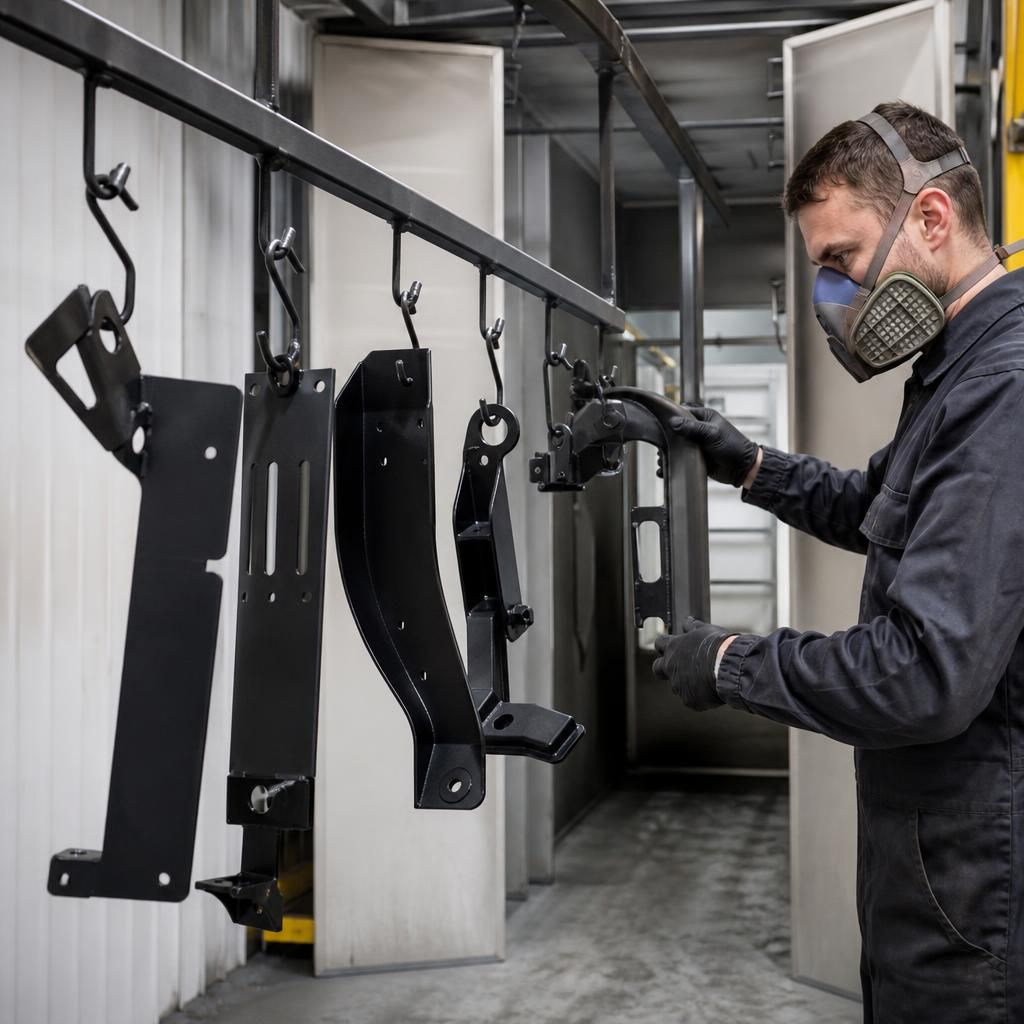
One hidden cost in specialist powder coating is bespoke fixturing. Components may need purpose-made hooks, racks or supports to keep them secure during coating while allowing the powder to reach the required surfaces. Complex shapes, heavy parts and limited contact points can increase setup, loading and handling work, particularly where existing production fixtures are unsuitable.
Mitigate this cost by providing component drawings, weights, orientation requirements and details of acceptable contact areas before quotation. Ask whether the price includes fixture design, manufacture, setup and storage, and separate any one-off tooling charge from recurring processing costs. A trial using representative parts can confirm that the proposed support method protects critical surfaces and does not create avoidable rework.