

How does the choice of powder coating material impact the overall project cost and performance?
The choice of powder coating material affects both the price of the coating system and the performance of the finished component. Higher-specification powders may cost more but can provide improved durability, chemical resistance, corrosion protection, weathering performance or a specialist finish, making material selection important to the project’s service conditions and expected lifespan.
The powder material affects project cost through more than the price of the powder itself. Its chemistry determines the preparation required, application method, film build, curing conditions, likely coating life and the risks of defects or premature failure. The most economical option is therefore the material that meets the component’s service requirements without adding unnecessary specification, rather than simply the lowest-cost powder per kilogram.
Powder chemistry should match the operating environment. Common coating families have different strengths:
- Polyester powders are commonly selected for components exposed to external conditions because they can provide resistance to weathering and ultraviolet exposure. The precise grade and finish still need to be matched to the expected environment.
- Epoxy powders can provide strong adhesion and resistance to chemicals and corrosion, making them useful where weathering is limited or where the component needs a robust protective barrier. Prolonged exposure to sunlight can affect their appearance, so they may not be suitable for every external application.
- Epoxy-polyester hybrids can provide a balance of properties for suitable indoor applications. They should not automatically be treated as an equivalent to an exterior-grade polyester system.
- Nylon and other specialist thermoplastic coatings are considered where resistance to abrasion, impact, friction or particular chemicals is more important than a conventional decorative finish. They may require different preparation, application and handling arrangements.
These categories are broad guides rather than complete specifications. The correct selection also depends on the substrate, component geometry, required appearance, operating temperature, contact with chemicals, exposure to moisture and the way the part will be handled in service.
Material cost is influenced by coverage and application requirements. Comparing powders solely by purchase price can give a misleading result. A material that requires a greater film thickness, additional coats or a separate primer may use more product and involve more processing. Specialist systems can also require tighter control of application conditions or dedicated handling procedures. Those requirements can increase preparation, masking, spraying, curing, inspection and packing costs.
Component design has a direct effect on this calculation. Deep recesses, sharp edges, internal faces and complex profiles can make it harder to achieve an even coating. A powder chosen for its performance may still fail to deliver that performance if the specified film build cannot be achieved consistently across the part. The quotation should therefore consider the component’s size, shape, quantity, surface condition and the areas that need masking or special treatment.
Preparation is part of the material choice. Powder will only perform as intended when contaminants, rust, mill scale, old coatings and handling residues have been dealt with appropriately. Different coating systems may place different demands on the substrate and pretreatment. A specialist protective system may need a particular surface profile, primer or controlled film thickness, while a standard decorative application may follow a different process. If preparation is under-specified, the apparent saving in material cost can be outweighed by adhesion problems, corrosion beneath the coating, rework or replacement.
Curing requirements affect both performance and cost. Thermoset powders need to reach the required metal temperature for the specified period so that the resin and curing agent form the intended film. Component thickness, material type and shape can affect how evenly the part heats. Under-curing may reduce the coating’s mechanical or chemical performance, while excessive heat can damage the finish or the substrate. Thermoplastic powders follow a different process and may require different equipment or application controls. The selected material must therefore be compatible with the available coating process and with any heat-sensitive components.
Appearance requirements can also alter the economics. Smooth, textured, metallic, translucent and special-effect finishes may differ in application difficulty, batch consistency and repairability. A highly uniform decorative finish can require more stringent inspection and handling than a functional coating where minor visual variation is acceptable. If a project uses several colours or finishes, cleaning, colour changes and separate processing may add to the overall cost.
Performance should be assessed over the intended service life. A lower-cost material may be appropriate for a protected indoor component with limited mechanical or chemical exposure. It may be a poor choice for parts exposed to outdoor weather, road contaminants, abrasion, repeated impact, industrial chemicals or high temperatures. Conversely, specifying a specialist material where those conditions do not exist can add cost without a corresponding practical benefit. The relevant comparison is the total cost of achieving the required service performance, including preparation, application, inspection, maintenance and the consequences of early failure.
For an accurate material recommendation, provide the coater with the substrate, component dimensions and quantity, indoor or outdoor exposure, expected contact with chemicals or moisture, operating temperature, abrasion or impact risks, required appearance, masking points and any existing coating. It is also useful to explain whether the priority is corrosion protection, wear resistance, low friction, chemical resistance, colour retention or a particular decorative finish. These details allow the material, pretreatment and process to be considered as one coating system rather than as separate cost items.
For Midlands businesses commissioning batch or specialist work, the practical decision is to specify the performance conditions first and then compare suitable powder systems. Collection and delivery planning should preserve the condition of prepared and finished parts, particularly where the coating is vulnerable to scratching before full handling and installation. A coating quotation is most meaningful when it identifies the proposed material and process, any additional preparation or primer, the expected finish and the assumptions used to price the work.
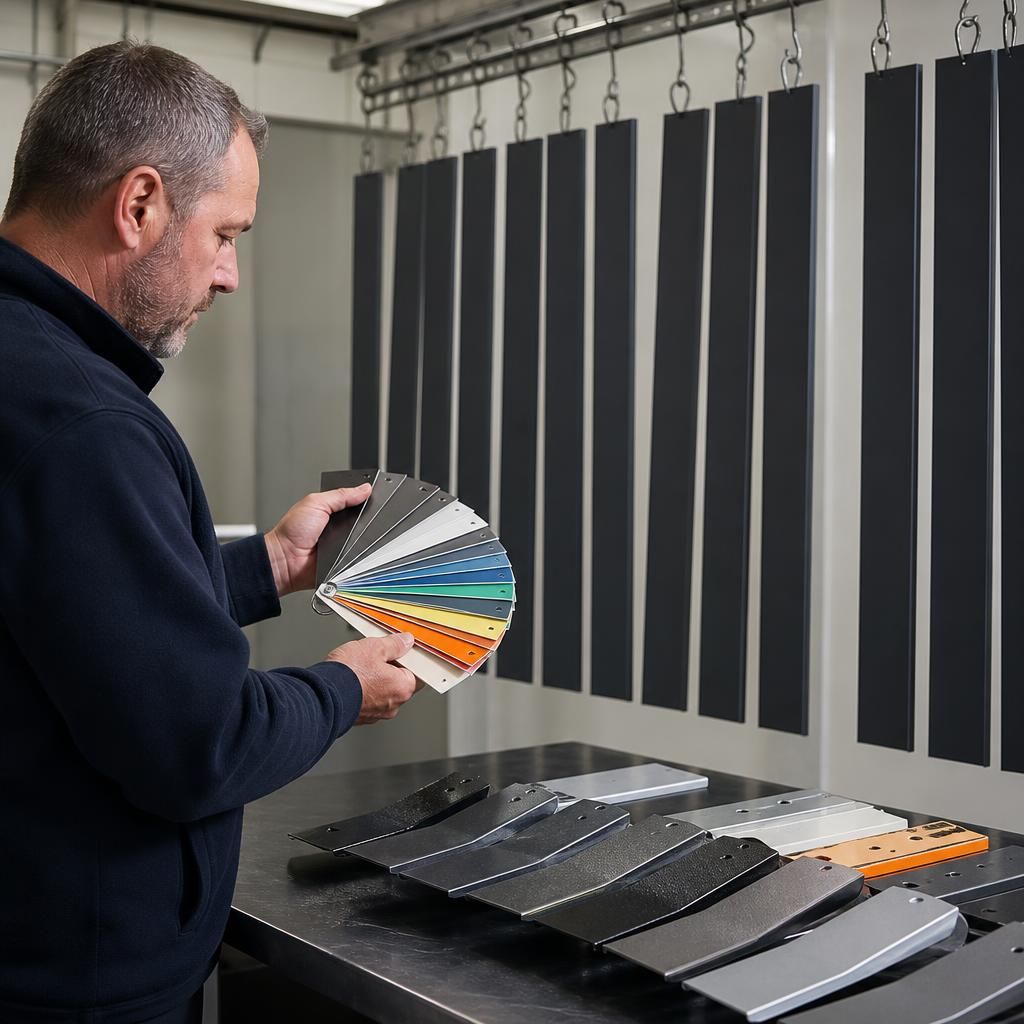
Powder coating material selection can affect future maintenance as well as the initial application cost. A finish that is difficult to match or repair may require a larger area, or the complete component, to be recoated if damage occurs.
This is particularly relevant for textured, metallic, translucent and other specialist finishes, where a local repair may not blend with the original surface. Before approving the material, consider how replacement parts, touch-ups and future batches will be matched. Retaining the powder specification, finish reference and an approved sample can help maintain consistency throughout the component’s service life.