

What maintenance practices are required to ensure optimal performance of conveyorised powder coating lines?
Optimal performance requires a planned maintenance schedule covering conveyor movement, powder application equipment, booth extraction, filters, curing oven controls, earthing and safety systems. Regular cleaning, inspection, calibration and record-keeping help prevent contamination, uneven curing, defects and unplanned downtime.
Optimal performance of a conveyorised powder coating line depends on a documented preventive maintenance system, not simply repairing equipment after a failure. The system should define what is maintained, who is responsible, which condition indicates a problem and how the line is released back into production after work has been completed.
Build the maintenance plan around equipment criticality. Identify the parts of the line whose failure would stop production, affect coating quality or create a safety risk. Give these items a documented maintenance interval based on the equipment manufacturer’s guidance, operating hours, production load, powder type and site conditions. Less critical items can be reviewed at longer intervals, while high-load or high-contamination areas may require more frequent attention.
The plan should distinguish between different types of maintenance:
- Operator care: simple checks and housekeeping tasks completed as part of normal line operation.
- Preventive maintenance: scheduled work intended to replace, adjust or service components before failure.
- Condition-based maintenance: work triggered by evidence such as unusual noise, vibration, temperature, pressure or electrical readings.
- Corrective maintenance: controlled repair of a fault, followed by a check that confirms the underlying cause has been addressed.
Use condition trends rather than isolated observations. A single reading may not indicate a developing fault, but a gradual change in motor temperature, air consumption, pressure stability or curing performance can reveal deterioration at an early stage. Record relevant readings in a consistent format so that maintenance personnel can compare them with the line’s normal operating baseline. Any change should be assessed alongside recent product defects, material changes and production adjustments.
Control lubrication and replacement parts carefully. Incorrect lubricant, excess lubricant or contamination from a lubricant can damage components and compromise finished work. Maintenance instructions should specify the approved lubricant, application point and quantity. Replacement filters, seals, belts, bearings, sensors and other wear parts should be identified by the correct specification rather than by appearance alone. Keeping suitable critical spares on site can reduce the time needed to restore the line after an unexpected component failure.
Manage the line after repairs or alterations. Maintenance work can change operating conditions even when the repaired component appears to be functioning. After intervention, confirm that guards and access panels are correctly refitted, settings are returned to their authorised values and all temporary tools or materials have been removed. Where software, control parameters or electrical components have been changed, retain a record of the original setting and the reason for the change. Uncontrolled adjustments can make later fault-finding difficult and may produce inconsistent results between production runs.
Include a formal post-maintenance release check. The line should not return directly to normal production solely because the repair is complete. Run the relevant equipment through its operating sequence, check for abnormal sounds or behaviour, and confirm that interdependent systems respond as expected. The first coated parts or test pieces should be assessed against the approved finish standard before the batch proceeds. This helps identify faults introduced during maintenance, such as an incorrect setting, a misconnected component or a displaced part.
Investigate recurring faults at their source. Replacing the same component repeatedly may conceal a wider problem, such as misalignment, excessive loading, unsuitable operating parameters, contamination or an installation error. A useful fault record should include the date, affected equipment, symptoms, probable cause, parts used, corrective action and follow-up result. Reviewing these records enables the maintenance team to identify repeated failure patterns and decide whether a design change, revised procedure or supplier assessment is needed.
Coordinate maintenance with production planning. Planned stoppages should be grouped where practical so that related work can be completed during the same intervention. Production staff should communicate upcoming changes in product dimensions, coating material, throughput or line settings because these may alter the maintenance burden. A controlled handover between production and maintenance teams prevents equipment being returned to service with unresolved adjustments or incomplete information.
Train operators and maintenance personnel for their respective responsibilities. Operators should know which changes require escalation and should not bypass protective devices or make unauthorised adjustments to correct a quality problem. Maintenance staff need access to current technical instructions, electrical drawings, pneumatic diagrams and control-system information. Competence should be reassessed when the line is modified, a new coating process is introduced or a recurring fault indicates that existing procedures are insufficient.
Finally, review the maintenance programme itself. Downtime records, repeat failures, rejected work and post-maintenance findings should be used to refine task intervals and procedures. A conveyorised line is being maintained effectively when it operates within its intended settings, produces repeatable results and has traceable evidence that faults, repairs and process changes have been properly controlled.
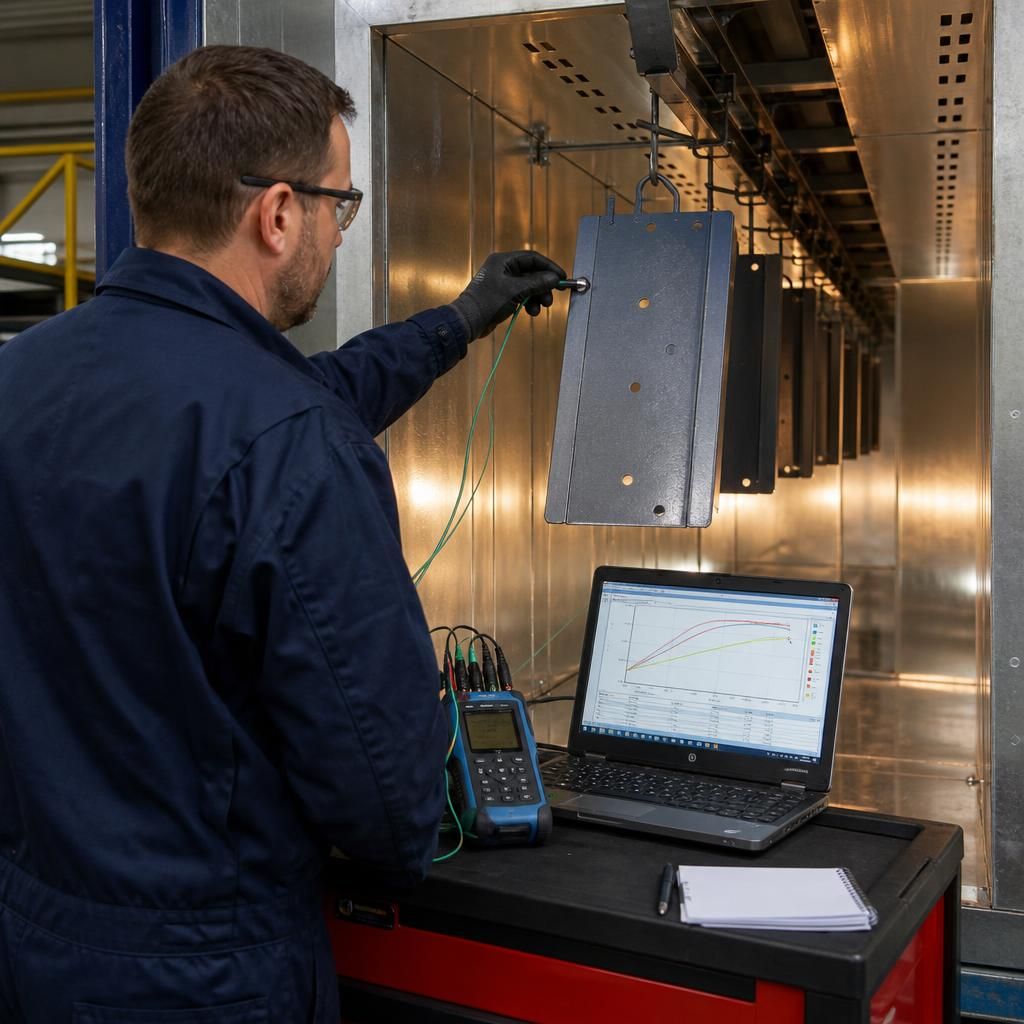
Regular curing-oven temperature profiling is an important maintenance practice because the oven’s displayed temperature does not necessarily show the temperature reached by the coated metal parts. Attach suitable temperature sensors to representative workpieces and compare the recorded profile with the approved curing requirements for the powder being used.
Carry out profiling after work on burners, heating elements, fans, dampers, insulation or control sensors, and repeat it when the conveyor speed, loading pattern or product dimensions change significantly. Review the results for cold spots, excessive temperature variation and insufficient time at curing temperature. This can identify airflow or heating problems before they appear as poor adhesion, inconsistent gloss or under-cured finishes.
Keep each profile with the date, product configuration, line settings and corrective action. The records provide objective evidence that the oven is maintaining suitable conditions and help maintenance staff distinguish a genuine equipment fault from a change in coating material or production setup.